From Construction Sites to Medical Degrees: Egyptian Laborer’s Long Journey Through Education and Sacrifice
“Provision is not just money, but good upbringing. My first dream of educating my daughters has been fulfilled, and now I hope that God will bless me with a visit to the Sacred House and performing Hajj with my wife, my daughters, and my son Muhammad.” — Uncle Salah
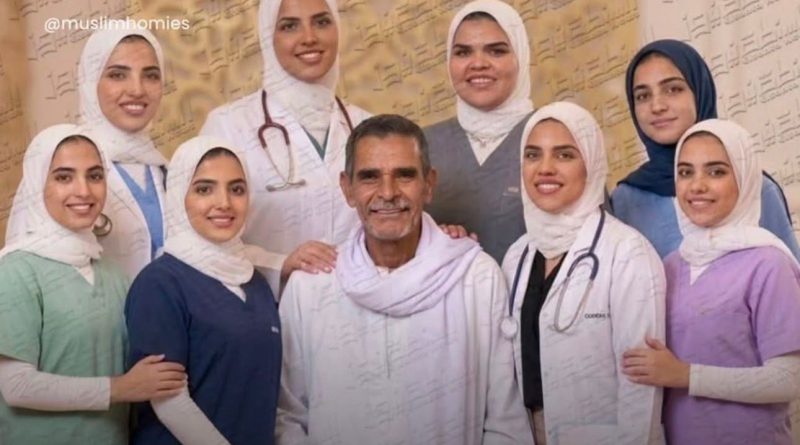
For more than three decades, an Egyptian construction worker from the governorate of Fayoum spent his days on building sites and his nights focused on a different project: the future of his children. Known locally as Uncle Salah, the laborer’s story has drawn attention after details emerged about how all eight of his daughters graduated from medical schools despite years of financial hardship and demanding working conditions.
According to information shared alongside photographs circulating online, Uncle Salah worked in construction for approximately 35 years. During that period, he raised a family of eight daughters and one son while facing economic challenges common to many low-income households.
Despite limited financial resources, he prioritized education as the central goal for his family.In a statement attributed to him, Uncle Salah described his understanding of provision and success in terms that extended beyond financial wealth. “Provision is not just money, but good upbringing,” he said.
The remark reflects a philosophy that appears to have guided his decisions throughout decades of work and family life.The achievement of seeing all eight daughters complete medical education represents the culmination of a long-term commitment to schooling in a household where resources were reportedly constrained.
Medical education is widely regarded as one of the most demanding academic paths, requiring years of study, intensive examinations, and significant personal dedication. For families with limited incomes, supporting multiple children through higher education can present substantial financial and logistical challenges.
The account indicates that Uncle Salah’s primary ambition was to ensure that his daughters received an education capable of providing professional opportunities and long-term stability. Over the years, that objective remained at the center of family life. While he continued working in construction, his daughters progressed through their studies and eventually graduated as doctors.
The story has resonated with many observers because it highlights the role that education can play in transforming the prospects of a family across generations. In many parts of the developing world, access to higher education is viewed as one of the most effective pathways for social and economic mobility.
Families often make significant sacrifices to support children pursuing professional qualifications, particularly in fields such as medicine, engineering, and law.In this case, the accomplishment is notable not only because of the number of graduates produced within a single household but also because all eight daughters entered and completed medical programs.
The outcome underscores the importance of sustained parental support and the determination of students who must navigate years of rigorous academic requirements.The available information does not provide details about the specific institutions attended by the daughters or the specialties they pursued.
However, the reported result eight medical graduates from one family—has become the defining element of the narrative and a symbol of perseverance amid difficult circumstances.
For Uncle Salah, the educational success of his daughters appears to represent the fulfillment of a lifelong ambition. In his statement, he referred to their graduation as the realization of his “first dream.” Rather than framing the achievement in terms of personal recognition or material gain, he described it as the completion of a goal that had guided his efforts for decades.
With that objective accomplished, he expressed hope for another aspiration centered on faith and family. According to the statement, his next wish is to undertake the Islamic pilgrimage of Hajj with his wife, daughters, and son Muhammad.
Hajj, one of the five pillars of Islam, is a religious obligation for Muslims who are physically and financially able to perform it at least once in their lifetime.His comments suggest a continuity between family responsibility and spiritual aspiration. Having dedicated much of his working life to supporting his children’s education, he now looks toward a goal that would allow the family to share a significant religious experience together.
The story also reflects broader social changes taking place across many parts of the Middle East and North Africa, where increasing numbers of women are pursuing higher education and entering professional fields.
Medical schools in several countries in the region have seen substantial female enrollment over recent decades, contributing to a growing presence of women in healthcare professions.Although the available information focuses primarily on the achievements of one family, it also highlights themes that resonate far beyond a single household.
The combination of parental sacrifice, educational attainment, and intergenerational advancement remains a powerful force in societies where access to professional careers can alter the economic trajectory of entire families.
For observers who have followed the story, the image of a construction worker spending decades laboring under difficult conditions while supporting the education of nine children offers a vivid illustration of long-term commitment.
The outcome, reflected in the graduation of eight daughters as doctors, stands as a testament to years of persistence rather than a single moment of success.Today, Uncle Salah’s words continue to draw attention because they frame achievement in a manner distinct from conventional measures of wealth.
His statement that provision is “not just money, but good upbringing” encapsulates the principle that appears to have defined his journey. After 35 years of work and the fulfillment of his ambition to educate his daughters, his focus has shifted toward a new dream—making the pilgrimage to the Sacred House alongside the family whose future he spent a lifetime helping to build.