
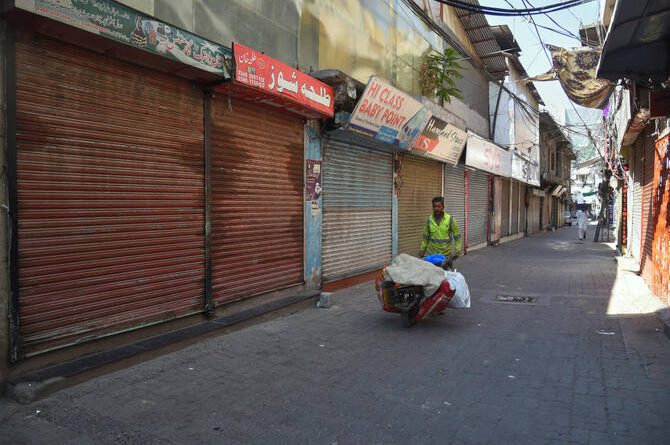
Strike call by banned group paralyzes transport and commerce in Pakistan-administered Kashmir
Muzaffarabad-Businesses closed and public transportation services were suspended across Pakistan-administered Kashmir on Tuesday after a strike called by the recently banned Joint Awami Action Committee (JAAC), deepening political tensions following deadly clashes that left seven people dead earlier this week.
The shutdown affected major urban centers, including the regional capital Muzaffarabad, where residents reported largely deserted markets, closed shops and inactive transport hubs. Similar conditions were reported in other towns across the territory.The strike followed violent confrontations on Sunday in the city of Rawalakot between JAAC supporters and security personnel.
According to authorities, seven people were killed in the unrest, marking one of the deadliest episodes of political violence in the region in recent years.The clashes erupted after the Supreme Court of Pakistan-administered Kashmir ruled that 12 legislative seats reserved for Kashmiri refugees residing in Pakistan are constitutionally protected and cannot be abolished without a formal constitutional amendment.
The JAAC, an alliance established in 2003, has campaigned for expanded political rights for residents of the territory and has long demanded the elimination of the refugee seats. The group argues that the arrangement grants disproportionate political influence to individuals who do not live within the territory.
Residents told local media that public participation in Tuesday’s strike was difficult to assess, with some people appearing to support the shutdown while others remained indoors due to concerns over potential violence.Prior to Sunday’s clashes, the JAAC had announced plans for a strike and a long march from Rawalakot to Muzaffarabad.
Witnesses said thousands of supporters gathered in the eastern city of Mirpur on Tuesday in preparation for the planned mobilization.Authorities responded by deploying additional police and security personnel throughout the region.
Internet services were also suspended in several major cities in an effort to limit mobilization and prevent further unrest.Police and regional government officials accused armed JAAC supporters of opening fire on security forces during Sunday’s violence. The organization has not publicly responded to those allegations in the information provided.
The regional government formally banned the JAAC last week, citing concerns over public order and security. Dozens of supporters have since been detained as part of the crackdown.Regional Prime Minister Faisal Mumtaz Rathore said his administration remains willing to engage in dialogue with representatives of the movement.
He stated that most of the group’s demands had been addressed during negotiations held last year, with the exception of issues relating to refugee seats and certain benefits provided to government officials and ministers.According to Rathore, those unresolved matters require legislative action because of constitutional limitations.
The refugee seats are allocated to individuals and families who migrated to Pakistan from Indian-administered Kashmir following decades of conflict over the disputed Himalayan territory. The arrangement was designed to provide representation for displaced communities affected by the region’s long-running political dispute.
Kashmir remains divided between Pakistan and India, both of which claim the territory in full. The dispute has been a central source of tension between the two nuclear-armed neighbors since their independence in 1947 and has led to multiple wars and recurring periods of instability.
Political tensions in Pakistan-administered Kashmir have intensified ahead of elections scheduled for next month, with debate over refugee representation emerging as a major issue following the recent court ruling and subsequent unrest.


