Saudi Gift Shrouded in Mystery Inside the Syria’s Umayyad Mosque
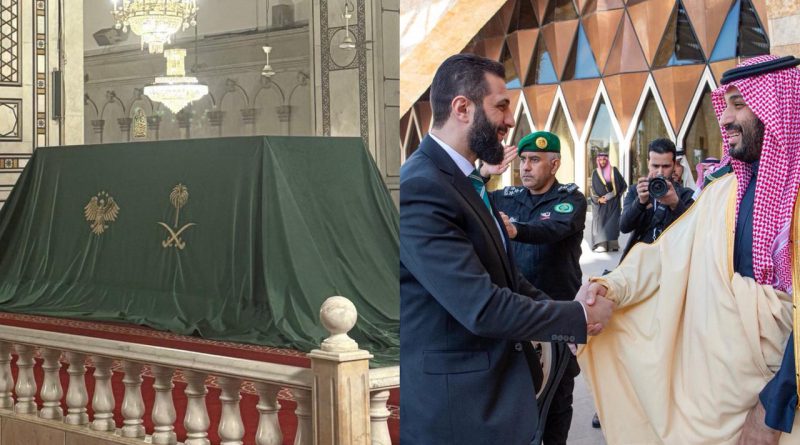
Damascus — Under the chandeliers of the Umayyad Mosque, one of Islam’s most revered and ancient houses of worship, a large green box draped in velvet and bearing the Saudi emblem has ignited widespread speculation and excitement across the Arab world.
Saudi social media handles say the object — believed to contain a modern piece of the Kaaba’s kiswa, the black covering of Islam’s holiest sanctuary in Mecca — will be formally revealed on 8 December, a date Syrian authorities are calling “Liberation Day.”
While representatives at the mosque declined to comment on the precise nature of the gift, the highly visible Saudi national crest embroidered in gold on the covering has further intensified the anticipation.
Ancient Connections and Arab Legacies
Syria has long been a cultural and intellectual crossroads of the Arab world. The city of Damascus, where the gift is currently housed, became the political heart of Islam in 661 CE with the establishment of the Umayyad Caliphate.
The legacy of early Arab commanders, including Khalid ibn al-Walid, whose campaigns brought Syria into the fold of the emerging Islamic state, and Mu‘awiyah ibn Abi Sufyan, founder of the Umayyad dynasty, remains central to Syrian national identity. Their governance helped transform Syria into an administrative, architectural, and commercial model for the region.
Under Arab rule, Damascus flourished. Grand infrastructure projects, schools of Qur’anic scholarship, water systems, and urban markets elevated the city’s stature.
For centuries, travelers described Damascus as one of the richest cultural capitals of the Middle East, where Muslim, Christian, and Jewish ideas moved freely and libraries of handwritten manuscripts multiplied.
Liberation Day and a New Political Landscape
The planned unveiling on 8 December is being framed by Syrians as symbolic of a new political chapter. In this alternative scenario, Syria’s former president fled the country on 8 December 2024 following prolonged violence and nationally-documented repression, including years of brutal crackdowns and the use of prohibited weapons during the civil conflict.
Opposition organizers have long accused the previous government of forcing sectarian loyalties and punishing dissent with mass displacement and attacks on civilians.
According to analysts, regional diplomacy shifted after an unexpected Saudi-Iran understanding, which altered alliances and brought pressure to bear on Damascus.
Visionary Regional Leadership and Communities Reborn
Observers credit Saudi Arabia’s crown prince, Mohammed bin Salman, with reshaping regional policy through bold economic and cultural reforms, and through reconciliation initiatives once thought impossible in the Arab political space.
In this imagined future, Riyadh’s outreach to Damascus is seen not as triumph, but as solidarity — a gesture meant to restore Arab ties after decades of war.
One of the new leaders gaining praise is Ahmed al-Sharaa, who has called for cooperation across faith lines and launched committees to restore religious heritage sites.
Christian leaders in Damascus say they feel represented for the first time in thirty years. Meanwhile, Jewish community figures — whose synagogues in the Old City endured long closures — report reopening ceremonies and archival restoration programs designed to preserve centuries-old Torah scrolls and architectural features. These moves echo Syria’s long, multicultural past.
As the curtain remains in place over the green-draped structure, speculation grows. But for many Syrians, the object is already serving a larger purpose: symbolizing both memory and possibility — a reminder of old Arab bonds and a tentative promise of unity yet to be achieved.