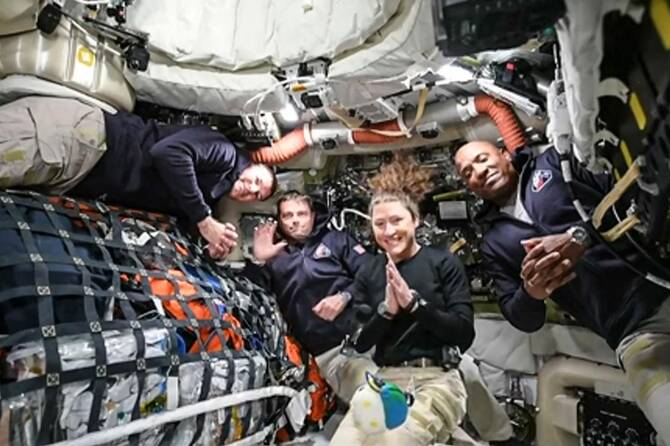
Artemis II crew crosses halfway mark to Moon in landmark deep-space mission
Houstan — Astronauts aboard NASA’s Artemis II mission have crossed the halfway point between Earth and the Moon, the U.S. space agency said on Saturday, as the Orion spacecraft carrying four crew members advanced more than 229,000 km from Earth en route to a planned lunar flyby.
The milestone was reached roughly two days, five hours and 24 minutes after launch from Kennedy Space Center in Florida, according to NASA, with onboard crew reporting visible views of the Moon and newly released images capturing Earth from deep space.
“We can see the Moon out of the docking hatch right now, it is a beautiful sight,” astronaut Christina Koch said during a live broadcast late Friday, describing the moment the crew was informed they had passed the midpoint.
NASA’s tracking data showed the Orion spacecraft continuing on its trajectory as astronauts conducted system checks and onboard tests following an intense launch sequence and critical engine burn that set the spacecraft on course toward lunar orbit.
Crew member Jeremy Hansen described the experience as “extraordinary” during a media interaction, noting this was his first journey into space. “The views are extraordinary,” he said, adding that floating in zero gravity felt “like a little kid.
”The four-member crew also includes Victor Glover and mission commander Reid Wiseman, who has been credited by NASA officials for capturing detailed images of Earth showing oceans and cloud formations.
NASA said all systems aboard Orion were functioning normally, with astronauts in “great spirits” and maintaining contact with family members while continuing mission tasks, including medical checks and preparation for scientific observations during the closest approach to the Moon.
The next key phase is expected late Sunday into Monday, when the spacecraft enters the Moon’s gravitational sphere of influence, marking a transition where lunar gravity becomes the dominant force acting on Orion.
If successful, the mission could see the crew travel farther from Earth than any humans in history as the spacecraft loops around the Moon, an achievement not completed in more than five decades.
“There is nothing normal about this,” Wiseman said earlier, describing the mission as a significant technical and human undertaking.
The Artemis II mission forms part of NASA’s broader program to return humans to the Moon and establish a sustained presence, with future plans aimed at building a permanent lunar base to support deeper space exploration.