Dhaka’s Verdict: Why Pakistan’s Islamist Gamble Backfired

The Yunus-led interim government provided fertile ground for Pakistan to manoeuvre this policy.
When Sheikh Hasina was removed from office in August 2024 after mismanaging two-month student uprising through violence, the political aftershocks were felt well beyond Dhaka. While an interim administration led by Nobel laureate Muhammad Yunus took charge shortly to stabilize and reset the country, but inside the shifting currents of Bangladeshi politics, there was another country saw opportunity, which was Pakistan.
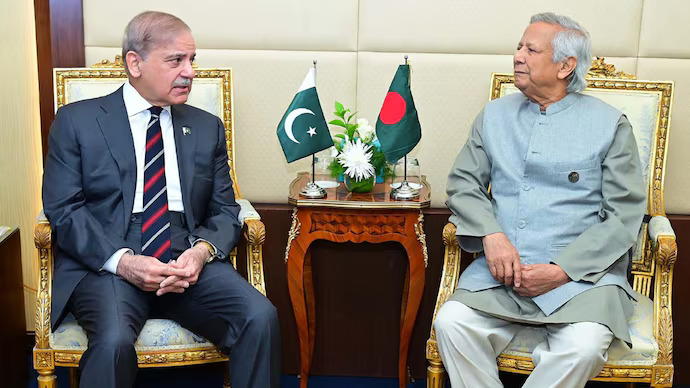
For Islamabad, the fall of Prime Minister Hasina, who was long perceived as closely aligned with India, appeared to offer a rare strategic opening. The interim arrangement which was crowded by sympathizers of Bangladesh Jamaat-e-Islami, created space for religious parties long marginalized under the Awami League’s rule. Pakistan moved quickly with intensified diplomatic exchanges, and even senior military leadership of two countries making reciprocal visits.
But what increased with unusual frequency was Pakistani religious delegations travelling to different cities and towns of Bangladesh from Dhaka to Cox’s Bazar in south and Sylhet in east, among others.
Behind the choreography appeared Islamabad’s clear calculation that if Bangladesh’s Islamist political sphere could be rejuvenated, Dhaka might be kept away from New Delhi and within the broader regional orbit of Islamabad. That bet seems to have failed now. In the recently concluded 13th general election, Bangladesh Nationalist Party (BNP) won a landslide two-thirds majority, winning 212 of the 299 seats on the ballot.
Led by Tarique Rahman, son of former Prime Minister Khaleda Zia and former President Ziaur Rahman, BNP campaigned on the slogan of “Bangladesh First”, emphasising that it will not be beholden to any foreign capital. This political messaging seems to have resonated powerfully with the Bangladeshi electorate.
Such a decisive vote has delivered a strong message to Pakistan, which seemed convinced that its favoured Islamist bloc will win the elections and give Islamabad a strong footing in Dhaka.
Pakistan’s Bangladesh policy in the post-Hasina moment followed a familiar template. It has for decades viewed South Asia through the prism of strategic competition with India. Where New Delhi consolidates influence, Pakistan seeks counterweights as has been witnessed in Afghanistan where this logic has shaped policy for years. In Bangladesh, Islamabad appeared to hope for a softer replay.
The Yunus-led interim government provided fertile ground for Pakistan to manoeuvre this policy. As Islamist networks that had faced political constraints under the Awami League suddenly found renewed visibility, Islamabad’s outreach extended beyond official channels into clerical and ideological spaces.
For instance, Maulana Fazlur Rehman, head of Deobandi Islamist Jamiat Ulema-e-Islam (F), led a delegation of around two dozen prominent Pakistani religious leaders to Bangladesh ahead of parliamentary election in November 2025. They addressed large gatherings, organised under the banner of Khatm-e-Nabuwat conferences, across major cities and towns of the country, which were reportedly held in support of Islamist political actors preparing to contest the February 12 election.
The symbolism of this religious affinity was hard to miss and, it seems, Islamabad believed that by encouraging the Islamization of Bangladesh’s political sphere, it could cultivate a government less beholden to India and more receptive to Pakistan.
Yet this approach rested on two flawed assumptions. Firstly, it overestimated the electoral pull of Islamist forces in contemporary Bangladesh and secondly underestimating the depth of Bangladesh’s historical memory around 1971 war crimes committed by Pakistan Army in what was then East Pakistan.
This memory and Islamabad’s reluctance to issue a formal apology over the war crimes remains central to Bangladesh’s national identity. It seems Pakistani policymakers willingly or otherwise seemed to calculate that five decades were enough to blunt that legacy and that religious affinity could transcend historical grievance.
For many Bangladeshis, Pakistan is not simply another state but a former ruler whose actions precipitated immense trauma which remains unchanged across generations. If anything, it has been institutionalized through education, public commemorations and war crimes trials. And BNP’s campaign slogans captured this sentiment with clarity as it called for “Bangladesh First” against any outright alliance with any foreign power (Na Pindi, Na Dilli).
Moreover, Pakistan’s attempt to leverage Islamization as a foreign policy tool also reveals a deeper tension. While Bangladesh is a Muslim-majority country, yet its political culture remains fundamentally based on Bengali linguistic nationalism. The Awami League’s secular framing was one expression of that synthesis.
Even the BNP, while more accommodating of religious parties as was witnessed during its earlier rules, has not sought to subordinate national policy to clerical authority. While it is true that interim government’s closeness with Jamaat-e-Islami may have energized segments of Islamist base, but, as the results showed, it did not translate into a groundswell.
Therefore, it is quite possible that Islamabad’s outreach through clerical visits, cross-border religious gatherings, symbolic solidarity may have reinforced suspicions that Islamist mobilization was being externally encouraged. For a country sensitive to sovereignty, such perceptions usually prove counterproductive.
In fact, there is an irony here. While Pakistan’s own domestic experience illustrates the complexities of entangling religion and statecraft, yet in Bangladesh, it appeared willing to encourage precisely that dynamic in pursuit of geopolitical advantage.
Nevertheless, the failure of Pakistan’s Bangladesh bid echoes its recent miscalculation in Afghanistan where Islamabad’s military-dominated establishment believed that it possessed decisive influence in Kabul after backing Afghan Taliban’s return to power in 2021. But relations with Afghanistan today are strained, marked by months long border closure and recurrent skirmishes along the contested Durand Line dividing the two countries.
It can be argued that Pakistan overestimated the durability of ideological affinity as a substitute for structural partnership in both the cases. Neither has religious affinity guaranteed strategic alignment with Kabul nor has it now delivered political ascendancy in Dhaka as Bangladesh’s electorate has signalled that while religion remains integral to social life, it does not automatically translate into foreign policy alignment.
For Pakistan, this presents a dilemma since Dhaka’s determination to pursue a “Bangladesh First” policy offers limited space for the kind of ideological leverage that Islamabad sought to cultivate.
While Islamabad’s Bangladesh policy after 2024 was built on the hope that a moment of political flux could be shaped into strategic realignment, its engagement will therefore need recalibration and for any pragmatism to sustain, the relations will have to be transactional and grounded in mutual interest rather than religious solidarity.
Disclaimer: Views expressed by writers in this section are their own and do not reflect Milli Chronicle’s point-of-view.