
Geneva Raises the Alarm on Pakistan’s Transnational Repression

What is unfolding in Pakistan’s case is part of a wider global trend. The line between domestic and international repression is becoming harder to draw.
At this year’s session of the United Nations Human Rights Council in Geneva, Pakistan was once again in the spotlight. That, in itself, is not unusual. What felt different, however, was the tone of the conversations taking place in the corridors and side events. The focus was no longer limited to what happens inside Pakistan’s borders. Increasingly, attention is shifting to what follows critics when they leave.
As someone who studies terrorism and state responses to dissent, I found this shift telling. It points to a broader transformation in how power is exercised. Repression, in this sense, is no longer something contained within territory. It travels with people. It adapts to new environments. And it often slips through the cracks of legal systems that were never designed to deal with such subtle, dispersed pressure.
The discussions on March 27 at the Palais des Nations brought this into sharper focus. Activists and observers described a pattern that many in academic circles have been tracking for some time: the gradual erosion of the idea that exile offers safety. What used to be a clear boundary—inside versus outside—now feels increasingly blurred.
Disappearances at Home, Silence by Design
To make sense of what is happening abroad, it is necessary to begin within Pakistan. Enforced disappearances remain one of the most troubling and persistent issues, particularly in regions like Balochistan. For years, families have protested, sometimes in small groups and sometimes in large marches, asking a simple question: where are their loved ones?
Reports by Human Rights Watch and similar organisations have documented these cases in detail. The pattern is painfully familiar. Someone is taken, often after an encounter with security forces. Then comes silence. No official acknowledgement, no clear legal process, and very little hope of accountability.
What is often missed in policy discussions is the wider effect of this practice. Disappearances are not only about removing individuals; they are about sending a message. Fear spreads outward—from the missing person to their family, their community, and beyond.
In my own research on political violence, I have seen similar dynamics in very different contexts. The actors may differ, but the outcome is strikingly similar: silence, caution, and self-censorship.
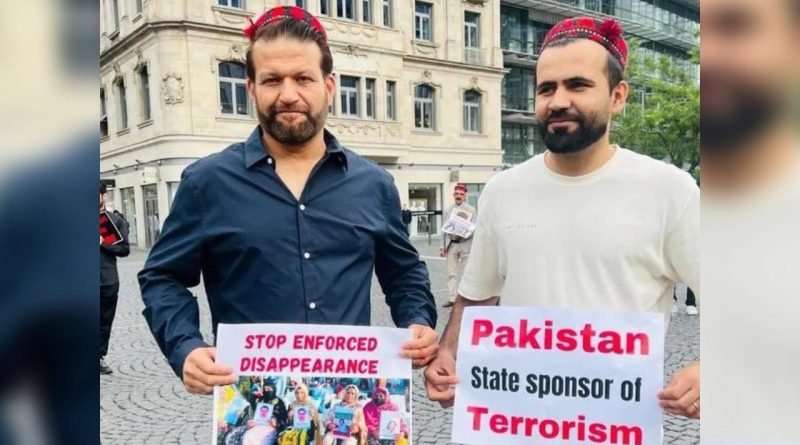
The case of Idris Khattak brought rare international attention to this issue. Yet it also highlighted a deeper problem. For every case that reaches global headlines, many more remain invisible. This uneven attention creates what some scholars describe as a “hierarchy of suffering,” where only a handful of stories are heard while the rest fade into the background.
This is reinforced by a lack of transparency. Legal processes are often opaque, oversight is limited, and avenues for redress are weak. Over time, this creates a system where such practices can continue with little consequence. It is from within this environment that the outward projection of pressure begins.
When Pressure Crosses Borders
What became clear in Geneva is that these domestic patterns do not stop at the border. Instead, they seem to follow those who leave. Testimonies from activists, including Roshaan Khattak, painted a picture that is less dramatic than high-profile international incidents, but no less unsettling.
The methods described are rarely direct. There are no dramatic confrontations or visible operations. Instead, the pressure is quieter. Family members back home are approached or questioned. Administrative hurdles appear unexpectedly—delayed documents, unexplained complications. Messages arrive, sometimes anonymous, reminding individuals that distance does not necessarily mean safety.
Because these actions are informal and often deniable, they are extremely difficult to address. Host governments in Europe or North America may be aware that something is happening, but proving it is another matter entirely.
Freedom House has identified Pakistan as one of several countries engaged in what is now termed transnational repression. What stands out in this case is not spectacle, but persistence. There are no headline-grabbing incidents, but rather a steady, ongoing pressure that shapes behaviour over time.
From a research perspective, this challenges how we think about coercion. Traditional frameworks tend to separate what happens inside a country from what happens outside it. But here, the two are clearly connected. The same habits, the same tools—only adapted to a different setting.
A Contemporary Glimpse: Pressure Through Families
A recent case involving journalist Waqas, reported by DropSite, offers a glimpse into how this can unfold in practice. He alleged that police in Karachi harassed his parents after he reported on Punjab Chief Minister Maryam Nawaz and claims regarding her son Junaid Safdar’s use of a government Gulfstream jet for a private European trip. According to his account, his family was pressured into issuing a statement.
The Sharif family has firmly denied these allegations, calling them propaganda and stating that the aircraft in question was undergoing maintenance. As with many such cases, the details are contested and difficult to independently verify.
Yet what matters analytically is the pattern. The idea that pressure can be applied not directly to the individual, but to those close to them, is not new. It is, however, highly effective. People may be willing to take risks themselves, but far fewer are willing to see their families bear the consequences.
In studies of coercion and political violence, this kind of indirect pressure is well understood. It works precisely because it targets emotional and social ties that are almost impossible to shield. When used by states, it becomes even more complex, raising difficult questions about accountability and response.
A Policy Gap That Is Hard to Ignore
One of the clearest takeaways from the Geneva discussions is that policy has not kept pace with reality. There is growing documentation of abuses within Pakistan, and now increasing evidence of pressure beyond its borders. Yet responses remain fragmented.
There is still a tendency, particularly in Europe, to assume that offering asylum or residency is enough. In many cases, it is not. The forms of pressure described by activists do not fit neatly into existing legal categories. They rarely cross the threshold required for criminal prosecution, but they still have a real impact on people’s lives.
This creates a difficult situation for governments. How do you respond to something that is hard to prove, easy to deny, and yet clearly harmful? Existing counterterrorism frameworks offer little guidance, as they are largely focused on non-state actors. Diplomatic considerations, meanwhile, often limit how far states are willing to go in confronting such practices.
There are no easy solutions. Better documentation and coordination between countries would be a start. So too would legal frameworks that recognise and address transnational repression more directly. Without such steps, there is a risk that these practices will become more common, not less.
The Bigger Picture
What is unfolding in Pakistan’s case is part of a wider global trend. The line between domestic and international repression is becoming harder to draw. States are finding ways to extend their reach without resorting to overt or easily traceable actions.
For those of us who study political violence, this presents both a challenge and a warning. The tools of control are evolving, and our ways of understanding them need to evolve as well.
The discussions in Geneva made one thing clear: leaving a country no longer guarantees distance from its power structures. Repression, in its modern form, is more flexible than that. It moves through networks, relationships, and systems that span borders.
The question now is whether international institutions and national governments are prepared to deal with this shift. If not, they risk confronting a new reality with outdated assumptions—and that is rarely a winning strategy.
Disclaimer: Views expressed by writers in this section are their own and do not reflect Milli Chronicle’s point-of-view.


