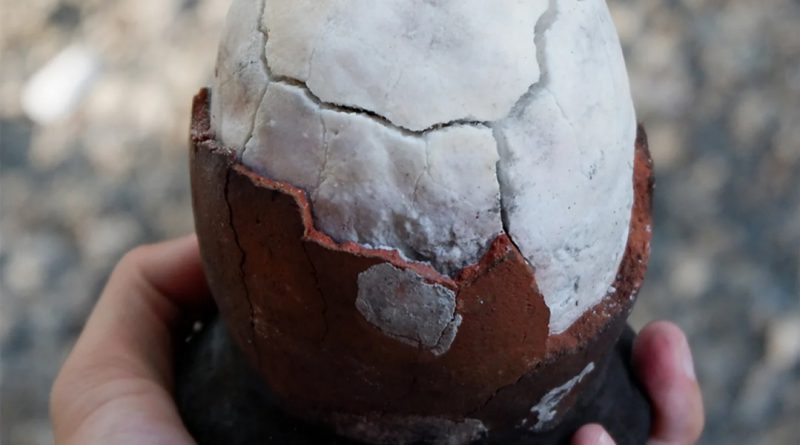
The ‘Dinosaur Egg’ Salt: How a Rare Filipino Tradition Is Being Revived
On the Philippine island of Bohol, inside a humble workshop covered with a traditional thatched roof, 68-year-old craftsman Romano Apatay carefully tends to a process that has survived for centuries.
Using a scoop fashioned from an empty shell, he slowly pours salty brine into a row of brown clay containers that hang above a small wood fire. The clay vessels, shaped like large spheres, gradually heat until their surfaces begin to crack.
Once that moment arrives, Apatay removes the pots from the flames and allows them to cool. When the clay shell becomes brittle, he gently turns each vessel upside down and breaks it open with his fingers. Inside lies a perfectly round white lump of salt—one of the rarest culinary products in the world.The salt is known locally as asin tibuok, a phrase that translates roughly to “whole” or “unbroken salt.”
But many people today know it by a more colorful nickname: “dinosaur egg salt.” Its unusual egg-like shape has captured the imagination of food lovers around the globe.For centuries, this unique salt was once a common sight across the island. Today, however, only a handful of artisans remain who still know how to produce it.
Apatay is among the last practitioners continuing the tradition, and he has become part of a small movement determined to keep the craft alive.
The origins of asin tibuok stretch back hundreds of years. Historical records indicate that the salt was already being produced on Bohol as early as the 17th century. One of the earliest descriptions comes from a Spanish missionary who wrote about the unusual salt-making methods practiced by local communities.
The missionary recorded how coastal residents filtered seawater through ashes made from burned coconut husks before baking the resulting brine inside spherical clay containers. The process created dense, rock-hard balls of salt with a smoky, mineral flavor unlike any other.
Yet researchers believe the practice predates Spanish colonization of the Philippines.Ethnoarchaeologist Andrea Yankowski, who has spent years studying traditional salt production on Bohol, says the craft likely existed long before written records began. She first encountered asin tibuok about two decades ago while conducting fieldwork on the island.
Over time, Yankowski noticed that the number of traditional salt makers known locally as manganisays—was steadily shrinking. By 2019 she realized that only a small number of artisans remained, prompting her to begin documenting their techniques and stories.According to Yankowski, salt production was once a vital part of the island’s economy. Many coastal communities participated in the craft, creating a network of families dedicated to producing the prized mineral.
“This salt was not just for local use,” she explains. “It was regularly exchanged with farmers in the interior parts of the island for rice and other crops. It also traveled beyond Bohol through trade with neighboring islands.”
In earlier generations, asin tibuok played an everyday role in local cuisine. Families would attach a string to the solid salt orb and dip it directly into dishes such as rice porridge to add seasoning.
Unlike ordinary table salt, which dissolves quickly, asin tibuok releases flavor slowly. Its smoky undertones come from the coconut husk ash used during the filtration process, giving it a distinctive taste prized by chefs today.
For communities along the Bohol coastline, salt-making also represented more than just a livelihood—it was a cultural identity passed down through families.At its peak, roughly a hundred households were believed to be involved in the craft.
Knowledge of the process was traditionally shared across generations, with children learning the techniques by observing their elders.But during the late 20th century, this centuries-old practice began to fade.
Several factors contributed to the decline of asin tibuok production. One of the biggest challenges was the labor-intensive nature of the process. Making a single batch of salt can take months of preparation and careful attention.
The first step involves collecting coconut husks, which must be burned slowly to produce ash. That ash is then layered into large filtration basins made of bamboo. Seawater is poured through the ash, producing a concentrated liquid known as tasik.
This mineral-rich liquid is later boiled repeatedly until it forms a dense brine. Finally, the brine is poured into clay pots and baked over a fire until the water evaporates, leaving behind a solid mass of salt.Each clay container must be broken open to retrieve the salt inside, meaning the vessel can only be used once.
This makes the process both time-consuming and costly.As younger generations pursued different careers and modern salt became widely available, fewer people were willing to continue the demanding craft.
For Romano Apatay, continuing the tradition is about honoring the heritage of his ancestors.He learned the salt-making techniques from older members of his community and has spent decades refining the method.
Today he is determined to keep the practice alive despite the challenges.“It is very important to protect this craft,” he says. “It represents the work and knowledge of our forefathers.”Producing the salt requires patience, skill and dedication qualities that Apatay believes should not be lost.But in recent years, an unexpected wave of interest has begun to breathe new life into the craft.
Surprisingly, the revival of asin tibuok has been fueled in part by the internet.Food enthusiasts on social media platforms began sharing videos and posts about the unusual “dinosaur egg” salt. The visually striking shape of the salt balls and the dramatic process of breaking open clay pots captured widespread attention.
One major boost came in 2021 when Filipino culinary personality Erwan Heussaff published a video documenting the traditional production process. The video reached millions of viewers online and introduced the rare salt to a global audience.Soon after, younger chefs and food creators began experimenting with the ingredient, showcasing it in modern dishes and restaurant kitchens.The salt also appeared in popular culture.
In 2023, it was featured in an episode of the Filipino television drama Replacing Chef Chico on Netflix, further increasing its visibility.As curiosity grew, food lovers and tourists started visiting Bohol to see the traditional craft in person.
The renewed attention reached an important milestone in December 2025 when asin tibuok was officially recognized by UNESCO as part of the Intangible Cultural Heritage in Need of Urgent Safeguarding.
This designation highlights cultural traditions that are at risk of disappearing and encourages efforts to protect them.For the salt makers of Bohol, the recognition brought both pride and hope. It also helped draw global awareness to the fragile status of the craft.
Researchers and cultural advocates believe the recognition could support educational programs and training initiatives aimed at encouraging younger artisans to learn the tradition.
Despite the renewed interest, the future of asin tibuok remains uncertain. Only a small number of artisans continue to produce it, and the process requires both time and specialized knowledge.
Preserving the craft will likely depend on whether younger generations are willing to invest in learning the complex techniques involved.Still, the growing appreciation among chefs, historians and cultural organizations offers reason for optimism.For Romano Apatay, each clay pot he opens is more than just a container of salt it is a symbol of history, resilience and identity.
As he carefully reveals another gleaming white sphere from its fragile shell, he knows that the future of this extraordinary “dinosaur egg” salt rests on the dedication of those determined to keep the tradition alive.