Plug-In Balcony Solar Systems Gain Momentum in United States as States Ease Regulatory Barriers
“It’s kind of like ‘don’t tell me what to do in my own back yard and on my own balcony,’” solar advocate Harold Stryker said as more U.S. states move to legalize plug-in solar systems.
Small-scale plug-in solar systems designed for balconies, patios and apartment buildings are beginning to gain traction in the United States as state governments reconsider regulations governing residential energy generation and grid access.
The systems, commonly referred to in Germany as “Balkonkraftwerk” or “balcony power plants,” allow residents to generate electricity through compact solar panels that plug directly into household electrical outlets.
Advocates say the technology offers a lower-cost and more accessible entry point into renewable energy generation, particularly for renters and apartment residents who cannot install conventional rooftop solar systems.While the technology remains relatively uncommon in the United States, its adoption has accelerated in parts of Europe, especially in Germany, where an estimated 4 million balcony solar units have been installed.
The growing European market has drawn attention from U.S. renewable energy advocates and lawmakers seeking to expand access to decentralized electricity generation amid rising energy costs and increasing consumer interest in energy independence.
Supporters of the systems argue that plug-in solar technology could help broaden participation in residential renewable energy by reducing installation costs and simplifying deployment. Unlike traditional rooftop solar systems, balcony solar units are generally smaller and designed for direct consumer installation without major electrical modifications.
Harold Stryker, a solar advocate involved in promoting the technology in the United States, said the systems are intended to supplement household electricity use rather than replace conventional grid power entirely.“Then you do need to draw the rest from the grid as you do now,” Stryker said, describing how the systems operate alongside existing electricity supply networks.
The systems typically generate enough electricity to offset portions of residential consumption during daylight hours. Advocates say they are particularly suitable for powering small appliances, electronics and other routine household uses.The expansion of balcony solar in Europe has been supported by comparatively streamlined regulatory frameworks and government policies encouraging distributed renewable energy adoption.
Germany has emerged as one of the leading markets for the technology, where the systems have become increasingly visible on apartment balconies and residential buildings.In the United States, adoption has proceeded more slowly because of varying utility regulations and electrical standards across states and municipalities.
Utility companies in some jurisdictions have raised concerns regarding grid safety and operational risks associated with consumer-installed generation systems.Some utilities have argued that improperly connected systems could create safety risks for maintenance workers or affect grid stability during outages and repairs.
Those concerns have contributed to restrictions or approval requirements in several states.Stryker rejected those arguments in relation to small-scale balcony systems, saying existing regulations were originally developed for significantly larger rooftop solar installations.“And that is patently ridiculous for these little systems,” he said.
“Those laws were intended for rooftop systems five to 20 times as large.”The debate reflects broader tensions within the U.S. energy sector regarding distributed electricity generation and the role of consumers in power production. Utilities have increasingly faced pressure from renewable energy advocates and consumer groups seeking expanded access to technologies that reduce dependence on centralized electricity systems.
At the same time, regulators and grid operators have sought to balance innovation with safety and technical reliability requirements.The legal environment for balcony solar systems in the United States began shifting more significantly in 2025, when Utah became the first state to formally authorize plug-in solar systems.
Following Utah’s move, legislation concerning balcony solar or plug-in solar technologies was introduced in 34 states and Washington, D.C., according to the source material. Measures authorizing the systems have since passed in Colorado, Connecticut, Maine, Maryland, New Hampshire and Virginia.
The regulatory changes indicate growing bipartisan interest in distributed renewable energy technologies at the state level, particularly as policymakers seek ways to expand energy resilience and consumer choice.Supporters also argue that balcony solar systems could help broaden renewable energy participation among lower-income households and urban renters who have historically faced barriers to rooftop solar adoption.
Traditional residential solar installations in the United States often require property ownership, significant upfront investment and approval from utilities or homeowners’ associations. Balcony systems, by contrast, are generally marketed as portable and comparatively inexpensive.
The emergence of the technology comes during a period of continued growth in renewable energy investment globally. Governments and energy companies have accelerated deployment of solar and wind infrastructure as part of wider efforts to reduce greenhouse gas emissions and diversify electricity generation sources.
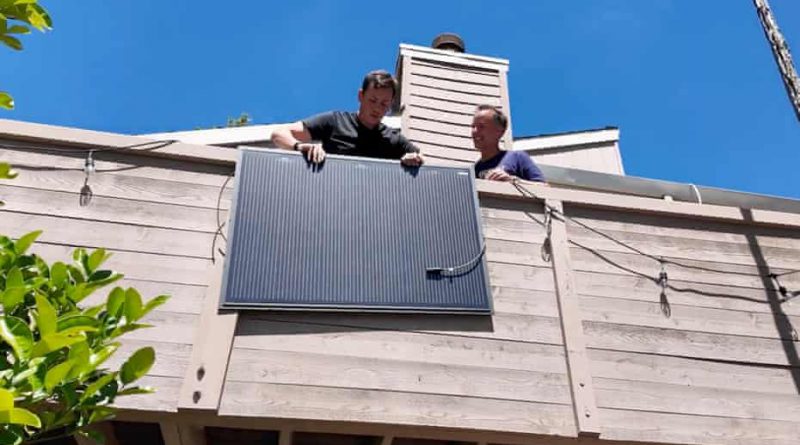
Consumer interest in household-level energy resilience has also increased in recent years following periods of extreme weather, grid disruptions and rising utility costs in parts of the United States and Europe.Among those adopting the technology is Curtis, a resident of Sunnyvale, who installed a balcony solar panel at his residence.Curtis said the appeal of the system was tied partly to the idea of greater personal energy independence.
He acknowledged that neighbors might question the appearance of the panel mounted on his balcony railing but said he viewed the installation as a practical first step toward self-sufficiency.“I think that’s what gets me excited,” Curtis said. “Being able to power my own stuff and be self-sufficient like in baby steps, which is pretty cool.”
Advocates say increasing legalization of balcony solar systems could encourage broader consumer adoption over the coming years, particularly if states continue simplifying approval requirements and standardizing regulations.
The source material for the report was provided by Climate Central, an independent group of scientists and communicators focused on climate and environmental reporting.