Canada Condemns Foreign Interference in Alberta but Dismisses India’s Complaints

Foreign interference is unacceptable in Canada. It shouldn’t become acceptable simply because it’s aimed at India.
I don’t pretend to have deep, on-the-ground knowledge of Alberta’s separatist debate. But Canada’s near-universal pushback against foreign interference in that conversation has been heartening, because it reveals a civic reflex Canadians still share, whatever your view on separation, you don’t want outsiders manipulating a domestic question.
Recent reporting has made the concern concrete. A study summarized by Global News warned that foreign actors, including American and Russian ones, are meddling in Alberta’s separatist debate in ways that threaten Canadian sovereignty (Global News, May 2026). Canada’s National Observer reported research showing inauthentic ‘news’ channels and influence campaigns amplifying Alberta secession and annexation narratives (Canada’s National Observer, April 2026). The Guardian reported a major Alberta voter-data breach linked to separatist organizing, exactly the kind of vulnerability experts warn can be exploited (The Guardian, May 2026).
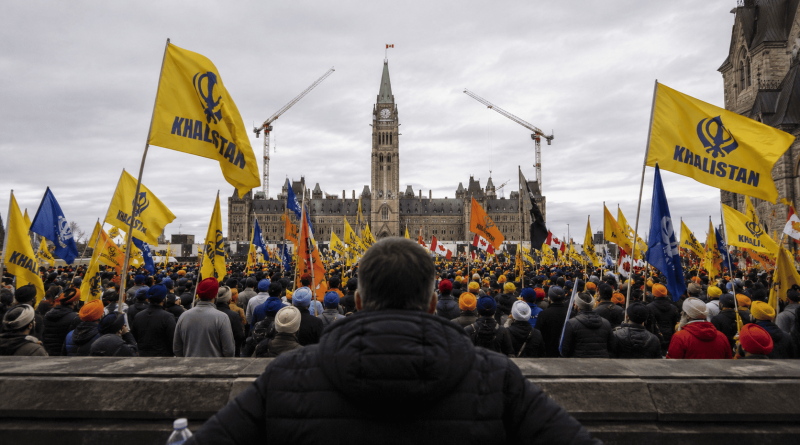
So, Canada’s standard is clear: foreign interference is unacceptable, especially when it rides on disinformation, data exposure, and community targeting. Good. Now apply that same standard to how many Indians, across political views, have experienced the Khalistan file for years.
From India’s perspective, the core complaint is at least a few decades old that Canadian political space, and institutions have enabled an overseas separatist ecosystem to operate openly from Canada, often wrapped in ‘rights’ language, even as India links that ecosystem to extremism, intimidation, and criminality. That is not a characterization I’m inventing; it is an official position India has put on record. In September 2023, India’s Ministry of External Affairs explicitly referred to ‘Khalistani terrorists and extremists’ sheltered in Canada and said, ‘the space given in Canada to a range of illegal activities including murders, human trafficking and organised crime is not new’.
Canadians can disagree with India’s framing. But the asymmetry in Canadian instincts is hard to miss. When Alberta becomes the target, Canadians immediately reach for the language of sovereignty, manipulation, coercion, and democratic integrity. When India raises similar concerns about separatist organizing from Canadian soil, often paired with intimidation politics and crime allegations, Canada’s reflex is too often to repackage it as ‘a disagreement about free speech’.
Canada’s own intelligence reporting has, in fact, moved closer to India’s concern than Canada’s political class admits. The CSIS Public Report states that ongoing involvement in violent extremist activities by Canada-based Khalistani extremists continues to pose a national-security threat to Canada and Canadian interests, and notes that some fundraising can be diverted toward violent activity (CSIS Public Report, 2025). That is not India lobbying Canada. That is Canada describing a domestic threat.
The double standard isn’t only about what is tolerated on Canadian soil. It’s also about what Canadian politicians choose to amplify abroad and that record spans parties.
During the 2020–21 farmers’ protest, Prime Minister Justin Trudeau publicly called the situation ‘concerning’ and signalled support for peaceful protest and dialogue (Hindustan Times, December 2020). Conservative MPs spoke too. In the House of Commons, Arnold Viersen said Sikhs were ‘thinking of and praying for India’s farmers’ protesting new legislation (House of Commons Hansard, November 2020).
Conservative MP Brad Vis tabled petitions from constituents ‘concerned for the safety of farmers’ protesting domestic legislative changes in India (House of Commons Hansard, December 2020). Conservative MP Tim Uppal likewise said India’s farmers ‘deserve to be heard and respected’, a message amplified in media coverage (Scroll, December 2020). Ontario NDP MPP Gurratan Singh was also cited among Canadian politicians voicing concern about the protests, showing the commentary extended beyond Ottawa into provincial politics (Canada’s National Observer, December 2020).
The Amritpal Singh episode in 2023 is even more instructive because it involved public order and violence, not merely protest. Al Jazeera reported that Amritpal and supporters armed with swords, knives and guns raided a police station in February 2023 after an aide was arrested, an event central to the later crackdown and manhunt (Al Jazeera, April 2023). India Today reported Punjab Police describing the Ajnala, Punjab incident as an attack on police and highlighting pressure on authorities during the confrontation. (India Today, February 2023).
Now ask a simple question: if a mobilized group stormed a police station in Canada to force the release of an aide, under threat, with weapons visible, would Canadian authorities treat it as ‘civil liberties’ theatre, or would they enforce criminal law and restore public order?
Canadian political reactions again moved quickly into public positioning. Global News reported that MPs from multiple parties criticized India’s crackdown and internet restrictions, and it specifically noted Conservative voices as well. Conservative deputy leader Tim Uppal and Conservative MP Jasraj Singh Hallan among them (Global News, March 2023). Canada’s Foreign Minister Mélanie Joly said Canada was following developments ‘very closely’ (The Indian Express, March 2023). Jagmeet Singh called the crackdown ‘draconian’ and urged Canadian intervention (Hindustan Times, March 2023).
Outside government, the World Sikh Organization of Canada issued a formal statement condemning the “security operations” in Punjab and raising fears about extrajudicial harm, illustrating how non-government actors in Canada also shaped the narrative internationally (World Sikh Organization of Canada, March 2023)
India’s response to both episodes followed the same script: formal diplomatic pushback and a clear message that Canada was commenting on internal Indian matters. In 2020, India summoned Canada’s envoy, warned that Trudeau’s remarks could ‘impact ties’, and called the commentary ‘ill-informed’, ‘unwarranted’, and ‘interference’ (Al Jazeera, December 2020) (India Today, December 2020) (Reuters, December 2020).
In 2023, as Canadian politicians and organizations criticized the Punjab crackdown, Indian officials framed the operation as law-enforcement action to ‘nab a fugitive’, signalling that Canada’s commentary was external noise while India pursued policing. (The Indian Express, March 2023.)
Put the pattern together and the hypocrisy becomes harder to ignore. Canada is right to reject foreign interference in Alberta. But Canada’s political class has repeatedly engaged in rhetorical interference in India, on mass protests and on an internal security crackdown triggered by a police-station attack, then bristled when India said, plainly, ‘this is our internal matter’.
That is why the Alberta interference debate matters beyond Alberta. It has forced Canadians to admit, in real time, that democratic debates can be manipulated through proxies, disinformation, intimidation, and exploitation of institutional openness. Canada is suddenly fluent in the language of foreign influence because it can taste it.
The underlying principle is that sovereignty is not selective. If foreign interference is wrong when aimed at Canadian unity, it is equally wrong when Canadian space is used to inflame separatist politics abroad.
Foreign interference is unacceptable in Canada. It shouldn’t become acceptable simply because it’s aimed at India.
Disclaimer: Views expressed by writers in this section are their own and do not reflect Milli Chronicle’s point-of-view.