
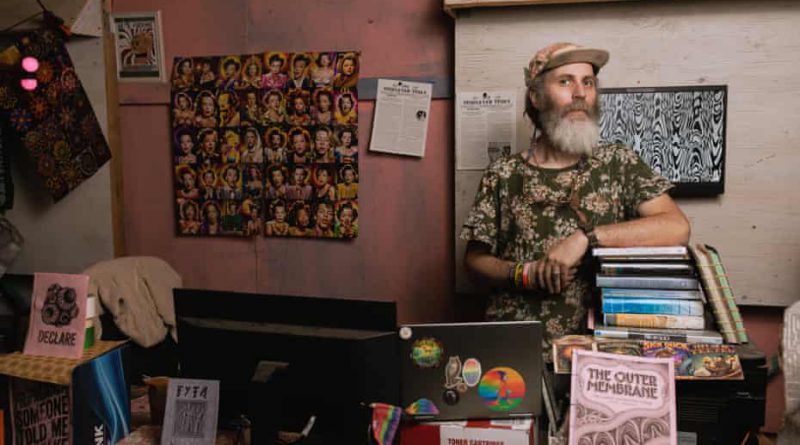
Desert experiment challenges traditional higher education model in remote California outpost
“In a lot of ways it’s an alternative to college… I don’t see how the university system as it is now can sustain itself.”
A group of writers gathered on weathered couches in a sparse, plywood structure in the California desert recently, reading poetry and exchanging critiques in a setting that, at first glance, resembled a typical university workshop.
Laptops rested on knees, tea was poured into cups, and participants offered encouragement after each reading. But beyond the circle, the surroundings told a different story: a windswept, isolated landscape with no permanent infrastructure, far removed from any conventional campus.
The gathering took place at what participants call Mars College, an experimental learning community located near Bombay Beach, roughly 200 miles from Los Angeles and about 40 miles from the nearest grocery store. The site sits beside the Salton Sea, a shrinking and environmentally stressed body of water, and consists of temporary structures assembled from plywood and metal frames.
Co-founder Gene Kogan, a programmer and artist, said the name “Mars College” emerged informally, reflecting the stark terrain. “It kind of looks like Mars out here,” he said, describing the barren surroundings.The initiative operates outside the framework of traditional higher education.
There are no degrees, formal admissions, or accreditation systems. Tuition is not charged in the conventional sense, though participants contribute a few hundred dollars to cover shared costs such as internet access, food, and sanitation facilities. There are no permanent utilities; electricity is largely generated through solar panels, while water and waste management require transportation to and from the site.
Classes are organized daily and led by participants themselves, covering topics ranging from creative writing to solar panel installation and mathematical concepts. The structures hosting these activities are erected at the start of the program in January and dismantled by April, when the seasonal “semester” ends and participants leave.
Kogan said the project is not intended to replicate a university. “I’m not attached to the word college,” he said. “I’m not trying to convince anyone we’re a university of sorts.” He described it instead as an alternative model that responds to concerns about rising education costs and changing labor market conditions.
The concept emerged partly from experiences at large-scale gatherings such as Burning Man in Nevada, where temporary communities and structures are built and later dismantled. One of the project’s co-founders, who goes by Freeman, began constructing modular living spaces from industrial pallet racks at the festival. After acquiring a 20-acre plot of desert land in 2019 for approximately $20,000, he established a more setting for the experiment near Bombay Beach.
Kogan, who holds a mathematics degree from Columbia University and later received a Fulbright scholarship to study art and technology spaces in India, contributed to building a network of participants. He issued an open call in 2019 inviting people interested in collaborative learning and off-grid living.
The initial group consisted largely of acquaintances, he said, with participation expanding over time.Despite its unconventional structure, Mars College reflects some of the broader pressures facing traditional higher education systems. Kogan pointed to the availability of online educational content and questioned the sustainability of high tuition fees.
He noted that during the pandemic, universities such as Columbia continued charging students substantial fees even as instruction moved online.“At the age of the internet, you can get educational content for free,” he said. “But the thing that you can’t get for free is a place for young people to go through this learning phase together.”Participants at Mars College come from varied backgrounds.
Some hold advanced degrees, while others have not completed formal schooling. Current attendees include a former English major interested in off-grid living, a microbiologist with a doctorate who produces a camp journal, and individuals from nearby communities such as Slab City.
Others travel internationally and participate intermittently.Daily life at the site is shaped by environmental constraints. Strong desert winds frequently generate sandstorms, coating surfaces in dust and requiring protective measures such as goggles. Water must be transported in tanks, and waste must be removed manually.
Temperatures rise significantly during spring, often reaching triple digits.“Here, you can’t take anything for granted,” Kogan said, referring to the logistical challenges of sustaining the community.The curriculum reflects the skills required to operate in such an environment, including practical instruction in energy systems and construction.
At the same time, creative and technical subjects are integrated into the program, with participants exploring a range of projects and collaborative work.The influence of emerging technologies is also evident in the community’s activities. Workshops on coding and digital tools are common, and some systems within the camp, including lighting and organizational functions, are automated.
Participants debate how such technologies should be incorporated into creative and academic work, reflecting wider discussions taking place in educational and professional settings.Environmental concerns have also surfaced in relation to the broader region. Proposals for large-scale data infrastructure near the area have raised questions about resource use, particularly electricity and water consumption.
Kogan acknowledged encountering such discussions but said they are not central to the project’s focus, which remains on community-based learning and experimentation.Freeman described the environment as conducive to exploration and collaboration.
“It’s nice being around other people using it extensively to see what it’s capable of,” he said, referring to the range of tools and projects developed at the site.For some participants, the blending of human and automated contributions to creative work has prompted reflection.
The microbiologist who compiles the camp’s journal wrote in an editor’s note about balancing different forms of authorship and experimentation, describing it as an evolving process.The temporary nature of Mars College is a defining feature. Each year, the structures are dismantled at the end of the program, and the land returns to its unoccupied state.
Participants disperse, often returning to conventional careers or other pursuits, before reconvening the following year.The model raises questions about scalability and long-term viability, particularly in comparison with established institutions.
However, its founders emphasize that the project is not designed as a replacement for universities but as a parallel experiment.As the current session approaches its conclusion, the site is already preparing for disassembly.
The plywood classrooms, communal spaces, and solar installations will be taken down, leaving behind only the desert landscape.


