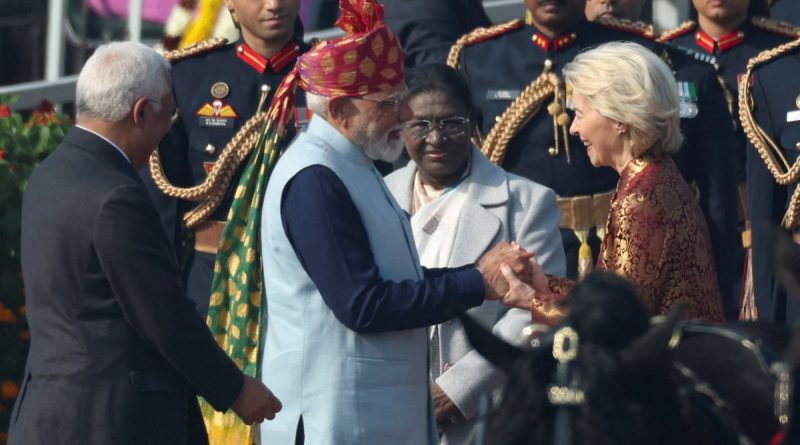
India and EU finalise historic free trade pact amid shifting global alliances
New Delhi – India and the European Union have concluded negotiations on a long-awaited free trade agreement, marking a major milestone in global commerce as both sides navigate a changing geopolitical landscape. The deal, expected to be formally announced soon, is being described as historic for its scale, scope, and long-term economic impact.
The agreement brings together India and the 27-nation European Union, representing nearly a quarter of global GDP and a combined consumer base of around two billion people. It is designed to significantly lower trade barriers and deepen economic integration between two of the world’s largest markets.
Indian officials said the formal signing will follow a legal vetting process that could take up to six months. Implementation of the agreement is expected within a year, allowing businesses time to prepare for new market access and regulatory changes.
Trade between India and the EU reached approximately 136.5 billion dollars in the fiscal year ending March 2025. Officials on both sides expect this figure to rise sharply once the deal comes into force.
The agreement aims to liberalise trade in goods, streamline regulations, and promote investment flows across sectors. It is being framed as balanced and forward-looking, with provisions that protect sensitive domestic interests while opening new opportunities.
The timing of the deal is significant, coming amid strained trade and political relations with the United States. Recent tariff threats and policy uncertainties have pushed many economies to diversify their trade partnerships.
India and the EU have both been active in concluding new trade agreements over the past year. The EU has recently signed pacts with Mercosur, Indonesia, Mexico, and Switzerland, while India has finalised deals with Britain, New Zealand, and Oman.
These moves highlight a broader global trend of hedging against overdependence on any single economic partner. They also reflect a desire to stabilise supply chains and reduce exposure to unilateral trade actions.
Negotiations between India and the EU had stretched on for nearly two decades, marked by long pauses and repeated restarts. Talks were relaunched in 2022 after a nine-year gap and gained urgency amid rising global trade tensions.
Momentum increased further after leaders from both sides agreed last year to fast-track the process. High-level political backing helped negotiators bridge gaps on several contentious issues.
One of the most sensitive areas was automobile trade. The EU sought steep cuts in India’s high import duties on cars, which can exceed 100 percent.
India, meanwhile, pressed the EU to ease restrictions on steel exports. As one of the world’s largest steel producers, New Delhi argued that existing curbs unfairly limited its access to the European market.
As part of the compromise, India is expected to significantly reduce tariffs on cars imported from the EU. This move is seen as a major concession and a signal of India’s willingness to open its traditionally protected market.
At the same time, negotiators agreed to exclude certain sensitive farm and dairy products from the deal. India has consistently maintained that protecting millions of small and subsistence farmers is a political and economic necessity.
The deal also comes against the backdrop of a failed India–United States trade agreement last year. That collapse, combined with new tariffs, accelerated India’s push to deepen ties with other major economies.
For European companies, the agreement offers improved access to one of the fastest-growing large economies in the world. For Indian exporters, it promises easier entry into a high-income market with stable demand.
Analysts say the agreement could reshape trade flows, boost investment, and strengthen strategic ties beyond economics. It is also likely to influence India’s future trade negotiations with other partners.
While challenges remain in implementation, both sides see the deal as a foundation for long-term cooperation.
In an era of uncertainty, the India–EU trade pact is being positioned as a statement of confidence in multilateral engagement.