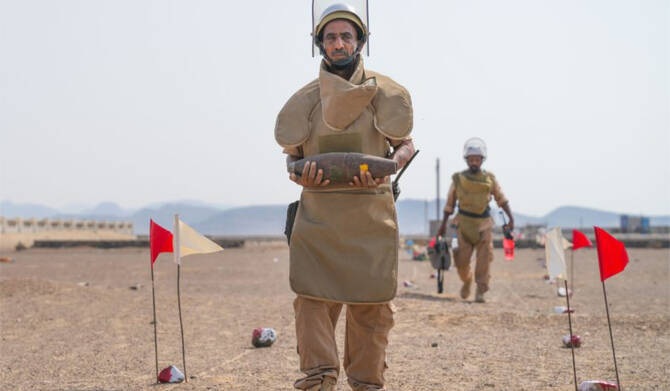
Saudi-Led Demining Project Removes Hundreds of Explosive Devices Across Yemen
Riyadh – A Saudi-supported humanitarian demining initiative has continued its efforts to improve civilian safety in Yemen by clearing a large number of explosive hazards from multiple regions.
The project focuses on reducing risks to communities and restoring safer living conditions in areas affected by unexploded devices.
During the past week, trained teams successfully removed 1,181 explosive devices from different parts of the country.
These items included unexploded ordnance, landmines, and other hazardous remnants that posed ongoing dangers to everyday life.
The clearance operations covered a wide geographic area, reaching governorates such as Marib, Aden, Jouf, Shabwa, Taiz, Hodeidah, Lahij, Sanaa, Al-Bayda, Al-Dhale, and Saada.
These regions include residential zones, rural communities, and key routes used by civilians and aid workers.
Unexploded devices often remain hidden in fields, roads, and near homes long after conflicts subside.
Their presence restricts movement, disrupts livelihoods, and creates long-term safety concerns for families.
The demining initiative prioritizes locations where civilians are most vulnerable, including villages, schools, and access roads.
By clearing these areas, the project supports safer travel and helps communities regain access to essential services.
Since its launch in 2018, the program has cleared more than 531,000 explosive devices across Yemen.
This cumulative effort reflects years of sustained work by specialized teams operating under challenging conditions.
A key component of the project is its focus on local capacity building.
Yemeni demining engineers are trained to international standards and equipped with modern tools to carry out their work safely and effectively.
Training programs emphasize technical skills, safety procedures, and careful identification of different explosive types.
This approach ensures that local teams can continue clearance operations with professionalism and confidence.
In addition to removing hazardous devices, the initiative provides assistance to individuals injured by explosives.
Support includes medical aid and rehabilitation resources aimed at helping affected people rebuild their lives.
Explosive remnants of war often have long-term humanitarian consequences, particularly for children and farmers.
Accidental encounters can result in injuries that affect families and communities for years.
By addressing these risks, demining operations contribute to broader recovery and stability efforts.
Cleared land can be reused for housing, agriculture, and infrastructure development.
The project also plays an important role in enabling humanitarian access.
Safe roads and cleared areas allow aid organizations to deliver food, medicine, and other essential supplies more efficiently.
Demining teams work methodically, surveying land before carefully neutralizing and removing devices.
Each operation follows strict safety protocols to protect both workers and nearby residents.
Community awareness is another important element of the initiative.
Local residents are informed about risks and encouraged to report suspected explosive hazards.
This cooperation between demining teams and communities improves effectiveness and builds trust.
It also helps ensure that cleared areas remain safe over time.
The ongoing work highlights the importance of humanitarian-focused mine clearance in post-conflict environments.
Removing explosive threats is a crucial step toward restoring normalcy and supporting long-term development.
While challenges remain, continued clearance efforts bring tangible improvements to daily life.
Families can move more freely, children can attend school safely, and farmers can return to their land.
Overall, the demining project represents a sustained humanitarian commitment.
Its focus on safety, training, and community support contributes to reducing harm and promoting recovery.