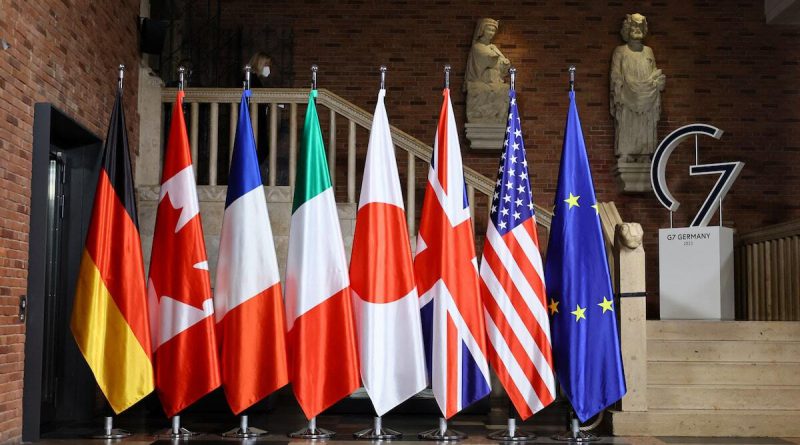
G7 Finance Ministers Convene in Washington to Tackle Rare Earth Supply Risks
Tokyo – Finance ministers from the Group of Seven economies are set to meet in Washington to focus on the growing strategic challenge of rare earth supplies.
The discussions reflect mounting concern among advanced economies about their heavy dependence on a narrow group of suppliers for critical minerals.
Rare earth elements are essential for modern technologies, including electric vehicles, renewable energy systems, advanced electronics, and defense equipment.
Supply disruptions or price volatility in these materials could have far-reaching consequences for global manufacturing and national security.
The Washington meeting is expected to take place on January 12 and will bring together finance leaders from the United States, Europe, and Asia.
According to sources familiar with the agenda, one of the central topics will be the idea of introducing price floors for rare earth materials.
Price floors are seen as a mechanism to encourage investment in mining and processing projects outside dominant supply regions.
Without such safeguards, companies often struggle to compete with lower-cost producers, making alternative supply chains financially unviable.
Most G7 nations, with the exception of Japan, remain heavily reliant on China for rare earths and related processing capabilities.
This dependence has raised alarms amid rising geopolitical tensions and concerns over the use of trade leverage.
The issue gained urgency after past export restrictions and policy shifts highlighted the vulnerability of global supply chains.
Last year, G7 leaders agreed on a coordinated action plan aimed at securing critical mineral supplies and strengthening economic resilience.
That plan emphasized diversification, domestic production, recycling, and cooperation with trusted partners.
Officials began exploring the concept of minimum price guarantees as early as last year to support non-Chinese producers.
The United States took a first step by setting a minimum price in a contract designed to boost domestic rare earth production.
Supporters argue that such measures reduce investment risk and provide long-term certainty for mining and refining projects.
Critics, however, caution that price floors could distort markets if not carefully designed and internationally coordinated.
The Washington talks are expected to examine how G7 countries can align their approaches to avoid fragmentation.
Finance ministers will also likely discuss broader critical mineral strategies, including lithium, cobalt, and nickel.
These materials are central to energy transition goals, particularly the rapid expansion of electric vehicles and battery storage.
Securing reliable supplies has become a core economic priority as governments invest heavily in green technologies.
The meeting signals a shift toward treating rare earths not just as commodities, but as strategic assets.
Coordination at the G7 level is intended to send a strong signal to markets and potential investors.
It also reflects a broader effort to reduce systemic risks created by concentrated supply chains.
While concrete policy announcements are not guaranteed, the talks are expected to shape future cooperation.
Outcomes may influence national subsidy schemes, trade agreements, and partnerships with resource-rich countries.
As competition for critical minerals intensifies globally, the G7’s approach could set a benchmark for other economies.
The Washington meeting highlights how economic policy, industrial strategy, and geopolitics are increasingly intertwined.
Rare earths, once a niche concern, are now firmly at the center of global economic planning.