Myanmar Begins Phased Elections Amid Hopes for Gradual Political Stability
Naypyitaw – Myanmar has entered a new political chapter as the first phase of its nationwide election process concluded, marking the country’s first general polls since 2021.
The multi-phase election is being conducted across the country in stages, reflecting efforts to manage voting in a complex security and administrative environment.
Authorities have said the phased approach is designed to ensure broader coverage and logistical coordination across regions with varying conditions.
Despite challenges, the commencement of voting represents an attempt to move toward institutional governance after several years of political uncertainty.
The election is being held in three phases stretching from late December through January, covering a majority of the country’s townships.
Officials argue that this structured timeline allows for better oversight, security planning, and voter access across diverse regions.
The military-backed administration has maintained that the polls are an essential step toward restoring order and economic recovery.
Leaders have repeatedly stated that elections are a foundation for long-term stability and a return to routine political processes.
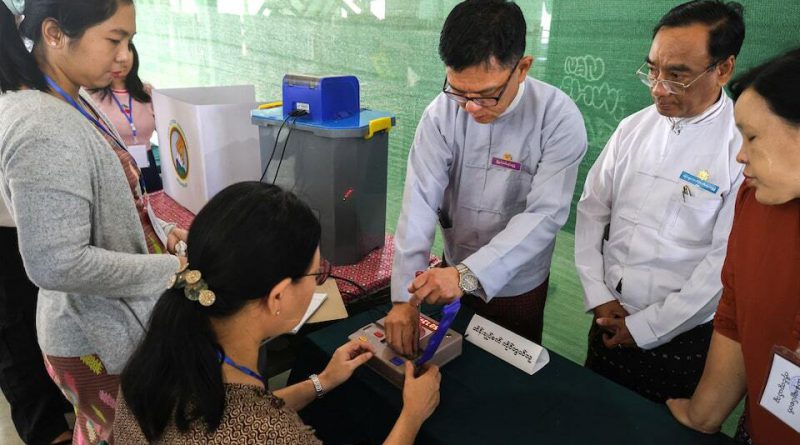
In the capital, voting took place under tight security arrangements, reflecting the authorities’ emphasis on maintaining calm during the process.
State media highlighted participation by senior officials as a symbol of institutional continuity and confidence in the electoral exercise.
Residents in several urban centres noted that voting proceeded peacefully, with polling stations operating according to schedule.
While turnout appeared modest in some areas, officials say participation levels may rise in subsequent phases as voting expands to more regions.
The phased structure means that millions of voters will still have opportunities to cast ballots in January rounds.
Election administrators have emphasized that access and safety remain priorities as voting continues.
The military-aligned Union Solidarity and Development Party is widely expected to perform strongly, given its nationwide organisational presence.
Political analysts note that the party’s extensive candidate list reflects preparedness and long-standing electoral experience.
Supporters argue that continuity in governance could help stabilise policy-making during a period of economic and humanitarian strain.
Myanmar continues to face significant internal challenges, including displacement and infrastructure pressures, which have shaped the electoral environment.
Authorities say the election is part of a broader roadmap to address these issues through formal political institutions.
The government has pointed to elections as a mechanism to channel political participation into structured debate rather than conflict.
International reactions have been mixed, but officials maintain that domestic priorities must guide the country’s political path.
They argue that gradual political processes are necessary in a nation as diverse and complex as Myanmar.
The election schedule covers 265 of the country’s 330 townships, reflecting both ambition and caution in the rollout.
Security forces have been deployed to ensure polling can proceed without disruption in designated areas.
In previous elections, voter participation has varied widely by region, and officials say comparisons will become clearer after all phases conclude.
The authorities have not yet announced a final date for results, citing the need to complete all voting rounds first.
Election officials say transparency measures, including indelible ink and monitored polling stations, are being used to maintain procedural integrity.
Images broadcast by state media showed orderly voting procedures, with citizens following established rules.
The phased election comes at a time when Myanmar is seeking to stabilise governance and revive investor confidence.
Officials believe that an elected administration will be better positioned to engage with regional partners.
They also argue that political continuity can support long-term development planning.
While challenges remain, the initiation of elections is being framed by authorities as a step forward.
The coming weeks will determine how voter engagement evolves as additional phases are conducted.
Observers say the full picture of participation and outcomes will only emerge once all rounds are complete.
For now, the first phase signals an attempt to transition toward structured political processes.
The election process, despite obstacles, underscores an ongoing effort to shape Myanmar’s political future through ballots rather than prolonged uncertainty.