OPINION: When Terrorists Speak for the State in Pakistan

Pakistan has for years made efforts to blur such distinctions, often planting insinuations that Afghanistan harbored anti-India militant leaders.
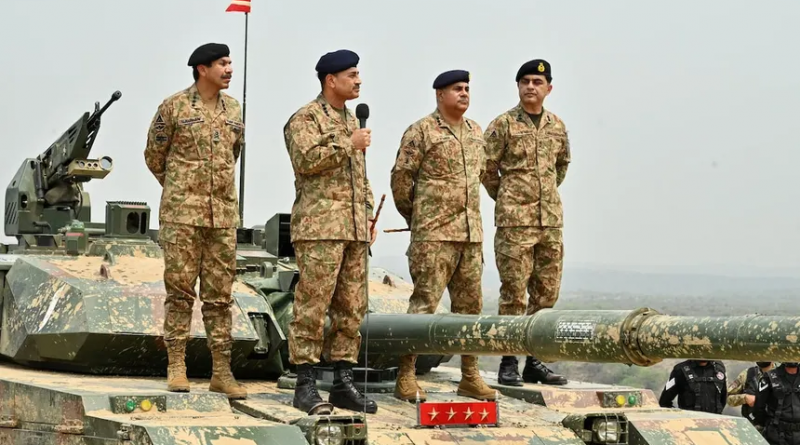
There are moments in politics when the veil slips, not because of investigative exposés or declassified files, but because the actors themselves say the quiet part out loud. Pakistan may be living through such a moment now. As Army Chief Field Marshal Asim Munir consolidates unprecedented authority through constitutional engineering and his elevation as the country’s first Chief of Defence Forces, he has found an unlikely but telling source of public endorsement: the leadership of Pakistan’s most notorious terrorist organizations.
In a recent video message, Qari Mohammad Yaqoob Shaikh, a senior cleric associated with Hafiz Saeed, the United Nations-designated terrorist and founder of Lashkar-e-Toiba (LeT), welcomed Munir’s outreach to religious leaders on the issue of tensions with Afghanistan. More strikingly, Shaikh issued a blunt warning to Kabul: if the Taliban government failed to allow Afghan soil to be used “against Pakistan’s enemies,” then “we will stand with the Pakistan Army against Afghanistan.”
This was not the rhetoric of a fringe preacher indulging in bluster. It was a public articulation of a long-standing, carefully managed relationship between Pakistan’s military establishment and jihadist proxies like LeT and Jaish-e-Mohammad (JeM). What is new is not the policy, but the openness with which it is now being advertised.
For decades, analysts, diplomats, and intelligence agencies have described LeT and JeM as instruments of Pakistan’s regional strategy. Islamabad has denied this with practiced indignation, insisting these groups are either rogue actors or victims of international conspiracy. But when senior figures who are directly ied to jihadist ecosystem (LeT leadership in this case) openly threaten a neighbouring country while pledging allegiance to the Pakistan Army, the deniability collapses.
The statement is revealing precisely because it abandons all pretence. When Shaikh says “we will stand with the Pakistan Army,” he is not speaking metaphorically. As chairman of the Ulema-o-Mashaikh Rabta Pakistan (which organise religious clerics) and a long-time associate of Jamaat-ud-Dawa, LeT’s political and charitable front, he represents a clerical-militant ecosystem that has historically mobilized fighters, logistics, and ideological cover in service of the state’s security objectives. His words amount to an admission: militant groups exist not alongside Pakistan’s military strategy, but within it.
However, the LeT is not the only group that has been sustained by Pakistan Army. Terrorist groups like Maulana Masood Azhar’s Jaish-e-Mohammad (JeM), Sipah Sahaba, Jundullah, Islamic State Khorasan, among several others, occupy a similar space. Founded with the backing of Pakistan’s security establishment after Azhar’s release in the 1999 Kandahar hijacking incident, JeM has repeatedly surfaced at moments when Islamabad sought escalation without accountability. Be it the 2001 attack on India’s Parliament or the 2019 Pulwama bombing, it has conducted dozens of terrorist attacks against India.
The threats by Qari Yaqoob are not an innovation but rather a reversion. Pakistan’s use of on jihadist proxies has a long history and dates back to the 1980s, when its Inter-Services Intelligence (ISI), flush with American and Saudi support, trained tens of thousands of local and foreign fighters for the Afghan jihad against the Soviet Union. When the Soviets withdrew in the late 1980s, Pakistan did not demobilize the returning mujahideen but rather redirected them to Kashmir in order to bleed India. It unleashed a cycle of violence that has killed thousands of Kashmiris with echoes till today.
What has changed in 2025 is the direction of pressure. As relations between Islamabad and Kabul deteriorate, Pakistan’s traditional coercive tools such as border closures, trade disruptions, diplomatic browbeating, have proven to be insufficient against the Afghan Taliban in recent months as tensions grow. Interestingly, Afghan Taliban were once assumed to be pliable clients of Pakistan Army, which backed the group through two decades of the US-led war on terror and helped them overtake Kabul in 2021.
However, once in power, the group has resisted Pakistani demands, particularly on allowing Afghan territory to be used for Pakistan’s security objectives or the so-called strategic depth. As such, faced with economic strain and a non-submissive Kabul, Pakistan’s military appears to be dusting off a familiar playbook and once again use these terrorist groups as leverage.
The irony is that this tactic rests on a strategic myth Islamabad itself has encouraged: that JeM and LeT are ideologically aligned with the Afghan Taliban. They are not. Historically, these groups have operated at the Taliban’s sufferance, not under its command. Their loyalty has been consistently vertical toward Pakistan’s military.
In fact, the way Pakistani military establishment embedded its proxies to fight along Taliban against the American forces, is being refashioned to allow them operate in tactical alliance with the Islamic State Khorasan elements, a group which has emerged as the most credible security threat for the Afghan Taliban regime in Kabul.
Pakistan has for years made efforts to blur such distinctions, often planting insinuations that Afghanistan harbored anti-India militant leaders. The only reasoning for this in today time can be to sow mistrust between Kabul and New Delhi, which have seen a turnaround in the relations in recent months. The Afghan Taliban has shown major interests in elevating the ties with the Indian government, signified by ministerial visits by its Foreign Minister Mawlawai Amir Khan Muttaqi, among others to India. A better relationship between India and Afghanistan is a death warrant for Pakistan dreams of keeping Kabul subservient and dependent.
The public statements from LeT-linked clerics now inadvertently confirm this. Their threat is conditional, not operational: if Afghanistan does not comply, then militants will stand with the Pakistan Army against it. That conditionality exposes agency. These groups are not acting independently in pursuit of ideological jihad; they are awaiting activation.
For Pakistan’s military leadership, this arrangement serves multiple purposes. It allows pressure to be applied without formal escalation. It signals resolve to domestic audiences without risking direct confrontation. And it reinforces the Army’s central claim to indispensability that only it can manage both the state and the militants it has nurtured.
But this strategy carries costs that Pakistan has paid before and is paying again. Proxy warfare corrodes institutions. It radicalizes society. It undermines civilian authority. And it traps the military in a cycle where such extremist groups must be perpetually indulged, managed, or redirected, never dismantled.
General Munir’s consolidation of power, aided by constitutional rewrites and the creation of a supra-service command structure, appears designed to centralize control at a moment of regional volatility. That jihadist endorsements accompany this process is not incidental. It reflects an ecosystem in which militant legitimacy and military authority are mutually reinforcing.
For the international community, the lesson is not new, but it bears repeating. Pakistan’s problem is not a lack of capacity to control extremist groups; it is a lack of will to relinquish them as tools of statecraft. When terrorist leaders speak openly in the language of national strategy, it is because they believe, correctly, that they are protected, sanctioned, and ultimately useful.
And for India and Afghanistan alike, the statements from JeM and LeT leaders should settle lingering debates. These organizations are not rogue actors, nor are they autonomous ideological movements drifting across borders. They are instruments, covert or open depending on Islamabad’s calculations.
What is different now is that Pakistan’s proxies are no longer whispering their purpose in the shadows. They are declaring it on camera. And in doing so, they have exposed not a conspiracy theory, but a governing doctrine that Pakistan has long denied, and one it can no longer convincingly conceal.
Disclaimer: Views expressed by writers in this section are their own and do not reflect Milli Chronicle’s point-of-view.