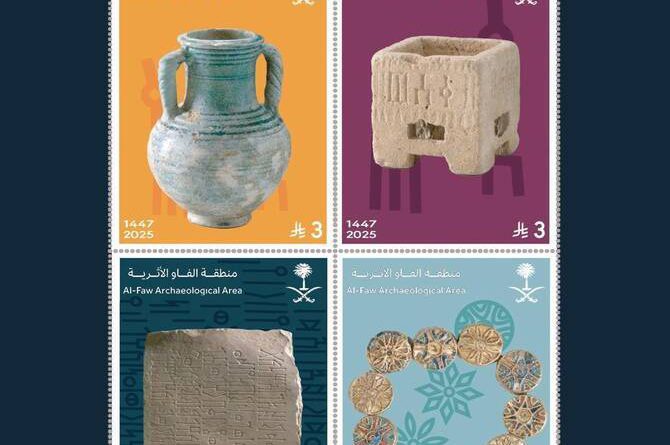
Saudi Post Commemorates Al-Faw’s UNESCO Recognition With Special Stamp
Riyadh – Saudi Arabia has marked a significant cultural milestone with the release of a commemorative postage stamp celebrating the inclusion of the Al-Faw Archaeological Area on the UNESCO World Heritage List.
Issued by Saudi Post, the SR3 stamp reflects national pride in preserving history and honoring a site that represents thousands of years of human settlement and cultural exchange.
Al-Faw’s recognition as the Kingdom’s eighth UNESCO World Heritage Site reinforces Saudi Arabia’s growing global role in safeguarding ancient civilizations and shared human heritage.
Situated south of Riyadh, Al-Faw occupies a strategic location between the vast plains of Wadi Ad-Dawasir and the dramatic Tuwaiq mountain range.
This geographical position placed the site at the heart of historic trade routes linking southern Arabia with central and eastern regions of the peninsula.
For centuries, merchants, travelers, and settlers passed through Al-Faw, contributing to its emergence as a vibrant center of commerce, culture, and social life.
Archaeological evidence shows that the area contains nearly 12,000 remains, revealing a continuous pattern of human habitation spanning more than 6,000 years.
These remains document how successive communities adapted to their environment, managing resources and building settlements that thrived in challenging desert conditions.
Over time, the landscape of Al-Faw was shaped by human interaction with water sources, trade networks, and surrounding natural features.
The site was eventually abandoned around the fifth century AD, largely due to the depletion of water resources that once sustained its population.
Despite this abandonment, Al-Faw has remained remarkably preserved, offering archaeologists and historians invaluable insights into pre-Islamic Arabian societies.
Discoveries at the site span prehistoric periods through the late pre-Islamic era, highlighting the presence of three distinct populations over different eras.
Among the most notable features are paleolithic and neolithic tools, cairns, circular stone constructions, and tapered architectural forms.
The sacred mountain of Khashm Qaryah stands as a spiritual and cultural landmark, complemented by rock carvings that reflect belief systems and artistic expression.
Equally significant is the ancient water management system, which demonstrates advanced knowledge of hydrology and environmental adaptation.
The remains of the city of Qaryat Al-Faw further illustrate urban planning, trade organization, and social structure in ancient Arabia.
By issuing a commemorative stamp, Saudi Post highlights the importance of cultural heritage as part of national identity and global dialogue.
Such stamps serve not only as postal instruments but also as educational artifacts treasured by collectors, researchers, and heritage enthusiasts worldwide.
They capture defining moments in Saudi history, ensuring that achievements in preservation and cultural recognition reach a broad international audience.
Al-Faw now joins other renowned Saudi heritage sites on the UNESCO list, reflecting the Kingdom’s diverse historical landscape.
These include Al-Hijr, At-Turaif in Diriyah, Historic Jeddah, the rock art of Hail, Al-Ahsa Oasis, the Hima Cultural Area, and the Uruq Bani Maarid protected reserve.
Together, these sites tell a powerful story of human creativity, resilience, and continuity across millennia.
The recognition of Al-Faw and its commemoration through a national stamp symbolize Saudi Arabia’s long-term commitment to heritage conservation and cultural diplomacy.
As global interest in archaeology and cultural tourism grows, Al-Faw stands as a bridge between ancient civilizations and contemporary appreciation.
Through thoughtful preservation and international recognition, the Kingdom continues to present its rich past as a source of pride, learning, and inspiration for future generations.