King Abdulaziz Foundation Unveils Rare Photographs from Historic 1916 Basra Visit
Riyadh – The King Abdulaziz Foundation has brought a remarkable chapter of Arabian history back into public view by unveiling rare archival photographs capturing King Abdulaziz’s visit to the outskirts of Basra in 1916, a moment that highlights the early foundations of regional engagement and visionary leadership.
These newly revealed images offer a window into a formative period of King Abdulaziz’s life, when diplomacy, relationship-building, and strategic foresight played a central role in shaping his approach to leadership across the Arabian Peninsula and neighboring regions.
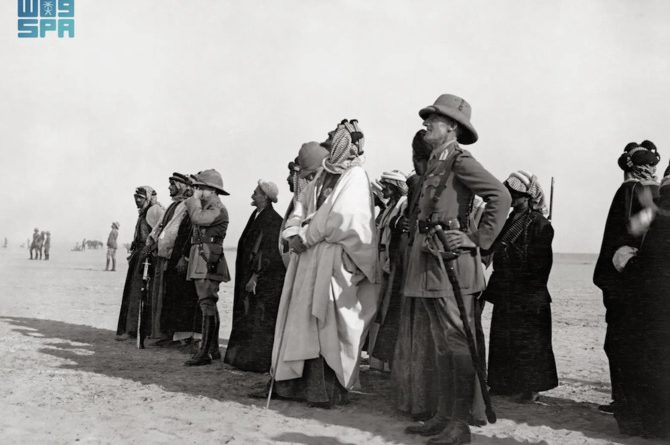
One striking photograph shows King Abdulaziz standing confidently with his companions in the Basra desert, reflecting a leader deeply engaged with his surroundings and committed to forging meaningful connections beyond traditional boundaries.
Captured by British photographer Gertrude Bell, the image is part of a broader historical collection that documents political, cultural, and social transformations across the region during the early twentieth century, a time of profound transition and opportunity.
The Basra visit holds lasting significance as it illustrates how King Abdulaziz prioritized dialogue and cooperation during an era often marked by instability, choosing engagement as a path toward long-term regional understanding.
Rather than seeking influence through confrontation, the visit reflected a forward-looking vision centered on mutual respect, stability, and shared prosperity, values that would later define his enduring legacy as a unifying leader.
Historians view this journey as an early example of King Abdulaziz’s diplomatic instincts, demonstrating how personal engagement and cultural awareness helped establish trust across diverse communities.
The photographs also underscore the importance of Basra as a regional crossroads, where political, economic, and cultural exchanges shaped the broader Middle Eastern landscape during the early 1900s.
By preserving and sharing these images, the King Abdulaziz Foundation continues its mission to safeguard Saudi Arabia’s historical memory while making it accessible to new generations and international audiences.
The archival material offers more than visual documentation, providing insight into leadership built on pragmatism, patience, and openness to collaboration in a rapidly changing world.
Scholars note that King Abdulaziz’s early movements beyond central Arabia played a crucial role in shaping his understanding of regional dynamics, helping him navigate complex political realities with balance and foresight.
The inclusion of Gertrude Bell’s work adds further historical depth, as her extensive documentation remains an invaluable record of the Arabian Peninsula’s evolution during a pivotal era.
Through these photographs, viewers gain a deeper appreciation of how individual encounters and journeys contributed to broader processes of unity, state-building, and regional cooperation.
The Basra images also resonate today, offering timeless lessons on diplomacy and leadership that remain relevant in contemporary discussions about regional dialogue and partnership.
Cultural institutions across the Kingdom increasingly emphasize such historical narratives to highlight Saudi Arabia’s longstanding engagement with its neighbors and its role in promoting stability.
The Foundation’s initiative reflects a growing global interest in archival heritage as a bridge between past and present, allowing history to inform modern perspectives.
As these photographs circulate, they reinforce King Abdulaziz’s image not only as a nation-builder but as a leader guided by wisdom, restraint, and strategic vision.
By shedding light on this early visit, the Foundation contributes to a richer understanding of the historical roots that shaped modern Saudi Arabia’s diplomatic and cultural outlook.