Volkswagen Sets €160 Billion Investment Plan Through 2030 Amid Market Pressures
Automaker prioritizes Europe as shifting global conditions reshape long-term strategy
Volkswagen Group has outlined a new long-term investment plan totaling €160 billion through 2030, signaling a strategic recalibration as the company responds to evolving global market conditions.
The announcement reflects a tightened approach compared with previous cycles, positioning Europe—particularly Germany—as the central focus for future technology, product development, and infrastructure upgrades.
The updated plan is part of the company’s rolling five-year strategy and marks a reduction from earlier budgets, which peaked in 2024 before a period of intensified financial strain.
The automaker’s performance in China and the United States has played a significant role in these adjustments, with both markets presenting new challenges.
Volkswagen, which oversees brands including Audi and Porsche, has been affected by tariffs on vehicles imported into the U.S., creating added cost pressures.
At the same time, heightened competition in China—especially within the electric vehicle sector—has disrupted traditional sales expectations and compressed margins across multiple brands.
These pressures have been most visible at Porsche, whose global sales rely heavily on China and the United States.
The brand recently announced substantial changes to its electric vehicle strategy, reflecting the need for cost discipline and more targeted product planning.
Volkswagen’s leadership emphasized that the new investment focus aims to strengthen operations within Europe, including support for next-generation technology and manufacturing capabilities.
The strategy also includes ongoing discussions about efficiency improvements and expanded savings programs, particularly within Porsche, with deliberations expected to continue into 2026.
As part of the transition, the company is preparing for leadership changes at the top.
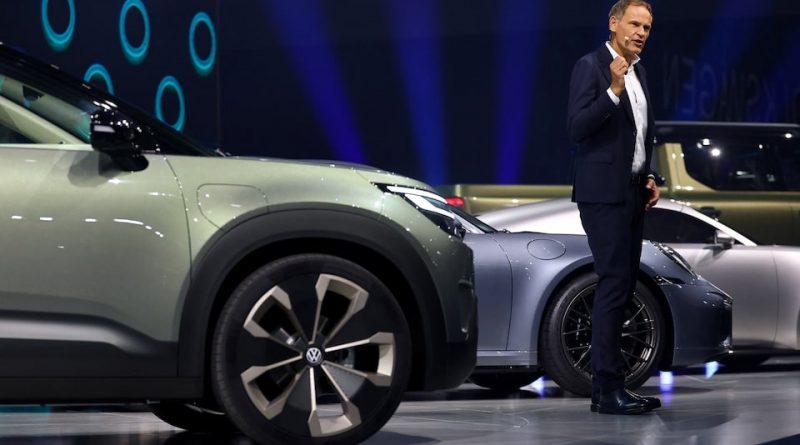
Oliver Blume will step down as Porsche CEO in January, allowing him to concentrate fully on his role as Volkswagen Group CEO during a pivotal transformation period.
Blume has noted that several strategic decisions hinge on broader policy developments, including the consideration of a potential U.S. manufacturing site for Audi.
Such a project would depend heavily on financial incentives or industrial support from Washington, reflecting global shifts in automotive investment patterns.
In China, Porsche does not anticipate major growth in the near term but sees opportunities in expanding localized production through broader Volkswagen Group partnerships.
Blume also suggested that the development of a China-specific Porsche model could be possible in the future should market conditions and consumer tastes align.
The extension of Blume’s contract as Volkswagen Group CEO until 2030 provides continuity as the company navigates its long-term transformation.
The renewed mandate signals support from major stakeholders, including the Porsche and Piech families and the state of Lower Saxony, both highly influential shareholders.
Blume acknowledged that shareholders have faced losses since Porsche’s public listing three years ago, emphasizing his responsibility to address concerns as the group moves forward.
The updated investment plan aims to balance financial stability with innovation, ensuring that Volkswagen remains competitive amid rapid global industry changes.
Overall, the group’s recalibrated €160 billion roadmap highlights a shift toward consolidation, regional prioritization, and strategic evolution.
As the automotive sector adapts to new regulatory, economic, and technological dynamics, Volkswagen is positioning its European operations at the center of its long-term future.