North Korea Pledges Expanded Nuclear Arsenal, Intelligence Role
SEOUL-North Korea said it will strengthen its nuclear arsenal in both scale and capability while significantly expanding the role of its military intelligence agency focused on South Korea, according to state media on Friday, underscoring Pyongyang’s continued emphasis on military preparedness despite renewed reconciliation efforts from Seoul.
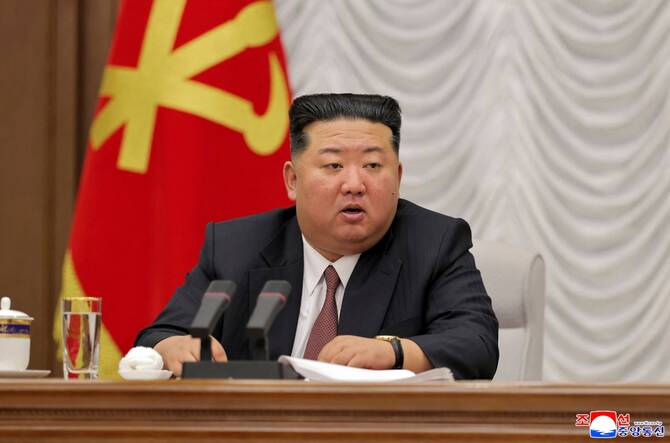
The announcement followed an enlarged meeting of the Central Military Commission of the ruling Workers’ Party of Korea held on Thursday, where senior officials discussed measures aimed at reinforcing the country’s defense posture. The Korean Central News Agency (KCNA) said the meeting approved steps to bolster the country’s nuclear force “both in quality and quantity.”
KCNA also reported that the meeting endorsed a broader mandate for the General Reconnaissance and Intelligence Bureau, North Korea’s military intelligence agency responsible for operations involving South Korea. The agency said the bureau plays a key role in assessing potential threats and collecting strategic intelligence.
According to KCNA, the meeting reviewed plans to significantly strengthen the bureau’s military reconnaissance and intelligence capabilities, reflecting Pyongyang’s stated objective of improving its ability to monitor and respond to perceived security threats.
North Korea remains subject to extensive international sanctions over its nuclear weapons and ballistic missile programs. The Korean Peninsula also remains technically at war because the 1950-53 Korean War ended with an armistice rather than a peace treaty.
Friday’s announcement came after Pyongyang repeatedly rejected conciliatory overtures by South Korean President Lee Jae Myung. North Korea has described the South as its “most hostile” adversary and has declared its status as a nuclear weapons state to be “irreversible.”
Hong Min, a senior researcher at the Korea Institute for National Unification, said the latest decisions reflect North Korea’s evolving policy of treating the two Koreas as separate and hostile states rather than parties operating under the armistice framework.
“Military reconnaissance takes on a different meaning under a state-to-state approach, as intelligence activities targeting another sovereign state can carry diplomatic implications,” Hong told AFP.
Security analysts have previously said North Korea is seeking advanced military technologies, including satellite capabilities, as part of its growing defense cooperation with Russia following the deployment of North Korean troops in support of Moscow’s war in Ukraine.
In 2023, North Korea successfully launched what it described as a military reconnaissance satellite and later claimed it had captured images of key U.S. and South Korean military installations, although independent verification of those claims has been limited.
South Korea’s Unification Ministry said it was closely monitoring developments related to the reported expansion of North Korea’s military intelligence organization.
North Korea has a long history of intelligence operations directed at South Korea. Since the end of the Korean War, its activities have ranged from intelligence gathering to covert operations, including the 1997 assassination of high-profile defector Lee Han-young.
Among the country’s most prominent intelligence operatives was Jeong Su-il, who entered South Korea in 1984 under the identity of Muhammed Kansu, presenting himself as a Filipino-Lebanese academic. After his identity was uncovered, he served prison terms in South Korea before later pursuing a career as a historian specializing in the Silk Road and the history of West Asia.