
Kanishka at 41: 329 Dead, but the Khalistani Extremist Network Still Lives

Once the record appears unknowable, the accused become victims and the mastermind a martyr.
On June 23, federal flags were lowered, wreaths were laid and Canada again promised never to forget Air India Flight 182.
Then Canada returned to forgetting.
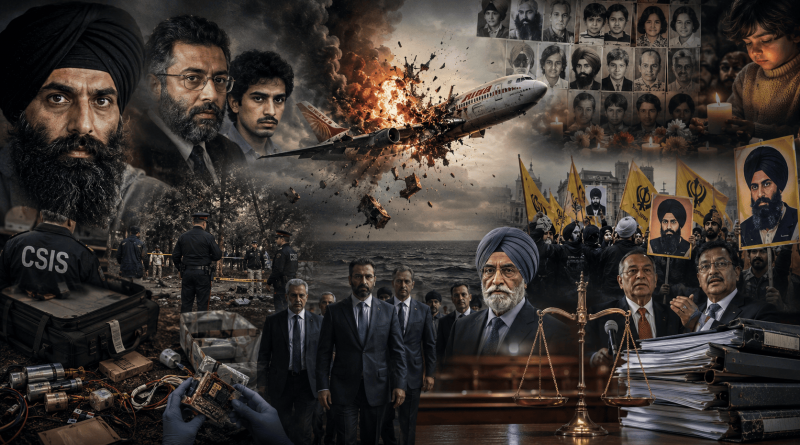
Forty-one years ago, a bomb destroyed Air India Flight 182, Kanishka, over the Atlantic, killing all 329 aboard, including 82 children. Fifty-five minutes earlier, another bomb from the same plot exploded at Tokyo’s Narita Airport, killing two baggage handlers.
It is Canada’s deadliest terrorist attack. A June 2025 Angus Reid Institute survey found that only 17 per cent of Canadians could identify it, 32 per cent had never heard of it and 51 per cent believed it had never truly been treated as a Canadian tragedy.
That ignorance matters. Canada’s failure began with ignored warnings, deepened when evidence and witnesses were lost, and hardened when uncertainty allowed the plot’s leaders to be remade as martyrs.
Babbar Khalsa had operated in Canada since the early 1980s. Its leader, Talwinder Singh Parmar, was wanted in India and known to Canadian agencies. On June 4, 1985, CSIS officers surveilling him followed Parmar and Inderjit Singh Reyat into woods near Duncan, British Columbia, heard an explosion, recorded it as a possible gunshot and ended surveillance.
It was one of many warnings that were ignored. Informants reported plans involving two bombs and two aircraft. Air India warned about time-delay devices hidden in checked baggage. Authorities had classified warnings that weekend’s flight.
Still, a man using the name ‘M. Singh’ checked a bag in Vancouver and did not board.
His bag did.
The bombing was preventable. Authorities were monitoring suspects, heard the bomb test and knew extra precautions were needed. Had the intelligence been connected, the suspects properly investigated or unaccompanied baggage stopped, Kanishka could have been prevented.
Instead, 329 people were blown out of the sky.
The plot reflected a Khalistani network. Parmar led Babbar Khalsa. Ajaib Singh Bagri was associated with it. Reyat, the bomb-maker, was linked to the International Sikh Youth Federation (ISYF). The Crown alleged that Ripudaman Singh Malik helped finance the plot, although he and Bagri were acquitted.
Members of both organizations were implicated. Yet Canada waited nearly eighteen years, until 2003, to list Babbar Khalsa International and the ISYF as terrorist entities. Meanwhile, their networks kept operating and building influence in Canada.
After 329 people were murdered in a plot organized largely on Canadian soil, it took a foreign tragedy (9/11), for Canada to create machinery to list and isolate terrorist organizations.
Why did Kanishka not create the urgency to disrupt financing, restrict organizational reach and deny legitimacy to those networks?
Failure continued afterward. Japan preserved evidence from Narita, traced about 1,500 bomb components to Reyat’s bombs and helped secure his 1991 manslaughter conviction for killing two baggage handlers.
In Canada, CSIS estimated that about 210 surveillance tapes were recorded during the critical period; only 54 survived. Most were erased and replaced by summaries. Intelligence was not properly shared between CSIS and the RCMP. Witnesses faced threats, violence and death.
On January 26, 1986, an explosive device was found outside Tara Singh Hayer’s newspaper office. In 1988, he survived an assassination attempt that left him disabled. He continued exposing Khalistani violence and was a key witness but he was murdered in 1998, before the trial.
Reyat later pleaded guilty to manslaughter for helping construct the Flight 182 bomb and was convicted of perjury. Even after admitting his role, he named no one. His silence protected the plot and denied families the full truth.
Malik and Bagri were acquitted because the Crown could not prove its case beyond a reasonable doubt. The judge found serious credibility problems in prosecution testimony and witnesses. That conclusion must be respected but not separated from the fear surrounding witnesses.
The acquittals did not erase the conspiracy or findings on Parmar. The trial judge identified him as the mastermind; the Air India inquiry agreed. No one was convicted of murder for the 329 deaths; Reyat pleaded guilty to manslaughter.
Compromised justice created uncertainty. Uncertainty created mythology.
Kanishka was recasted as an Indian tragedy even though the plot was organized in Canada by Canadians, the bomb entered the aviation system here, most victims were Canadian and the principal failures were Canadian. Parmar’s responsibility was blurred; supporters presented his death before trial as exoneration.
Once the record appears unknowable, the accused become victims and the mastermind a martyr.
Parmar’s image continues to appear at Khalistan-related events in Canada, often labelled ‘Shaheed’. Bhindranwale, Hardeep Singh Nijjar and other figures associated with violence are similarly presented as heroes. Recent events in Brampton and Calgary displayed Khalistan flags alongside their portraits; some included graphic assassination imagery and depictions of children holding explosive devices. Khalistan activists were also present at this year’s Air India Flight 182 memorial at Queen’s Park.
This mythology sustains the Khalistani extremist movement.
If Parmar is accepted as leader of the Air India conspiracy, the movement must confront the murder of 329 innocent people, including 82 children. Recast him as a victim, martyr or man denied justice, and the burden shifts: the movement no longer answers for terrorism; it claims persecution.
Victimhood becomes political armour: violent actors become oppressed dissidents, criminal investigations become state repression, and grievance fuels organizing, fundraising and recruitment.
This mythology keeps the movement alive. By disputing the historical record and portraying identified perpetrators as victims, the movement avoids answering for the violence committed in its name. Without that victim narrative, it would have to confront the murder of 329 innocent people.
Journalist Terry Glavin reported on Khalistani militancy and the intimidation of Sikh opponents, way before the 1985 bombings. Former British Columbia premier Ujjal Dosanjh was severely beaten after denouncing Khalistani violence. Journalist Balraj Deol survived a violent attack. Hayer was shot, paralyzed and murdered.
Many Sikhs rejected Khalistani violence and paid heavily for opposing self-appointed spokesmen. This is not an indictment of Sikhs or Sikhism, but of a small, organized Khalistani extremist network that used fear to exaggerate its legitimacy.
That network gained political access. Politicians attend events where Parmar and other violent figures are displayed. Attendance alone does not prove endorsement of every banner. But leaders cannot seek the stage, applause and votes while refusing to confront the glorification around them.
Supporters may insist they target only the Indian state. But when suicide bombers and political assassins are celebrated and violent imagery normalized, authorities cannot assume only Hindus, Indo-Canadians, moderate Sikhs or known critics are at risk.
The CSIS Public Report 2025 says Canada-based Khalistani extremists continue to threaten Canada and Canadian interests, with some using Canadian institutions to advance extremist agendas and raise funds that may later support violence.
Canada improved airport security and intelligence sharing, but never learned to delegitimize, disrupt or politically isolate the Khalistani extremist network behind the attack.
Such networks weaken when financing is disrupted, intimidation prosecuted, deterrence is set, violent icons denied legitimacy and history taught honestly.
Kanishka did not end in 1985. Canada could have prevented the bombing, then failed to preserve crucial evidence, protect witnesses and secure full justice. Those failures allowed plot leaders to become martyrs, critics to be silenced and Khalistani violence to gain political legitimacy.
Today, CSIS warns Canada again.
Canada secured the aircraft.
It never confronted the Khalistani extremist network.
Disclaimer: Views expressed by writers in this section are their own and do not reflect Milli Chronicle’s point-of-view.
