OPINION: The Nijjar Canada Honoured and the Record It Ignored

Canadians were entitled to question India’s evidence and procedures. They were not entitled to pretend that no substantial record existed.
Canada has a remarkable ability to turn a complicated record into a clean symbol.
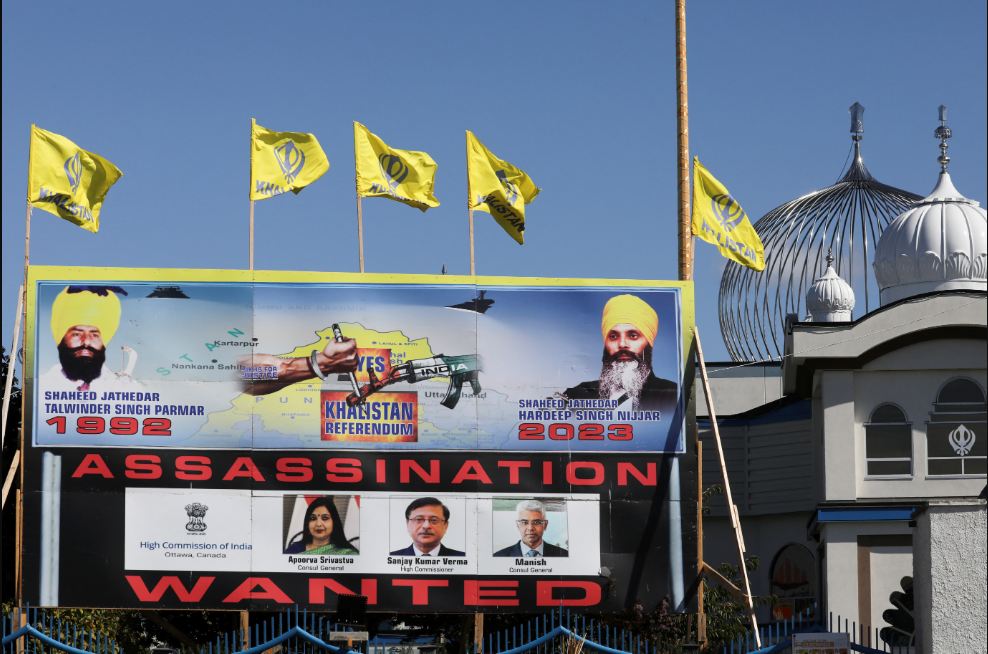
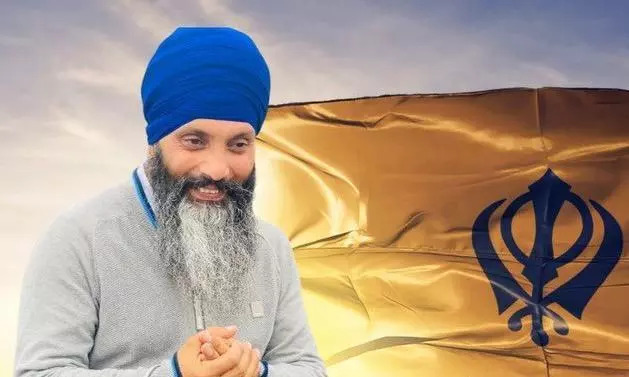
In June 2024, the House of Commons observed a moment of silence ‘in memory of Hardeep Singh Nijjar’, one year after he was shot dead outside the Guru Nanak Sikh Gurdwara in Surrey.
His killing on Canadian soil demanded investigation, accountability and justice. But remembrance should not require amnesia. If Parliament chose to honour Nijjar, Canadians were entitled to know the full record, not only the version constructed after his death.
Being Canadian is more than possessing a passport. Citizenship establishes legal status; it does not erase conduct or automatically certify civic virtue.
Nijjar’s Canadian story began in February 1997 when, according to Global News, he arrived at Pearson Airport using a fraudulent passport under the name ‘Ravi Sharma’. His refugee claim was rejected after adjudicators questioned parts of his account and documentation.
Eleven days later, he married a British Columbia woman who sponsored him. Immigration authorities rejected the application as a marriage of convenience. He appealed and lost in 2001. Nijjar eventually became a Canadian citizen on May 25, 2007, a date later confirmed publicly by then-immigration minister Marc Miller.
His citizenship was valid. The path preceding it remained relevant when politicians later presented him as an uncomplicated Canadian community leader.
So did his public conduct.
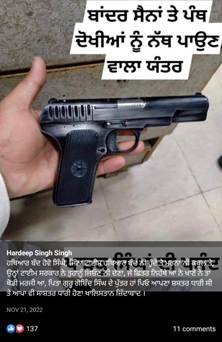
On Facebook, Nijjar posted an image of a revolver described as the ‘choice of a militant Sikh’. The accompanying text referred to keeping the ‘monkey-army’, a slur aimed at Hindus and ‘enemies of religion’ under control.
Video footage also shows Nijjar and supporters blocking access to Indian diplomatic premises in Canada.
In a recorded Sikh Temple speech, he praised the assassinations of Indian prime minister Indira Gandhi and former army chief General A.S. Vaidya as acts of militant martyrdom.
Celebrating political assassinations from a religious platform is not peaceful civic leadership. Displaying a firearm alongside dehumanizing language about another community is not pluralism.
When questions arose about Nijjar’s immigration history, Moninder Singh Baul of the BC Gurdwaras Council argued in a circulated video that Canadians had no standing to scrutinize his fraudulent passport or rejected refugee claim because ‘white Canadians came raping and pillaging’.
That did not answer the record. It attempted to place it beyond discussion.
Nijjar’s admirers also situated him within a militant lineage. A May 2024 profile published by the tribute site 1984tribute described him as ‘privileged’ to have developed close relations with Gurdeep Singh Deepa and others connected to the Khalistan Commando Force. It also stated that Jagtar Singh Tara later appointed him leader of the Khalistan Tiger Force.
These were not accusations written by Nijjar’s opponents. They were claims presented approvingly by supporters.
Tara was convicted for his role in the 1995 assassination of Punjab chief minister Beant Singh, the equivalent of a provincial premier in Canada. Describing proximity to such figures as a privilege is difficult to reconcile with the peaceful community-leader portrait later promoted here.
India designated Nijjar an individual terrorist under the Unlawful Activities (Prevention) Act in July 2020. In July 2022, India’s National Investigation Agency announced a reward for information leading to his arrest in a case alleging conspiracy connected to the attempted killing of a Hindu priest in Punjab.
These were Indian allegations and legal designations, not Canadian convictions. Canadians were entitled to question India’s evidence and procedures. They were not entitled to pretend that no substantial record existed.
That record was publicly available. Canadian and international media reported Nijjar’s immigration history, India’s terrorism designation, alleged militant associations, reported no-fly restrictions and criminal allegations. Those reports did not independently prove India’s case. They treated the background as relevant context.
Canadian politicians had access to the same record.
At least 21 MPs from the Liberals, Conservatives, NDP and Bloc Québécois sponsored or seconded Motion M-112, which cited Nijjar’s killing while addressing foreign interference, violence and intimidation.
Defending Canadian sovereignty and demanding accountability for a killing on Canadian soil were entirely proper. Neither required Parliament to empty Nijjar’s life of complexity.
When Justin Trudeau rose in the House of Commons in September 2023, he said Canadian agencies were pursuing ‘credible allegations of a potential link’ between agents of the Indian government and Nijjar’s killing. The language was qualified, but the consequences were immediate. Canada publicly accused another democracy before the underlying evidence had been disclosed or tested in court, damaging a relationship involving trade, security, immigration and millions of people connected to both countries.
Four men were later charged with first-degree murder and conspiracy. Reports linked some of the accused to the Bishnoi criminal network. That connection was folded into Canada’s claim that organized crime may have been used as a proxy for foreign interference.
But another possibility has never received equal public scrutiny.
Sources familiar with the circumstances of the case have privately raised the possibility that Nijjar’s death arose from gang-related violence and criminal rivalries rather than a foreign-government operation. That account has not been established in court and cannot yet be treated as proven. But neither has the claim that the Indian government ordered his murder.
The public has not seen the evidence underlying Trudeau’s accusation. No Canadian court has determined the motive for Nijjar’s killing, and no judicial finding has established that India directed it.
That unresolved gap matters. An allegation presented by a prime minister carries enormous political and diplomatic weight, even when the evidence remains secret. Once repeated often enough, a theory can harden into accepted fact before a court has examined it.
Canada maybe eventually proves foreign-state involvement. However, it may also emerge that criminal motives, personal disputes or gang rivalries were at play. Until the evidence is tested, responsible journalism and political leadership require both possibilities to remain open.
Instead, Canada settled quickly on a simplified narrative: Nijjar as a peaceful community leader killed through foreign interference, while his immigration history, militant rhetoric, criminal-network questions and alleged associations remained outside the national conversation.
That narrative reassured a politically organized pro-Khalistan constituency but left Canadians with an incomplete account of both the victim and the investigation. It also exposed Canada to the charge that domestic political considerations shaped the story before the evidence had been tested.
None of this excuses Nijjar’s killing. His death demanded a lawful investigation, and anyone responsible should be prosecuted regardless of his politics, beliefs or history.
But justice after death does not require a politically convenient biography. Nor should undisclosed intelligence be converted into a settled national narrative while credible alternative explanations remain unresolved.
Canada was right to investigate the killing.
It was not required to sanitize the person it chose to honour or ask Canadians to treat one unproven theory as a verdict.
Disclaimer: Views expressed by writers in this section are their own and do not reflect Milli Chronicle’s point-of-view.