Iran Guard General Reappears Before Khamenei’s State Funeral
DUBAI-A senior commander of Iran’s Islamic Revolutionary Guard Corps made his first public appearance in months as Tehran finalized preparations for the state funeral of late Supreme Leader Ayatollah Ali Khamenei, signaling the continued prominence of Iran’s security establishment during a sensitive political transition following the recent war with the United States and Israel.
Photographs released by Iranian state media on Friday showed Gen. Ahmad Vahidi attending meetings related to Khamenei’s funeral before appearing beside the late leader’s coffin during a smaller memorial service held Thursday night near Khamenei’s former residence in central Tehran.
Vahidi had not been seen publicly since Feb. 8, several weeks before the conflict began. His reappearance comes as Iran prepares for days of official mourning and ceremonies expected to attract millions of mourners and delegations from abroad.
Analysts say Vahidi has assumed an influential role in shaping Iran’s position during discussions over a possible permanent end to hostilities with the United States. They believe he is among a small group of senior officials maintaining direct contact with Iran’s new Supreme Leader, Ayatollah Mojtaba Khamenei.
According to reports cited by the Associated Press, Mojtaba Khamenei has remained out of public view since reportedly being wounded in Israeli strikes on Feb. 28 that killed his father, Ayatollah Ali Khamenei. Iranian authorities have not publicly detailed his movements since assuming the country’s highest leadership position.
Video released by Iranian state media showed mourners gathering near the husseiniyah within Khamenei’s compound in Tehran, where a memorial ceremony took place before the public funeral. State media said Khamenei’s coffin rested on a raised platform decorated with rows of red tulips, while white paper butterflies were suspended overhead as part of the ceremonial display.
Those attending, dressed predominantly in black, were identified by state media as relatives of people killed during the 12-day war in 2025 and the recent Iran conflict. Participants were seen passing scarves and other personal items to attendants to touch against the coffin, a practice observed by some Shiite mourners as an expression of reverence.
Later images showed Khamenei’s coffin draped with a red flag bearing the inscription “Ya Hussein,” a phrase associated with the seventh-century martyrdom of Imam Hussein, the grandson of the Prophet Muhammad. According to Iranian media, the flag had previously flown above the Imam Hussein shrine in Karbala, Iraq. In Shiite tradition, the red banner symbolizes the blood of one considered unjustly killed and serves as a call for justice and remembrance.
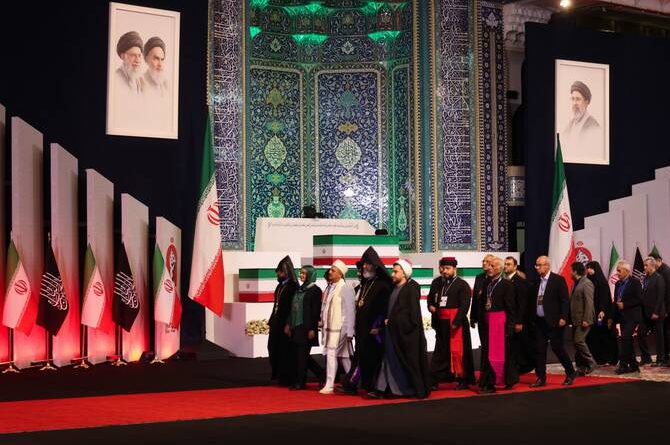
On Friday morning, security personnel carried Khamenei’s coffin by hand into Tehran’s Grand Mosalla, where it will lie in state before public funeral ceremonies begin. Religious leaders and senior officials paid their respects as they passed the coffins of Khamenei and several members of his family killed in the strikes, including his 14-month-old granddaughter, Zahra Mohammadi Golpayegani.
Beginning Saturday, Iran will launch a series of funeral events spanning several days. After ceremonies in Tehran, Khamenei’s coffin is scheduled to travel to cities in Iran and neighboring Iraq before burial.
Authorities have imposed extensive security and logistical measures for the ceremonies, including road closures, restrictions on movement in central Tehran and temporary airspace controls, as the government prepares for one of the largest public gatherings in the Islamic Republic’s history.
The funeral takes place at a time of heightened regional uncertainty, with Iranian leaders seeking to consolidate authority at home while navigating negotiations over the future of the ceasefire that followed the recent conflict.