Trump Hails Progress as US-Iran Qatar Talks End
DOHA-Indirect negotiations between the United States and Iran concluded in Qatar on Wednesday with both sides agreeing to establish a communication channel to monitor and record alleged violations of their preliminary agreement, as President Donald Trump described the talks as productive despite continued tensions following recent military exchanges.
Iran’s Deputy Foreign Minister Kazem Gharibabadi, who headed Tehran’s delegation, said the discussions ended with an agreement to create the communication mechanism by Thursday. The channel is intended to document and report breaches of the memorandum of understanding reached last month as the two sides work toward implementing its provisions.
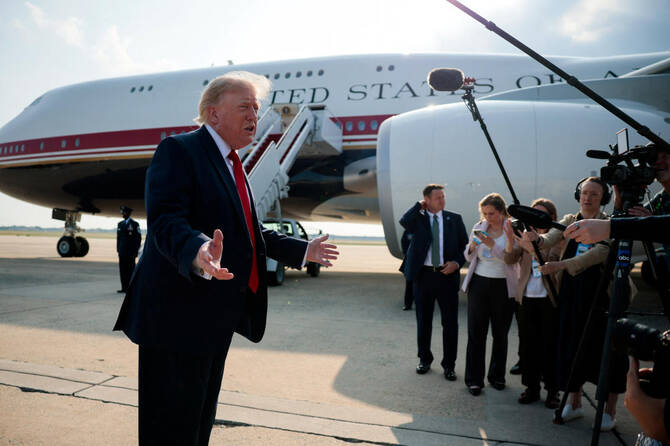
Speaking to reporters before boarding Air Force One, Trump said progress was being made in the negotiations and expressed optimism about efforts related to Iran’s nuclear program.
“As far as things are going, the denuclearization of Iran is moving along well,” Trump said. Referring to recent military action, he added that although the United States had struck Iran hard, relations in the negotiations were progressing positively.
Iran maintained that the discussions in Doha remained indirect. Foreign Ministry spokesman Esmaeil Baqaei rejected earlier suggestions that direct negotiations would take place, saying Tehran had no plans to hold direct talks with U.S. officials at any level in the coming days.
According to Gharibabadi, negotiators also discussed Iranian assets frozen abroad, an issue Tehran has consistently linked to any broader settlement. He said officials reviewed the use of part of an initial $6 billion and agreed that essential goods required by Iran would be purchased and made available.
A diplomat familiar with the negotiations told AFP that the technical discussions were designed to advance implementation of the memorandum of understanding reached during last month’s summit in Lucerne, Switzerland. The agreement, mediated by Qatar and Pakistan, established a 60-day ceasefire, called for reopening the Strait of Hormuz and outlined a timetable for negotiations covering both the conflict and Iran’s nuclear program.
The diplomat said U.S. envoys Jared Kushner and Steve Witkoff did not participate in the technical talks. Both officials instead met Qatar’s Prime Minister Sheikh Mohammed bin Abdulrahman Al-Thani on Tuesday to discuss the negotiations and regional developments, including the situation in Lebanon, according to Qatar’s Foreign Ministry.
The office of Qatar’s Emir, Sheikh Tamim bin Hamad Al Thani, said Kushner and Witkoff also met the ruler on Wednesday as diplomatic efforts continued.
Anna Jacobs, a non-resident fellow at the Arab Gulf States Institute, said the negotiations remained at an early stage but described the continuation of dialogue as a positive sign following recent hostilities.
She said the fact that both sides continued engaging after clashes in the Gulf suggested efforts to preserve the diplomatic process despite disagreements.
Implementation of the ceasefire has faced early challenges. Since the memorandum was signed, Iran and the United States have exchanged military strikes in the Gulf. Tehran targeted a commercial vessel it said had deviated from an approved route through the Strait of Hormuz, while U.S. Central Command said it subsequently struck 10 Iranian military targets.
Iran later launched strikes against U.S. military bases in Kuwait and Bahrain, actions that drew condemnation from both Gulf states.
Iran’s chief negotiator, Mohammad Bagher Ghalibaf, said earlier this week that implementation difficulties were inevitable following a conflict of such magnitude, particularly given what he described as the involvement of Israel. He said Tehran’s delegation in Doha would prioritize implementation of provisions related to the Strait of Hormuz and the conflict in Lebanon.
Recent days have seen a decline in exchanges of fire, while oil prices eased as markets responded positively to the continuation of diplomatic engagement between Washington and Tehran. Fighting between Israel and the Iran-backed Hezbollah movement has also remained relatively subdued, although Tehran continues to insist that any final agreement must include an end to the conflict in Lebanon and the withdrawal of Israeli forces from occupied areas in southern Lebanon.