
Shakespeare’s Globe Blends Flamenco With ‘Love’s Labour’s Lost’ in New Stage Production
“The play is about passion, love and death, and flamenco expresses those themes with remarkable intensity,” director Indiana Lown-Collins said.
Shakespeare’s Globe is presenting a new production of William Shakespeare’s Love’s Labour’s Lost that combines the playwright’s language with the rhythms and movement of flamenco, as director Indiana Lown-Collins seeks to reinterpret one of Shakespeare’s earliest comedies through a distinctly Spanish artistic tradition.
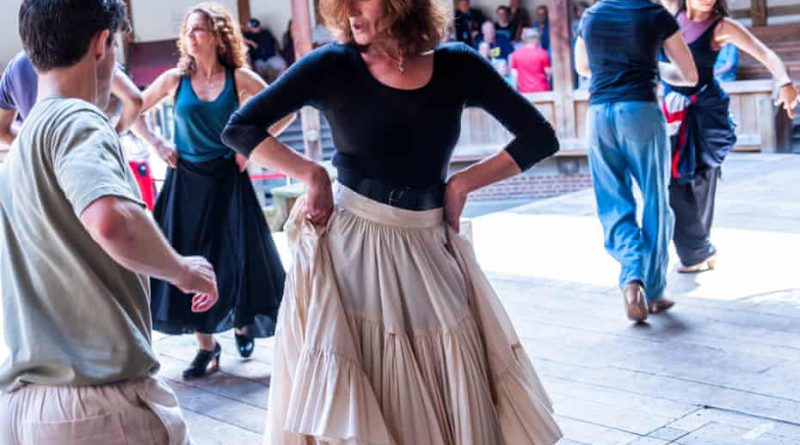
Rehearsals at the Globe have brought together actors, flamenco musicians and dancers, with live guitar, singing and percussive footwork forming an integral part of the production rather than serving as background accompaniment.
Lown-Collins, who is half-Spanish and spent part of her childhood in Spain, said flamenco provided her introduction to the performing arts. During her earlier role as resident associate director at Shakespeare’s Globe, she became convinced that the theatre’s open-air architecture and oak stage would complement the sound and energy of the traditional Spanish art form.
“I just knew it would sound incredible,” she said, referring to the Globe’s acoustics.
When invited to direct a production at the theatre, Lown-Collins searched for a Shakespeare play that could naturally accommodate flamenco’s themes and emotional intensity. She selected Love’s Labour’s Lost, a comedy centred on a King of Navarre and his companions, who vow to avoid the company of women before their resolve is challenged by the arrival of a visiting princess and her attendants.
According to the director, the play’s exploration of love, desire and mortality aligns closely with the emotional vocabulary traditionally associated with flamenco.
“A lot of this play is about passion, love, sex and death – and flamenco does sex and death really well,” she said.
The production also uses flamenco rhythm to support Shakespeare’s language. Lown-Collins noted that Love’s Labour’s Lost contains an unusually high number of rhyming couplets, creating opportunities for actors to connect spoken dialogue with musical patterns.
She said members of the cast began experimenting with delivering sections of dialogue according to flamenco rhythms rather than relying solely on conventional Shakespearean speech patterns, an approach she said proved effective during rehearsals.
The score has been composed by flamenco guitarists Michael McMahon and Adrián Solá, who also perform on stage as part of the production. They are joined by additional musicians, including singer Carlos Lobo Cordón.
Widely regarded as one of Shakespeare’s most linguistically complex works, Love’s Labour’s Lost is often recognised for its elaborate wordplay and rhetorical style.
Lown-Collins said combining the text with a physically expressive performance style was intended to balance intellectual engagement with movement and emotion.
“It is a very wordy play,” she said. “What if you put something that is extremely visceral and physical alongside it?”
The production also extends that physical engagement to audiences. At the conclusion of the performance, spectators will be invited to participate in the traditional celebratory finale, with Lown-Collins expressing hope that the atmosphere created by the music and movement will encourage audience members to join in.
Love’s Labour’s Lost will run at Shakespeare’s Globe in London from July 17 until September 13.