
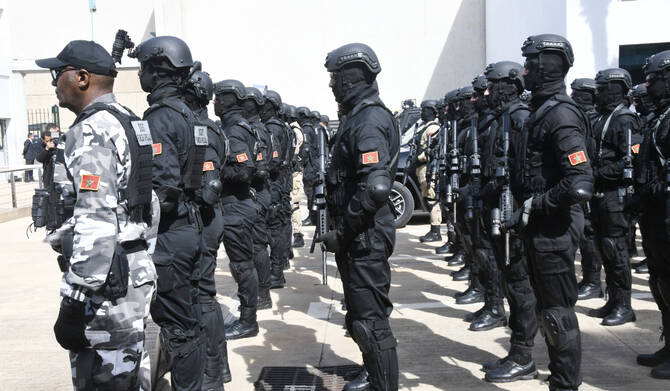
Moroccan officers join Gaza stabilization force as ceasefire efforts stall
Jerusalem-A Moroccan military contingent has arrived in Israel to join the International Stabilization Force (ISF) being assembled for deployment in Gaza, marking the first publicly confirmed participation by an Arab country in the multinational initiative linked to post-war security arrangements in the Palestinian territory.
The arrival of the Moroccan personnel was confirmed on Tuesday by the Board of Peace established under U.S. President Donald Trump’s administration. A source familiar with the deployment said the officers reached the ISF headquarters in southern Israel on June 18 and would assist in developing the force’s organizational structure while providing expertise in policing and security operations.
The official, speaking on condition of anonymity, confirmed that four Moroccan officers were part of the contingent but did not disclose whether additional personnel had also been deployed.
Morocco announced in February that it would contribute police and military personnel to the planned force, becoming the first Arab state to publicly commit troops to the initiative.
The deployment forms part of the second phase of a Gaza framework announced by Washington in January and later endorsed by the United Nations Security Council. The plan aims to transition the Gaza Strip from active conflict toward a longer-term security and governance arrangement following the war triggered by Hamas’ October 7, 2023 attack on Israel.
Under the framework, Israel would gradually withdraw forces from parts of Gaza, Hamas would be disarmed, and an international stabilization mission would be deployed to support security and reconstruction efforts.
Despite diplomatic backing, implementation has progressed slowly. While the ceasefire that entered into force in October has largely prevented a return to full-scale warfare, negotiations over a permanent settlement remain stalled.
The proposed stabilization force has been discussed repeatedly by international mediators but has yet to become operational inside Gaza.
Hamas stated in February that it could accept the presence of an international force provided it did not interfere in the territory’s internal affairs. The group has governed Gaza since seizing control of the enclave in 2007.
Israeli officials say their forces currently maintain control over approximately 70 percent of the Gaza Strip, up from slightly more than half immediately after the initial troop redeployments conducted under the ceasefire arrangements.
The truce has remained fragile, with both Israel and Hamas regularly accusing each other of violations while international mediators continue efforts to secure a broader political agreement.
According to Gaza’s health ministry, more than 1,000 Palestinians have been killed since the ceasefire took effect. The United Nations has previously cited the ministry’s casualty data as generally reliable for monitoring conflict-related fatalities.
The Israeli military has reported the deaths of five soldiers during the same period.
The arrival of Moroccan personnel represents a tangible step toward establishing the multinational security mission envisioned under the ceasefire framework, even as political and security obstacles continue to delay its full deployment inside Gaza.