
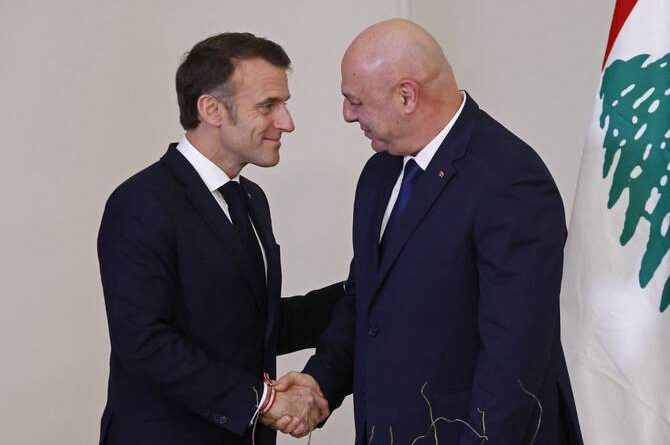
Macron, Aoun Weigh Post-UNIFIL Security Framework as Lebanon Prepares for Peacekeeping Transition
Beirut– Lebanese President Joseph Aoun and French President Emmanuel Macron have begun discussions on a potential international security framework for southern Lebanon after the anticipated conclusion of the United Nations peacekeeping mission in the area, reflecting growing diplomatic efforts to prevent a security vacuum along the Israeli-Lebanese border.
The talks come as the mandate of the United Nations Interim Force in Lebanon (UNIFIL), which has monitored the frontier region for decades, is expected to wind down by the end of 2026. Several European governments have reportedly expressed support for exploring alternative arrangements to maintain stability in southern Lebanon following the mission’s departure.
According to the Lebanese Presidency, Macron and Aoun discussed possible international participation in a post-UNIFIL security mechanism during a telephone conversation. The French leader indicated he would consult partner nations regarding their willingness to contribute to any future multinational presence.
“President Macron indicated that he would conduct outreach to a number of countries to determine their stance on this step,” the Lebanese Presidency said, noting that preparations would be necessary before UNIFIL’s expected withdrawal process begins in early 2027.
UNIFIL was first deployed in 1978 and was significantly expanded following the 2006 conflict between Israel and Hezbollah under United Nations Security Council Resolution 1701. The mission has since served as a key stabilizing force along the Blue Line, the UN-demarcated boundary separating Lebanon and Israel.
Diplomatic discussions have increasingly focused on how to preserve security coordination and monitoring mechanisms once the current peacekeeping framework concludes. A French proposal under consideration reportedly includes military and civilian options, as well as an alternative delegation structure involving European partners.
According to Lebanese officials, preliminary concepts envision an international force ranging from approximately 2,000 to 5,500 personnel. No final decision has been announced, and consultations among participating countries remain at an early stage.
European nations form the backbone of the current UNIFIL mission. Countries including France, Italy, Spain, Ireland, Germany, Finland, Austria and Greece contribute substantial numbers of peacekeepers and logistical support.
The two leaders also discussed developments in Lebanese-Syrian relations and ongoing coordination between Beirut and Damascus.
Aoun welcomed recent remarks by Syrian President Ahmed Al-Sharaa affirming Syria’s commitment to Lebanon’s sovereignty, independence and territorial integrity. According to the Lebanese Presidency, Al-Sharaa reiterated that Syria does not intend to intervene militarily in Lebanon and that any future Syrian role would be conducted exclusively through official Lebanese state institutions.
The discussions highlight broader regional concerns over maintaining security arrangements in southern Lebanon at a time of continued geopolitical uncertainty and ongoing efforts to strengthen state authority along the country’s southern frontier.