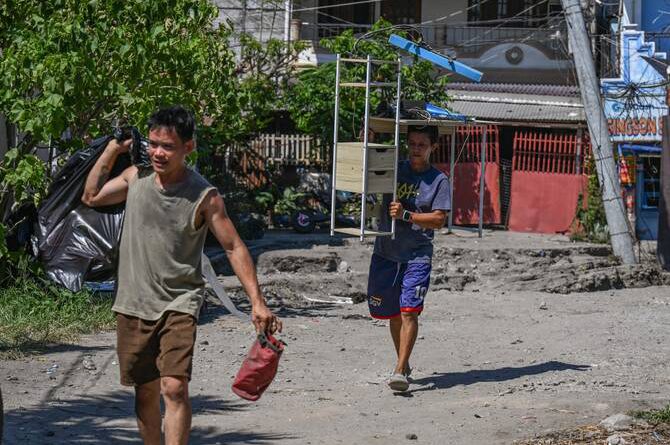
Hunger Threat Deepens as Quake Cuts Off Philippine Villages
General Santos-Authorities in the southern Philippines appealed for the immediate deployment of military helicopters on Thursday to deliver food and emergency supplies to landslide-isolated communities after a powerful earthquake left tens of thousands displaced and disrupted access to remote villages.
The request came three days after a magnitude 7.8 offshore earthquake struck near the southern province of Sarangani, killing at least 47 people, injuring 688 and leaving 31 others missing, according to disaster management officials.
More than 45,000 residents remained displaced, with roughly half staying in emergency shelters, after the quake damaged more than 12,600 homes across farming towns and urban centers in the affected region. Provincial authorities said many residents were reluctant to return home because of continuing aftershocks.
The hardest-hit province was Sarangani, where 20 fatalities were reported, most linked to a landslide that buried homes in the coastal municipality of Glan, according to the Office of Civil Defense.
Glan Mayor Victor James Yap said 10 of the town’s 31 villages remained inaccessible, largely due to landslides that blocked roads and cut off transport links. The municipality, home to more than 100,000 residents, continued to face severe logistical challenges in distributing aid.
“We need food and water but it’s difficult to transport them to some of our villages which remain isolated,” Yap told DZMM radio, urging the government to deploy air force helicopters to reach communities cut off from ground access.
Yap said a major road leading into the town had reopened, allowing fuel deliveries to resume as early as Thursday. However, electricity had yet to be restored and cellular communication services remained unreliable across parts of the municipality.
Most earthquake-related deaths were caused by collapsing structures, falling debris and landslides in Sarangani, General Santos City and the neighboring provinces of South Cotabato and Davao Occidental.
The disaster also triggered coastal hazards. Two swimmers drowned and another remained missing after being swept out to sea near General Santos shortly after the quake.
Authorities recorded waves reaching up to 1.4 meters above normal tide levels in parts of the southern Philippines, while smaller sea surges were detected in Indonesia, Palau and southern Japan.
The earthquake ranks among the strongest to strike the Philippines in the last five decades. It follows the magnitude 8.1 earthquake and tsunami of August 1976, one of the country’s deadliest natural disasters, which killed about 8,000 people.
The Philippines lies along the Pacific Ring of Fire, a seismically active zone where frequent earthquakes and volcanic eruptions occur due to the movement of major tectonic plates.