Guardian of the Desert Library: Mauritania’s Ancient Manuscripts Fight Time, Sand and Silence
“A civilisation survives not only in its monuments, but in the fragile pages someone chooses to protect.”
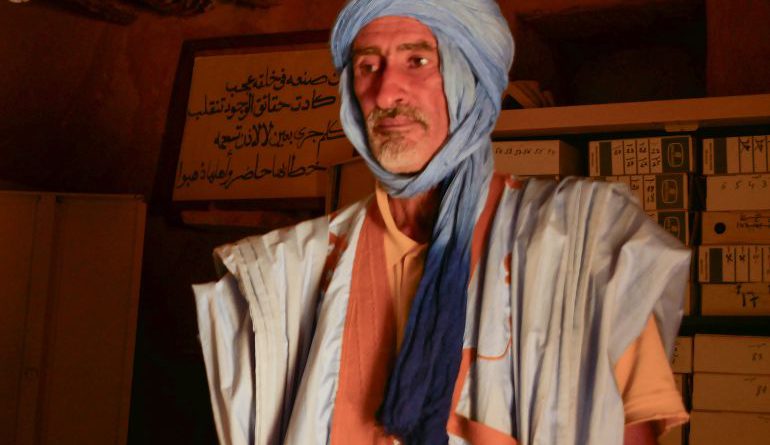
In the fading desert town of Chinguetti, where centuries-old stone alleys lead to libraries older than many modern states, Muhammad Gholam el-Habot spends his days preserving a fragile inheritance: rare Islamic manuscripts passed down through generations of his family.
Inside his cool, high-ceilinged library lined with steel bookshelves, el-Habot carefully pulls on white gloves before opening a thick Arabic manuscript. He turns its brittle brown pages slowly, inspecting them for damage before closing the volume, pressing his fingers gently across its worn leather cover, and placing it into a protective white box.
For the 50-year-old librarian, these books are more than historical objects. They are a sacred trust.“My relationship with them is like that of a father and his son,” el-Habot told Al Jazeera from his family’s library in Chinguetti, a medieval ksar, or fortified desert town, in Mauritania’s northern Adrar region. “We must protect them until God takes the land and all the people who are on the land.”
The el-Habot family library is among the few remaining private manuscript libraries still operating in Chinguetti, once one of the most important centres of Islamic scholarship and trans-Saharan commerce between the 13th and 17th centuries.
Today, much of the town stands abandoned as residents have gradually moved to larger cities in search of education, employment, and modern services.At its height, Chinguetti served as a major intellectual and commercial crossroads linking the Sahel with the Maghreb.
Camel caravans transporting salt, gold, and other goods passed through the town, while Muslim pilgrims travelling to Mecca on foot or by camel gathered there to prepare for their journey eastward through Cairo.The town became known across West Africa for its libraries and scholars. Islamic jurisprudence, hadith literature, mathematics, medicine, astronomy, and poetry were all studied and preserved there. UNESCO later referred to Chinguetti as the “Sorbonne of the Sahara,” while regional tradition described it as Islam’s “seventh holiest city.”
Much of that scholarly legacy came from local families such as the el-Habots. An ancestor of the current librarian, Sidi Mohamed Ould Habot, was among a group of Chinguetti scholars who travelled across the Muslim world between the 18th and 19th centuries, from Egypt to Andalusia, collecting and writing manuscripts.
Together, they amassed approximately 6,000 texts that were distributed across around 30 libraries in the town.The el-Habot family today maintains about 1,400 manuscripts, some written by their own ancestors. One of them focuses on the science of poetry.El-Habot said he did not originally intend to become the keeper of the collection.
He assumed responsibility in 2002 after his father became ill. In his family and community, the role was considered an honour rather than a career choice.“This is something that we have to do; it is a family obligation,” he said. “This is not even a question to be asked.”His ancestor left three conditions for future generations: the library must remain in Chinguetti, it must remain open to seekers of knowledge, and its keeper must be a male descendant considered religious and morally upright.
El-Habot says abandoning those principles would be a violation of both family duty and spiritual responsibility.Yet maintaining that commitment has become increasingly difficult.Mauritania is nearly 90 percent Sahara desert and has long faced desertification. Researchers say climate change is intensifying the problem.
Sandstorms and flash floods have become more frequent, while heatwaves and colder winter extremes place added pressure on ancient manuscripts and the traditional mudbrick structures that house them.Andrew Bishop, a researcher at the University of Wyoming who studies climate impacts on Saharan cultures, said the environmental threat to Chinguetti’s texts is growing more severe.
“Extreme heat and less predictable rainfall patterns means that texts are increasingly damaged by water or heat, making many manuscripts beyond repair,” Bishop told Al Jazeera. He added that the traditional mud libraries were never designed for sudden rainfall or prolonged temperatures above 40 degrees Celsius.
Annual rainfall in Mauritania has reportedly declined by 35 percent since 1970, making it harder for local communities to sustain herding and date palm agriculture. Economic decline has accelerated migration from Chinguetti, weakening the social systems that once supported the libraries.Today, many of Chinguetti’s roughly 4,500 residents live outside the original old town in newer cement buildings.
The historic ksar itself, built of dry stone and red mudbrick, faces the long-term threat of being buried by surrounding sand dunes, although no definitive timeline has been established.The fear is not theoretical. Just outside the town lie the excavated ruins of Abweir, believed to be the original Chinguetti, founded around 777 AD.
Local accounts say its residents relocated in 1264, likely after conflict, and over time the old settlement was swallowed by sand.Tourism, once a modest source of income for library owners, has also fluctuated sharply. Visitor numbers dropped significantly in the mid-2000s after armed groups targeted foreigners in parts of Mauritania. The COVID-19 pandemic further reduced travel.
Although security has improved and visitors are slowly returning, preserving manuscripts remains expensive. El-Habot must purchase chemicals to protect books from insects, improve storage conditions, and sometimes reprint or digitise manuscripts before they become unreadable.
The weather remains the greatest uncertainty.During the hottest months between April and December, the dry desert air makes old pages brittle. In colder months, the drop in temperature creates different preservation risks. To manage humidity during extreme heat, el-Habot sometimes places buckets of water around the library.
Flash floods pose an additional danger to books that have already survived centuries.In 2024, UNESCO launched a $100,000 restoration project supporting 13 family libraries in Chinguetti. The initiative provided air-conditioning units, shelving, storage boxes, computers, and printers to improve conservation capacity.Still, many libraries remain closed, with collections scattered among relatives or left vulnerable to neglect.
Researchers warn that the greater challenge may be generational rather than financial.Younger Mauritanians, many of whom leave for Nouakchott or abroad, are often less interested in continuing the difficult and low-income work of manuscript preservation.
El-Habot himself doubts that his two sons would accept the responsibility.Back in his library, he points to one of his favourite manuscripts. Its pages contain illustrations of the moon’s phases, an eclipse, and depictions of the holy cities of Mecca and Madina. His voice softens as he turns the pages.“I have to protect this heritage,” he said. “As mine, and also for all of humanity.”