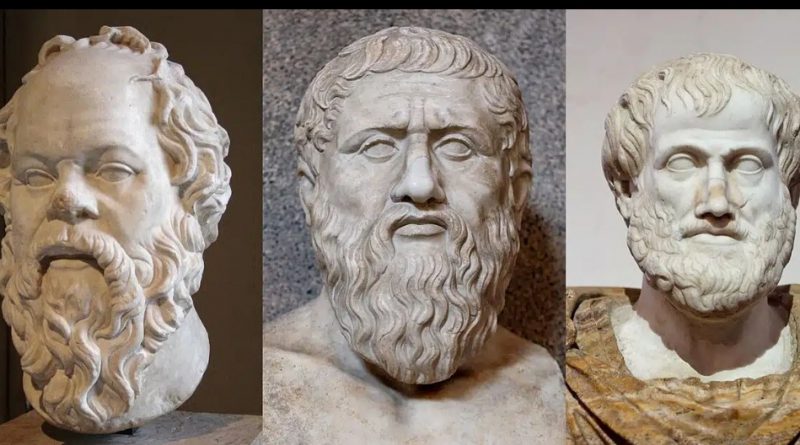
Ancient Greek Thinkers Reimagined Through Digital Storytelling as Classical Philosophy Finds New Audience
“Ideas outlive empires, and the voices of philosophers continue to shape the world long after their own age has passed.”
A new digital project revisiting some of the most influential figures of ancient Greece is drawing renewed attention to the enduring legacy of classical philosophy, history, and science by presenting leading thinkers of antiquity through immersive visual storytelling.
Produced by Equator AI and highlighted by GreekReporter, the project recreates major ancient Greek philosophers, historians, and scientists in a format designed to make their ideas accessible to contemporary audiences. Using advanced visual simulation and virtual reality-based presentation, the project allows figures such as Socrates, Plato, Aristotle, Herodotus, Thales, Homer, Demosthenes, and Chrysippus to narrate their own intellectual journeys in first-person form.
The initiative reflects a broader trend in public history and education where digital tools are increasingly used to bridge the gap between academic scholarship and general audiences. By placing historical figures in visually reconstructed environments and allowing them to “speak” through historically grounded narratives, such projects aim to deepen engagement with classical thought without altering the underlying historical record.
Among the first figures presented is Herodotus, widely regarded by historians as one of the foundational writers of recorded history. Born in Halicarnassus, a Greek city within the Persian Empire, and later associated with Thurii in southern Italy, Herodotus is best known for The Histories, his extensive account of the Greco-Persian Wars. His work combined travel observations, oral testimony, and political analysis, establishing an early model for systematic historical inquiry.
The Roman statesman Cicero later referred to him as “The Father of History,” a title that continues to define his place in historical scholarship.The project also features Thales of Miletus, a pre-Socratic philosopher often identified by later Greek thinkers as the first philosopher in the Western tradition. Aristotle described him as a foundational figure in rational inquiry.
Thales’ work extended across mathematics, astronomy, and political thought, and he is frequently associated with early scientific reasoning because of his attempt to explain natural phenomena through observation rather than mythology. His influence remains central to discussions of the origins of scientific philosophy.
Homer, whose identity remains debated among scholars, is represented through his literary legacy rather than biography. He is traditionally credited with composing the Iliad and the Odyssey, two epic poems that shaped ancient Greek education, ethics, and political imagination for centuries.
These texts became foundational works not only of Greek literature but also of the wider Western literary canon, influencing writers, dramatists, and philosophers across generations.Demosthenes appears as the political voice of classical Athens during one of its most turbulent periods.
Known for his speeches opposing the growing power of Macedon under King Philip II, Demosthenes used rhetoric as a tool of political resistance. His orations remain among the most studied examples of classical public speaking and offer historians valuable insight into the democratic tensions and strategic anxieties of fourth-century BCE Athens.
His fierce defense of Athenian independence positioned him as one of antiquity’s defining political speakers.Aristotle is presented as one of the most expansive intellectual figures in human history. A student of Plato and later tutor to Alexander the Great, Aristotle’s scholarship covered disciplines that would later develop into separate fields, including biology, ethics, metaphysics, politics, rhetoric, and logic.
His systematic method of categorizing knowledge shaped intellectual traditions across Europe, the Middle East, and Asia for centuries. His influence extended well beyond philosophy into law, theology, and natural science.
Socrates, whose teachings survive largely through the writings of his students, is depicted through his commitment to questioning accepted truths and challenging social conventions. Known for living modestly and rejecting material wealth, Socrates became one of Athens’ most controversial public intellectuals. He was sentenced to death on charges related to impiety and corrupting the youth, a trial that remains one of the most studied moments in the history of philosophy.
His method of inquiry, based on dialogue and critical questioning, laid the foundation for much of Western philosophical practice.
That legacy was carried forward by Plato, Socrates’ most famous student and the founder of the Academy in Athens, often considered one of the earliest institutions of higher learning in the Western world. Plato’s philosophical writings, particularly in dialogue form, explored justice, knowledge, ethics, and governance. His Theory of Forms became one of the most influential ideas in metaphysical philosophy, arguing that the physical world reflects higher, unchanging realities.
His work shaped later traditions ranging from Christian theology to modern political philosophy.The project concludes with Chrysippus, a major architect of Stoic philosophy.
Born in Soli, Cilicia, he later moved to Athens and studied under Cleanthes before becoming the third leader of the Stoic school around 230 BCE. Although most of his writings survive only in fragments cited by later authors, scholars credit him with developing Stoicism into a rigorous philosophical system. His work on logic, ethics, and determinism earned him the title of the “Second Founder of Stoicism,” reinforcing his central place in Hellenistic thought.
The inclusion of these figures reflects the breadth of Greek intellectual history, from epic poetry and political rhetoric to ethics and scientific inquiry. Their ideas emerged in different centuries and under different political systems, yet they remain interconnected through their influence on education, governance, law, and moral philosophy.
Projects of this kind also underline the continued relevance of classical studies in contemporary public discourse. Universities, museums, and educational institutions increasingly use digital reconstruction and interactive learning to make ancient material more accessible to younger audiences who may encounter philosophy first through screens rather than books.
While historians continue to debate interpretation, chronology, and attribution in many areas of classical scholarship, the central place of these thinkers remains uncontested. Their writings and ideas continue to shape modern conversations on democracy, justice, scientific reasoning, and human purpose.In bringing these voices into a contemporary visual format, the project does not replace traditional scholarship but instead offers a new point of entry into some of history’s oldest and most influential conversations.