Nigeria’s Aso-Oke Weavers Resist Mechanisation as Global Demand Fuels Cultural Revival
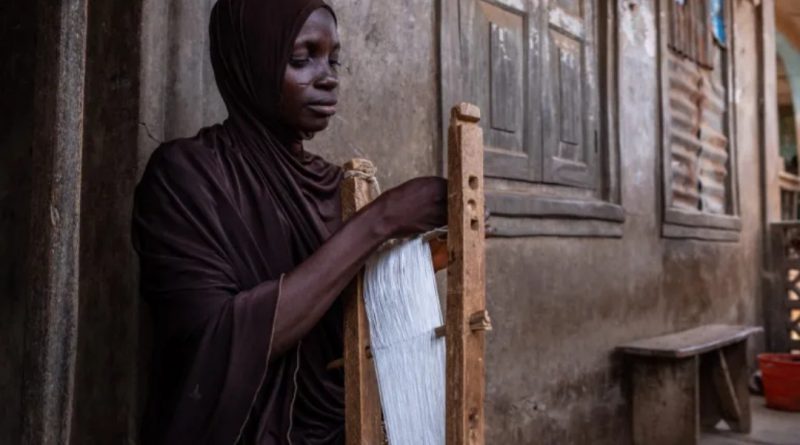
In the southwestern Nigerian town of Iseyin, the steady rhythm of wooden looms continues to define daily life as artisans preserve the centuries-old craft of weaving aso-oke, a traditional Yoruba handwoven fabric that has gained increasing recognition in global fashion markets.
Under trees, inside narrow sheds, and along dusty alleyways, artisans work for hours arranging colourful threads into narrow patterned strips that are later stitched together into wider cloth used for ceremonial wear, designer outfits, shoes, bags and accessories. Despite rising international demand and repeated attempts to modernise production, many weavers insist that aso-oke must remain handwoven to preserve its authenticity.
Located about 200 kilometres from Lagos, Nigeria’s commercial and fashion hub, Iseyin is widely recognised as the historic centre of aso-oke production. The fabric, whose name roughly translates to “cloth from up country,” has long been associated with Yoruba identity and social prestige.
Traditionally worn by wealthy families and ruling elites during weddings, festivals and major ceremonies, aso-oke has expanded far beyond formal occasions. It now appears in contemporary fashion collections across Nigerian cities and on international runways in London and Paris, reflecting both the influence of Nigeria’s fashion industry and the visibility of its diaspora abroad.
Its growing global presence was highlighted when Meghan Markle wore an aso-oke wrapper and shoulder shawl during her 2024 visit to Nigeria with Britain’s Prince Harry, bringing renewed international attention to the textile.For many weavers in Iseyin, however, the craft remains less about fashion visibility and more about livelihood.
Waliu Fransisco, 34, sits at his wooden loom weaving a cream-and-blue fabric, the repetitive click of the machine filling the workshop. A decade ago, he left his job as a nightclub singer in Lagos to learn the physically demanding work of weaving.
“Now I earn a decent living from weaving aso-oke and I’m satisfied,” he told AFP.Like many younger artisans entering the trade, Fransisco represents a generational shift in an industry traditionally dominated by middle-aged men.
Rising unemployment and limited formal job opportunities have drawn young people, including university graduates, back to Iseyin to learn the craft.The work remains labour-intensive. Historically, artisans prepared threads from raw cotton or silk by cleaning, spinning and dyeing fibres manually before setting them on wooden looms.
Colours were limited, and production was slow.Today, many weavers use pre-prepared threads in a wider range of colours, often imported from China, allowing for more varied designs while preserving the manual weaving process.
According to 42-year-old weaver Abdulhammed Ajasa, imported loom-ready thread has made it easier to experiment with patterns and respond to changing market preferences without abandoning traditional production methods.Still, the weaving itself remains entirely manual.Artisans spend hours arranging and tightening threads before weaving narrow, densely patterned strips.
The final product depends heavily on precision, rhythm and experience, qualities many say machines cannot replicate.“This is what Iseyin is known for,” said Kareem Adeola, 35, speaking from behind his loom. “We inherited it from our forefathers.
”Efforts to mechanise aso-oke production have largely failed, according to local weavers, who argue that machine-made versions lose the texture, strength and visual depth associated with authentic handwoven fabric.“If you use a machine to weave aso-oke, it won’t come out as nice as if it was handwoven,” Adeola said while working on a yellow-and-olive design.
“People have tried it before, and it did not work. It is meant by God to be handwoven.”That resistance to mechanisation reflects both economic and cultural concerns.Handweaving creates jobs in Iseyin, where much of the local economy depends directly or indirectly on textile production.
It also preserves a cultural identity tied closely to Yoruba history and craftsmanship.The physical cost, however, is significant. Long hours of sitting at wooden looms can cause chronic pain and other health problems, particularly for older weavers. Yet many continue to accept the strain as part of preserving the craft.For designers, aso-oke’s international rise presents both opportunity and concern.
Ayomitide Okungbaye, creative director of Lagos-based fashion label Tide Chen, has exhibited aso-oke designs in London and sees its growing global appeal as a positive development.“There is nothing wrong with your culture being worn by other people,” the 31-year-old designer said.But she warned that global recognition also raises questions about ownership and misuse.
“Where we start to have a problem is when there’s misappropriation or people start to claim ownership,” she said.The concern is not theoretical. Another Yoruba textile tradition, adire — produced using tie-dye techniques — has already faced challenges from counterfeit versions manufactured abroad, particularly from China. Designers fear aso-oke could face similar risks if demand continues to grow without stronger protections for local artisans.
At the same time, the expansion of aso-oke into mainstream and international fashion has changed how the fabric is used within Nigeria itself.“It is no longer reserved for special occasions,” said Isiaq Yahaya, a 45-year-old mathematician observing the shift in consumer behaviour.
Today, aso-oke appears not only at weddings and traditional ceremonies but also in everyday fashion, adapted into shoes, handbags, purses and contemporary ready-to-wear collections.This evolution has helped sustain the craft economically while keeping it visible to younger generations who may otherwise see traditional textiles as outdated.
In Iseyin, finished rolls of brightly coloured cloth are stacked in small shops waiting for buyers from Lagos, Abuja and overseas markets. Some weavers now collaborate with graphic artists and fashion designers to develop new patterns that appeal to younger customers without losing the fabric’s traditional identity.
The balance between innovation and preservation remains delicate.For artisans here, the question is not whether aso-oke should evolve, but how far that evolution can go before the fabric loses the very qualities that made it valuable in the first place.
As global demand grows, Iseyin’s weavers continue to work under open skies and wooden sheds, preserving a process that has survived generations not because it was the easiest method, but because it carried something machines could not reproduce.