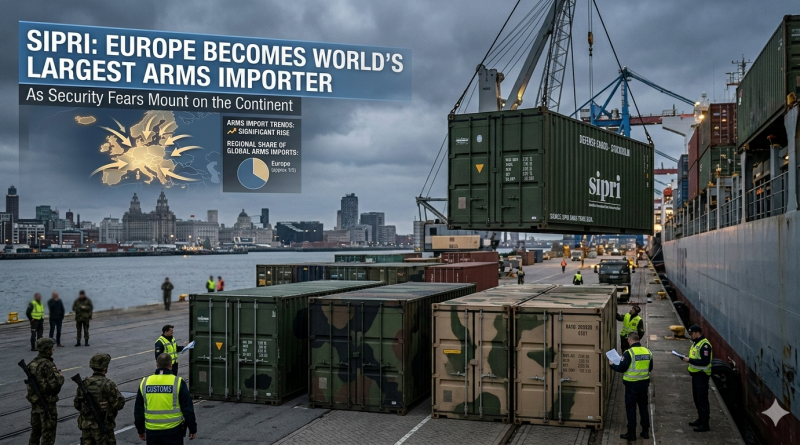
Europe becomes world’s largest arms importer as security fears mount, SIPRI says
Stockholm March 9 – Europe became the world’s largest arms importer over the past five years as governments accelerated military purchases in response to Russia’s threat and growing doubts about long-term U.S. security commitments, data released on Monday by the Stockholm International Peace Research Institute showed.
European countries more than tripled their arms imports in the 2021–2025 period compared with 2016–2020, according to the report from the Sweden-based research institute. The increase reflects efforts to supply Ukraine in its defence against Russia’s invasion and to rebuild European militaries after decades of relatively low defence spending.
“The sharp increase in arms flows to European states pushed global arms transfers up almost 10%,” said Mathew George, director of the institute’s Arms Transfers Programme.
Europe accounted for 33% of global arms imports during the period, a sharp rise from 12% in the previous five-year timeframe, the report showed.
The surge in European procurement followed Russia’s 2022 invasion of Ukraine, which prompted governments across the continent to replenish stockpiles and modernise armed forces.
Military assistance to Kyiv and the need to restore national inventories after decades of reduced defence spending have driven demand for advanced systems, including aircraft and air-defence capabilities.
Despite expanding domestic production, European governments continued to purchase significant volumes of equipment from the United States, particularly combat aircraft and long-range air-defence systems, according to the data.
The figures highlight the continuing reliance of many European countries on American defence technology even as European governments seek to strengthen their own defence industries.
Arms imports by Middle Eastern states declined by 13% during the same five-year period, although the region remains a major buyer of military equipment.
Saudi Arabia and Qatar ranked among the four largest individual arms importers globally.Pieter Wezeman, a senior researcher at the institute, said the decline mainly reflected large Saudi procurement orders placed in the previous reporting period that are still being integrated into the country’s military inventory.
He added that many governments in the region had already placed new orders before the latest escalation involving the United States, Israel and Iran, meaning the impact of those purchases is not yet fully reflected in the figures.
Wezeman said the current regional conflict is likely to boost demand further, particularly for anti-missile and air-defence systems.
“They will first replace what they have used, but also that they are going to look at buying more equipment to protect themselves even better than they can do now,” he said.
On the supply side, the United States increased its share of the global arms export market to 42%, up from 36% in the previous period, reinforcing its position as the world’s leading weapons exporter.
France ranked as the second-largest supplier with 9.8% of global arms exports.
Russia saw its share fall sharply to 6.8% from 21% following its 2022 invasion of Ukraine, according to the report.Combined European arms exports accounted for 28% of the global market, a figure roughly four times larger than Russia’s share and five times greater than that of China, underscoring Europe’s growing role in the international defence trade.