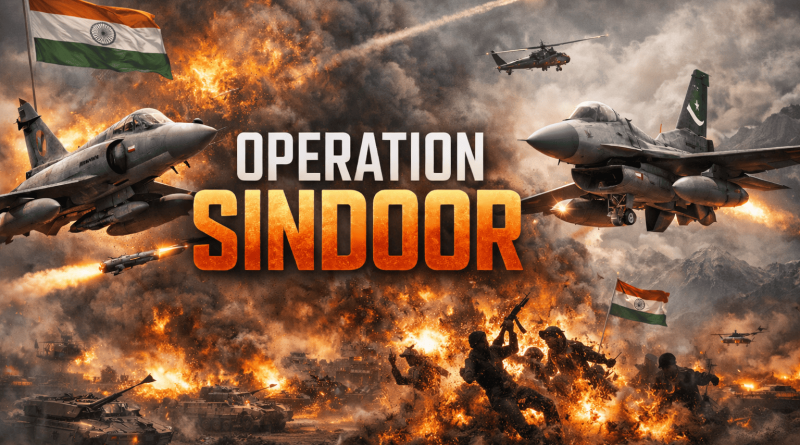
OPINION: Revisiting Operation Sindoor Post Fog of War

India did not try to completely control the airspace, and it did not keep up the pressure forever.
The crisis between India and Pakistan in May 2025, which has its lineage to the Pahalgam terror attacks that happened in April 2025, has a lot to say about escalation matrix, post-operation results and most importantly of all, how not to make it a protracted conflict. The Indian side has consistently maintained that it has been swift in its actions and achieved its targets on the first day of the strike.
However, as Pakistan climbed the escalation ladder on the second day, the Indian Armed Forces also upped the stakes. As the world at that time was grappling with protracted conflict from Russia-Ukraine to Israel-Gaza, the international community was fearing there were high chances of India-Pakistan getting into the clutches of prolonged conflict.
In the light of newer evidence, such as the one recently released Swiss Air Power related Think Tank report and as the fog of war is settling, two things remain clear: one, India has achieved what it wanted from those precision strikes; also, it did not up the ante unnecessarily and gave Pakistan an off-ramp as asked by Pakistan once achieving its goals.
What makes Operation Sindoor stand out is not that India attacked Pakistan. In 2019, that limit had already been reached. It’s not even the fact that two air forces are fighting in the air. What makes this episode different is that later revelations slowly broke down the initial story frame, making analysts rethink how escalation happened, how it was handled, and why it ended when it did.
After the air battles on May 7, it seemed like Pakistan had the upper hand because they were faster in media briefings. Early reports were shaped by statements from military officials, along with diagrams and confident briefings. In contrast, India didn’t say much. It didn’t say whether or not it had lost any planes, and it only said again that its strikes were aimed at terrorist infrastructure. This difference was important. Without verified information, initial claims spread quickly.
At that point, many people and different nations saw the crisis in a limited way: Pakistan had struck initially, India had taken the harm, and things had calmed down mostly because both sides were being careful. At the time, that reading wasn’t unreasonable. It wasn’t finished either.
As more information came to light, especially from sources that weren’t directly involved in either side’s story, a different picture began to emerge. A Swiss military think tank that studies air warfare wrote a long report on the war that focused less on claims of individual kills and more on how the air campaign changed over the course of four days. It came to a conclusion that was measured but important.
The report said that the Indian Air Force quickly adapted, weakened parts of Pakistan’s air defence network, and gained air superiority over large areas of Pakistani airspace, even though it acknowledged Pakistan’s early tactical successes. It suggested that this change changed the balance of power and was a big reason why Islamabad asked for a ceasefire by May 10.
At first, that conclusion didn’t get as much attention as it should have, maybe because it didn’t fit into the main story that the media was telling. But over time, a number of admissions that are hard to ignore have made it stronger. One of these times was when Pakistan’s Foreign Minister Ishaq Dar said in public that Indian strikes had hit Nur Khan Air Base. This was not an arbitrary place. Nur Khan is close to Rawalpindi and is closely linked to Pakistan’s air mobility and command infrastructure.
Governments don’t usually want to admit that damage has been done to these kinds of facilities, especially when doing so goes against their earlier claims of strong defence. The admission didn’t say how much damage was done, but it quietly answered a bigger question: Indian strikes had gone far beyond their intended targets.
That recognition also helped make sense of how Pakistan acted diplomatically during the crisis. The US Foreign Agents Registration Act showed that Pakistan asked US officials more than sixty times to step in and stop India’s strikes. These were not one-time actions. They required diplomats and registered lobbyists to stay involved by meeting with each other, calling each other, and writing to each other.
When looked at on its own, this kind of outreach might seem normal. In total, it points to something more urgent: a growing worry that the path of escalation was going too far for Islamabad to handle.
States facing military pressure frequently pursue external stabilisers, especially when nuclear deterrence complicates bilateral signalling. But the size of Pakistan’s outreach does show that they thought that continuing to escalate would be expensive, not just dangerous. In this light, the Swiss assessment’s claim that India had gained coercive leverage through air power starts to look less like a guess.
But the most telling confirmations may have come from actors who usually stay out of official discussions. Hafiz Abdul Rauf, the commander of Lashkar-e-Taiba, said in public that the Indian attack on Muridke was a “very big attack” that destroyed a major training facility.
Masood Ilyas, the commander of Jaish-e-Mohammad, said that their headquarters in Bahawalpur was badly damaged and many people died. These statements didn’t get as much attention over time as military briefings, but they are still important for analysis. Militant groups don’t usually talk about their own losses unless they can’t deny them anymore, even to themselves.
All of these admissions make it harder to believe that Operation Sindoor was mostly a symbol. They imply that the strikes produced significant impacts on infrastructure previously considered to be beneath India’s escalation threshold. More importantly, they made it harder to separate militant activity from the consequences at the state level by blurring the line between non-state actors and the strategic environment that supports them.
It’s interesting how air power was used to make this happen. India did not try to completely control the airspace, and it did not keep up the pressure forever. Instead, it looks like it had a more limited goal: to show that it could get through defended airspace, damage high-value assets, and then stop. This is a different way of escalating things. It sees air superiority as a short-term goal rather than a long-term one. In places where escalation ladders are short and nuclear signalling is always there, this kind of time is important.
From Pakistan’s point of view, the maths got harder and harder. Success in air-to-air combat did not protect infrastructure from being weak. Early narrative advantage didn’t stop later revelations from changing how people thought. By May 10, the costs of continuing the fight, especially with some Indian air superiority, probably outweighed the benefits of keeping it going.
At that point, asking for a ceasefire kept escalation under control and limited the further exposure of important assets. This has detrimental implications for South Asia. Nuclear deterrence still stops full-scale war, but it no longer protects you from heavy conventional pressure.
Denial strategies are still useful in the short term, but they are becoming less effective as more and more open-source intelligence, regulatory transparency, and delayed admissions become available. And the space for managing escalation through proxies seems to be getting smaller as infrastructure that was once off-limits becomes more and more contested.
Disclaimer: Views expressed by writers in this section are their own and do not reflect Milli Chronicle’s point-of-view.