The Night My Father Finally Spoke – A Daughter’s Recollection

My father did not speak of heroics. He spoke of paralysis. Of policemen gripping rifles they were not allowed to use.
A remembered narrative, as told to the author
This is based on a story narrated to me by a close friend, the daughter of a police officer who was posted at Bow Bazar Police Station, Calcutta, during the violence of August 1946.
What follows is her recollection of a single evening in 1969, when her father, having retired from the police service, finally spoke to his children about what he had witnessed—and what he had been ordered not to do. I have rendered her memory in the first person, preserving her voice and emotional truth, while accepting full responsibility for the structure, language, and interpretation of the narrative.
This is not an official account. It is not a historical report.
It is a human memory… shared, carried, and now written.
This is not my story in the sense that I lived it. It is my story because I inherited it.
What follows is what my father told us one evening in 1969—what he had carried silently for over two decades, and what he finally released at the dinner table, when the uniform no longer held him in its grip. I write this not as a historian, not as a witness, but as a daughter who saw her father cry for the first and only time.
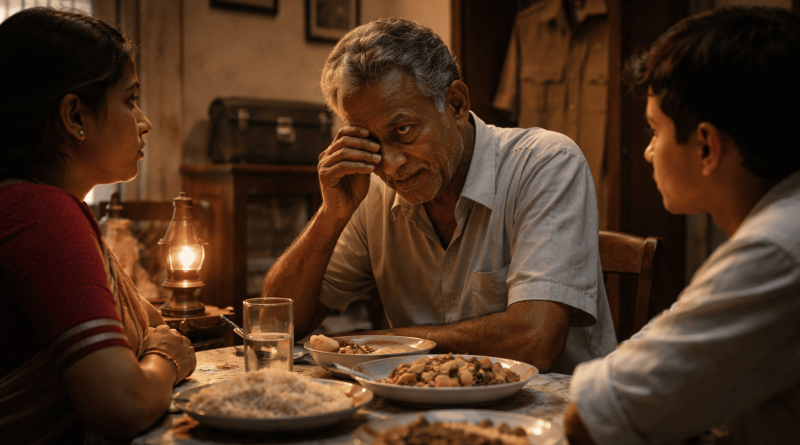
We were eating rice and dal that night.
Nothing special. No guests. No ceremony. Just another evening in a house that had finally learned the rhythm of having its patriarch home.
My mother had cooked aloo posto. The poppy seeds were ground fine, the mustard oil sharp enough to sting the nose. The ceiling fan turned lazily, clicking once every rotation, as if it too were tired of doing its duty. It was 1969. My father had retired from the police service a few months earlier, and for the first time in my life, he sat at the head of the table every night.
The uniform that had defined him for over three decades was folded away in an almirah, wrapped carefully in old newspapers. He still woke before dawn, still drank his tea without speaking, still sat upright as if an invisible parade ground stretched across our living room. Retirement had not softened him. Or so we believed.
Perhaps it was the absence of authority above him.
Perhaps it was the weight of silence finally becoming heavier than speech.
My younger brother asked the question without malice, without forethought.
“Baba,” he said between mouthfuls, “what was the worst day of your service?”
The spoon stopped midway to my father’s mouth.
My mother looked up sharply. In our house, there were unspoken rules. The police service was to be respected, not examined. Stories of duty were acceptable; stories of doubt were not. But my father did not scold my brother. He did not deflect. He did not laugh it away.
He placed the spoon gently on the plate.
And then, for the first time in my life, my father cried.
Not loudly. Not dramatically. Just tears—steady, unembarrassed—rolling down a face I had only ever known as controlled, disciplined, immovable. This was the man who had never cried at funerals, never flinched at violence, never raised his voice at home.
“I was posted at Bow Bazar Police Station,” he said finally.
“August 1946.”
The room went silent—not with reverence, but with fear.
Bow Bazar, before it burned, was not a place one associated with history. It was crowded, noisy, ordinary. Narrow lanes, leaning balconies, shops pressed against each other as if for protection. Hindus and Muslims lived cheek by jowl—not in harmony, not in constant conflict, but in the practical intimacy of shared walls, shared drains, shared irritations.
My father was young then, barely in his thirties. He had joined the police believing, perhaps foolishly, that the uniform existed to protect the weak, to impose order where chaos threatened. He believed in procedure, in law, in the idea that the state, when tested, would stand firm.
On 16 August 1946, Calcutta was told it was Direct Action Day. The phrase arrived without explanation, without boundaries. Orders filtered down the chain of command—strangely hollow, strangely evasive.
Maintain calm.
Avoid provocation.
Remain at posts.
And then, more clearly, more chillingly: Do not interfere without explicit instructions.
At first, there was confusion. Arguments escalated. Groups formed. Shops were vandalized. My father and his colleagues waited for clarity that never came. Wireless messages were sent. Requests for reinforcements were made. Senior officers were contacted—or were said to have been contacted.
By evening, confusion curdled into dread.
From inside Bow Bazar Police Station, they could hear it—the shouting, the running, the breaking of shutters, the first screams. Smoke rose in multiple directions, thin at first, then thicker, darker.
“No one told us to move,” my father said decades later.
“And no one told us to stop.”
By the second day, it was no longer a riot. It was slaughter.
There is a particular cruelty in being ordered to witness.
My father did not speak of heroics. He spoke of paralysis. Of policemen gripping rifles they were not allowed to use. Of standing near windows, recognizing lanes he had patrolled countless times, now filled with bodies. Of hearing people scream for help and knowing that moving without orders could end his career—and condemn his family.
In those days, disobedience did not mean a bad posting. It meant court-martial. Prison. Ruin.
“Do you know,” he asked us quietly at the dinner table,
“what it means to obey orders that you know are killing people?”
Later, people would say three thousand died. My father never trusted that number.
“Count the bodies you carry,” he said.
“Not the ones written in reports.”
He spoke of corpses stacked in alleys too narrow for vehicles. Of policemen sent in after the killing had passed, to clean up what intervention might have prevented. Of the smell that lingered for weeks, embedding itself in memory.
And then, after a long silence, he spoke of a man whose name he had not uttered in over twenty years.
“They called him Gopal Patha,” he said.
Gopal Prasad Mukherjee was known across Bow Bazar not because he was feared, but because he was loved. His meat shop was a fixture of the neighborhood. Behind it, he ran a wrestling akhara, where boys learned discipline before strength, restraint before aggression.
When the state withdrew and the police were bound by orders that became shackles, Gopal Patha did not wait.
He went on a mission—not to seek revenge, not to claim authority—but to save whoever could still be saved, and to end the brutality wherever he could. The young men from his akhara joined him instinctively. They moved through lanes they knew by heart, escorting families, holding ground, pushing back violence long enough for life to escape.
“He never wore his bravery on his sleeve,” my father said.
“And maybe that is why it mattered.”
August ended. The fires burned out. Calcutta resumed its rhythms. The British left. Independence came. Governments changed. Reports were written. Blame was managed.
My father continued in service.
He was promoted when due, transferred when required, commended occasionally. Never disgraced. Never celebrated. But something in him never returned from Bow Bazar.
He avoided that area whenever possible. He woke up sweating decades later. Sudden noises startled him. He never spoke of August 1946—to colleagues, to friends, not even to my mother.
Some wounds are not hidden because they are forbidden.
They are hidden because they are unbearable.
Retirement did not free my father from memory. It only freed his voice.
That night in 1969, he spoke because the state no longer owned his silence.
“The state,” he said quietly,
“can order silence. It cannot order forgetfulness.”
We finished dinner in silence.
No one asked questions. Some stories are not meant to be interrogated. They are meant to be carried.
When my father died years later, people spoke of his honesty, his discipline, his integrity. No one mentioned Bow Bazar. No one mentioned August 1946. No one mentioned Gopal Patha.
But I do.
Because this is not only the story of a city that burned.
It is the story of a father who obeyed—and paid the price.
And of a butcher who acted—and returned quietly to his akhara.
And because sometimes, the bravest thing a man can do
is not to fight, not to command, not to defy—
but to finally tell the truth to his children.
A truth his daughter carried for decades, and one she entrusted to me to tell.
Disclaimer: Views expressed by writers in this section are their own and do not reflect Milli Chronicle’s point-of-view.