China-Pakistan Narrative Warfare After the Pahalgam Kashmir Attack
These amplified efforts were mainly noticed after Operation Sindoor and around the announcement of the ceasefire between India and Pakistan.
The April 22, 2025 Pahalgam attack, which killed 26 people in the Baisaran valley of Kashmir, quickly evolved beyond a single act of violence into a wider strategic confrontation, as China emerged as a key supporter of Pakistan across both military and information domains, confronting India with a simultaneous on-ground and narrative-driven challenge.
The detailed analysis below is produced by ThinkFi, a research-focused think tank that used advanced open-source intelligence (OSINT) tools to trace, map and analyse coordinated influence operations surrounding the Pahalgam attack, exposing how misinformation, propaganda and narrative manipulation were deployed across digital platforms.

The first major narrative built against India was that related to the Indus Water Treaty (IWT) after India responded with its abeyance as a diplomatic measure in retaliation for the Pahalgam attack. From blaming India for weaponizing IWT to criticizing it for leading a humanitarian crisis, attempts were made at internationalizing the whole issue of IWT.
Along with efforts at pushing words like ‘water terrorism’ and ‘economic siege’, warnings of famines were circulated while sidelining the terror attack and the reason behind such actions taken by India. To further threaten India and portray China as capable of punishing India, parallel narratives circulated alleging China could block the Brahmaputra River, despite the absence of any official basis for these claims.
Subsequently Pakistan not only undertook efforts to defend and justify the Pahalgam attack, by making statements in support of the terror group The Resistance Front (TRF) a United States-designated terrorist organisation linked to Lashkar-e-Taiba and blaming the Indian government’s administrative failure in Kashmir but Pakistani linked twitter accounts further circulated a 9 page fake documents attributed to India’s Research and Analysis Wing (RAW) claiming the Pahalgam attack as a false flag operation designed by India itself to justify the strikes in Pakistan and suspension of the Indus Water treaty.
The next narrative sought to portray India as the sole provocateur in India-Pakistan hostilities, along with accusing New Delhi’s actions as pushing for Nuclear War and instability in South Asia. Amplification of words like ‘reckless’ and ‘unprovoked’ referring to India’s approach was spotted on social media.
Further, a sudden surge in coordinated Twitter activities from posts and accounts linked to China and Pakistan drew comparisons between the Indian response against a terror attack to the Israeli-style occupation in Gaza at the same time, also framing India as an apartheid occupier and accusing it of ethnic repression.
Similar accounts circulated a fabricated document appearing to be from India’s Atomic Energy Regulatory Board (AERB), falsely claiming a radiation hazard at a strategic military facility in Beas, Punjab. These efforts appear designed to spark fear, as well as paint India’s image as irresponsible and unsafe with its nuclear assets.
A clearer version of this coordinated campaign could be understood by noticing the attempts made at undermining the credibility of the Indian missile aircraft and missile performance like that of BrahMos, Rafale, and S-400 air defense systems, while promoting the Chinese systems like J-10C, JF-17, and PL-15.
Even though this narrative was circulated online between May 8th and 11th, it reached its peak on May 10th, 2025 only after the announcement of the ceasefire.

The aim of securing a financial gain from this clash was observable through the stock market behaviour. An intentional effort at discrediting the Indian Missiles and Aircrafts was substantiated by the twitter analysis of the keywords ‘BrahMos and Rafale’ whose peak (10 May) also coincided with the share price fluctuations of the Chinese defense Manufactures – Chengdu Aircraft Corporation and Shenyang Aircraft Corporation, whose stocks saw a sudden rise in that period.
These deliberate efforts by China to achieve financial gains out of the conflict by undermining the Indian aircraft while simultaneously promoting Chinese systems were even documented in official reports by France and the USA.

It is worth noticing that initially, the dissemination of these narratives was mainly driven by Chinese state-linked media outlets. However, the Chinese engagement intensified only when it became evident that the conflict, along with the information space, could yield economic and financial gains.
These amplified efforts were mainly noticed after Operation Sindoor and around the announcement of the ceasefire between India and Pakistan.
This shift is clearly visible in the analysis of the two famous Chinese applications – TikTok and Weibo, where open source (OSINT) analysis on the key terms ‘India & Pakistan’ started appearing only after 7th May, after Operation Sindoor, where the engagement on these terms ‘India & Pakistan’ was minimal or entirely absent before that. Indicating silence during the Pahalgam attack, in contrast to the heavy engagement during Operation Sindoor.

Following the consistent application of narrative warfare by the partnership, an element of irony was revealed when, after the ceasefire, a new narrative appeared portraying China as a peacemaker in the Indo-Pak hostilities. This stood in sharp contrast to China’s earlier activities in both military and information aspects.
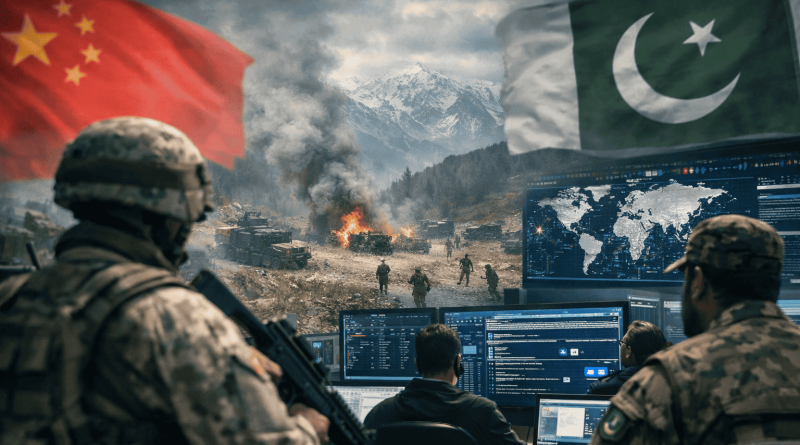
Taken together, the post-Pahalgam phase illustrates how modern conflict now extends beyond conventional military operations into the domain of perception warfare. Collectively, the dual strategy of offering real-time battlefield intelligence along with influencing the information space exemplifies a contemporary strategy of warfare, commonly described as Hybrid warfare.

This approach blurs the lines between physical and virtual combat, bringing the gap between military coordination and media manipulation to harm the other country both psychologically and strategically. These events indicate an evolving security environment where wars are not restricted to battle fields but travel even at the level of media, cyberspace, digital technologies, and public opinion.
This development reveals a new depth of collaboration between China-Pakistan and therefore indicates a need for India and its institutions to safeguard its national interests and regional stability.