EU on verge of landmark free trade pact with India, von der Leyen says
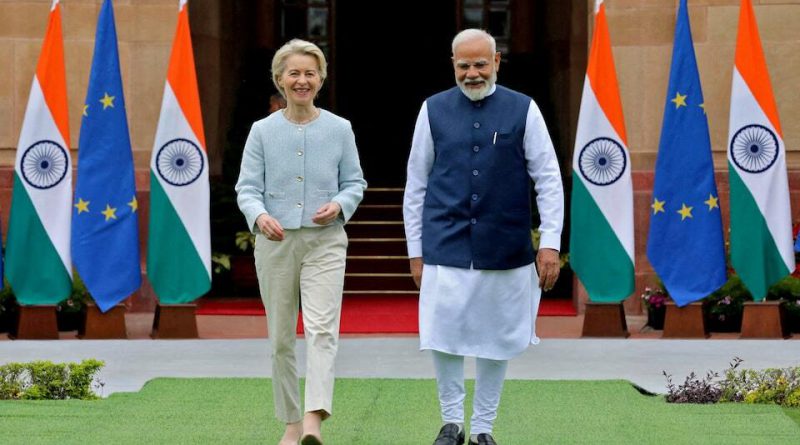
Davos – The European Union is close to finalising a long-awaited free trade agreement with India, a deal that could reshape global commerce and deepen economic ties between two of the world’s largest markets, European Commission President Ursula von der Leyen said while addressing the World Economic Forum in Davos.
Describing the proposed pact as potentially historic, she said negotiations had reached an advanced stage, even though some issues still needed to be resolved before the agreement could be sealed.
Speaking to global political and business leaders, von der Leyen highlighted the strategic importance of the deal for both sides at a time of growing geopolitical uncertainty and shifting trade alliances.
She said the agreement could create a combined market of nearly two billion people and account for close to a quarter of global gross domestic product, underlining why some have dubbed it the “mother of all trade deals.”
Her remarks reflected the EU’s broader push to diversify trade partnerships and reduce overdependence on a small number of markets.
Negotiations between the EU and India have spanned years, marked by pauses, restarts and complex discussions over tariffs, market access, labour standards, environmental rules and intellectual property protections.
Recent progress suggests both sides are now more aligned, driven by shared interests in economic growth, supply chain resilience and strategic autonomy. Analysts say global disruptions, including trade tensions elsewhere and supply chain shocks, have added urgency to the talks.
For India, the proposed agreement offers the prospect of expanded access to one of the world’s largest consumer markets, potentially boosting exports in sectors such as pharmaceuticals, textiles, information technology services and manufacturing.
Indian officials have repeatedly said a balanced deal could support domestic growth, job creation and investment, while positioning India as a key alternative manufacturing and services hub in the global economy.
From the European perspective, the trade pact would open doors to a fast-growing economy with a large and youthful population. European companies could gain improved access to India’s vast market, particularly in areas like automobiles, renewable energy, financial services, digital technology and high-end manufacturing.
The EU also sees the deal as a way to strengthen ties with a major democratic partner in Asia and reinforce rules-based trade at a time when protectionist pressures are rising globally.
Von der Leyen’s comments also come amid efforts by Brussels to broaden its trade network beyond traditional partners. The EU has been pursuing agreements with countries and regions across Asia, Latin America and the Indo-Pacific as part of a strategy to diversify supply chains and enhance economic security.
A successful agreement with India would be one of the most significant achievements of this strategy, given the size and complexity of the Indian market.
While optimism has grown, officials on both sides acknowledge that challenges remain. Issues such as tariff reductions on sensitive goods, regulatory standards, data protection and sustainability commitments have historically proven difficult.
However, recent diplomatic engagement at the highest levels has helped narrow differences, with leaders signalling political will to push the deal across the finish line.
Von der Leyen is expected to travel to India in the coming days, a visit that could provide additional momentum to the talks. Her trip is seen as a sign of the EU’s seriousness about concluding the agreement and strengthening its partnership with New Delhi.
Any breakthrough during the visit would be closely watched by global markets and policymakers alike.
If concluded, the EU-India free trade agreement could mark a turning point in relations between the two economies, setting the stage for deeper cooperation not only in trade but also in areas such as climate action, technology, and geopolitical coordination.
As negotiations enter their final phase, expectations are rising that the long-discussed deal may finally become a reality.