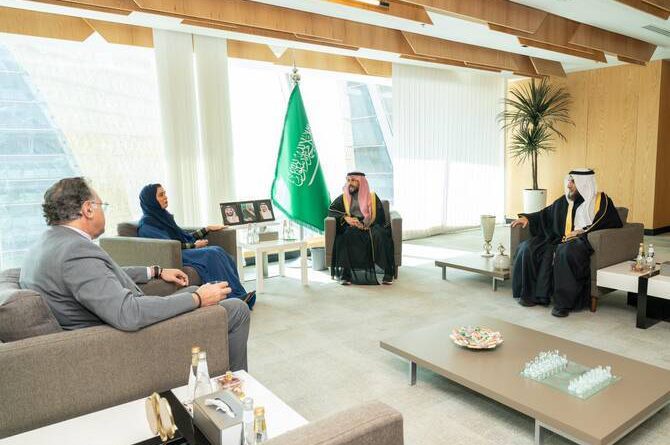
Saudi Health Leadership and WHO Strengthen Cooperation on Regional and Global Health Priorities
Riyadh – Saudi Arabia’s deputy minister of health for planning and development held high-level discussions with the World Health Organization’s regional director for the Eastern Mediterranean.
The meeting reflected continued engagement between national health authorities and international health institutions.
The talks focused on reinforcing cooperation between the Ministry of Health and the World Health Organization.
Both sides emphasized shared goals related to health system development and long-term sustainability.
Officials reviewed outcomes from earlier strategic discussions held between Saudi Arabia and the WHO.
These engagements have provided a framework for continued collaboration and structured dialogue.
Health priorities at both regional and global levels were part of the agenda.
The discussions highlighted the importance of coordination in addressing evolving healthcare needs.
Participants explored opportunities to strengthen resilient and adaptable health systems.
Such systems are seen as essential for improving service delivery and preparedness.
International partnerships were recognized as a key factor in advancing healthcare quality.
Collaboration enables the exchange of expertise, best practices, and technical knowledge.
The meeting also touched on future-oriented health planning initiatives.
These initiatives aim to support efficiency, innovation, and sustainable growth in healthcare services.
Saudi Arabia’s health strategy places emphasis on expanding investment opportunities.
Such efforts are designed to encourage innovation and private sector participation.
The discussions included ways to enhance the Kingdom’s role in global health cooperation.
This reflects a broader commitment to contributing constructively to international health initiatives.
Pharmaceutical sector development was another area of interest during the talks.
Localization and capacity-building were discussed as pathways to strengthen supply chains.
Technology transfer and knowledge sharing were highlighted as important enablers.
These elements support modernization and continuous improvement in healthcare delivery.
The World Health Organization’s regional leadership acknowledged the value of structured dialogue.
Ongoing engagement helps align national strategies with international health standards.
Health system resilience remains a priority across the Eastern Mediterranean region.
Coordinated efforts help address common challenges and promote regional stability.
The meeting underscored the role of long-term planning in health sector development.
Strategic alignment supports consistency and measurable progress.
Saudi Arabia continues to engage with international organizations to enhance health outcomes.
Such cooperation is part of broader efforts to improve population health and wellbeing.
Dialogue between national and international stakeholders fosters mutual understanding.
This approach supports collaborative problem-solving and innovation.
Health leaders emphasized the importance of policy coordination and shared objectives.
Aligned strategies help maximize the impact of health initiatives.
The discussions also reflected a commitment to continuous evaluation and improvement.
Learning from past initiatives informs future planning and execution.
The official visit forms part of ongoing engagement between Saudi Arabia and the WHO.
Regular exchanges strengthen institutional relationships and trust.
Overall, the meeting highlighted the importance of partnership-driven health development.
It reinforced a shared focus on quality, sustainability, and global cooperation.