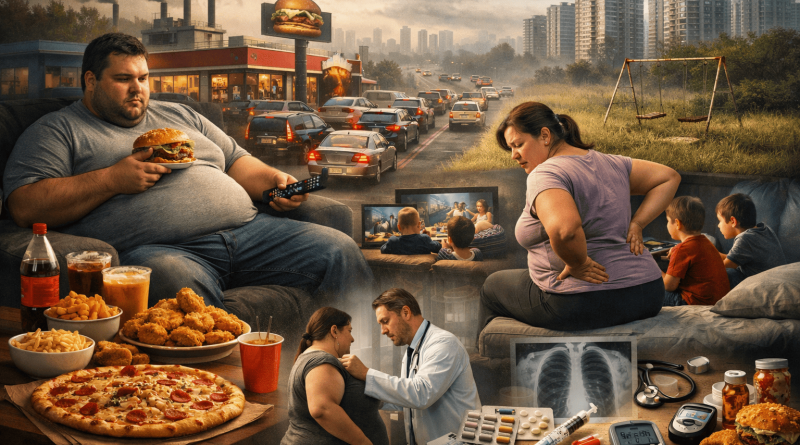
Obesity: A Silent Epidemic of the Modern Age — A Growing Red Flag

Your body is your lifelong home—nourish it, move it, respect it.
Obesity is often spoken of in the language of personal failure—poor discipline, unhealthy choices, or sedentary habits. This narrative, repeated in popular discourse and media commentary, places the burden squarely on individuals while ignoring the larger forces at play. Such framing is not only incomplete but deeply misleading. It simplifies a complex health condition into a matter of willpower, obscuring the structural realities that make healthy living increasingly difficult for large sections of society.
Obesity is not merely an individual concern; it is a silent epidemic shaped by modern lifestyles, economic systems, cultural shifts, and policy neglect. The environments in which people live today are engineered for convenience rather than well-being—characterised by ultra-processed foods, relentless marketing, sedentary work patterns, and shrinking spaces for physical activity. When unhealthy choices become the easiest, cheapest, and most accessible options, personal responsibility alone cannot carry the weight of prevention.
Treating obesity as a moral shortcoming has had serious consequences. It has fostered stigma, discouraged individuals from seeking medical or psychological support, and diverted attention from the need for systemic reform. Worse, it has allowed governments, industries, and institutions to evade accountability while the health burden continues to grow. By reducing obesity to a question of individual failure, societies have overlooked its profound implications for public health, healthcare systems, and economic productivity.
To address obesity meaningfully, it must be recognised not as a personal flaw but as a collective challenge—one that reflects how modern societies organise food, work, education, and urban life. Only by shifting the conversation from blame to understanding, and from judgement to shared responsibility, can obesity be confronted as the public health crisis it truly is.
A Growing Burden of Non-Communicable Disease
At its core, obesity is a chronic medical condition characterised by the accumulation of excessive body fat to a degree that impairs health and reduces quality of life. It is not merely a cosmetic concern or a matter of appearance; it fundamentally alters metabolic, hormonal, and inflammatory processes within the body. This disruption significantly increases the risk of non-communicable diseases, including type 2 diabetes, cardiovascular disorders, hypertension, musculoskeletal degeneration, respiratory complications, and certain forms of cancer.
The consequences of obesity extend beyond physical illness. Individuals living with obesity are more likely to experience reduced mobility, chronic pain, fatigue, and psychological distress, including depression and anxiety. Over time, these health challenges can limit productivity, strain healthcare systems, and diminish overall life expectancy. What makes obesity particularly dangerous is its gradual progression—often developing silently over years before manifesting as serious disease.
The World Health Organization has long recognised obesity as a major global health risk and a key driver of the worldwide rise in non-communicable diseases. Alarmingly, its prevalence has increased sharply across both developed and developing nations, cutting across age groups and socioeconomic boundaries. Once associated primarily with affluence, obesity now coexists with undernutrition in many countries, creating a dual burden that complicates public health responses.
This global rise reflects profound changes in diet, physical activity, and living conditions rather than sudden shifts in individual behaviour. As obesity becomes increasingly widespread, it poses not only a medical challenge but a societal one—demanding coordinated action in healthcare, education, urban planning, and policy. Recognising obesity as a serious, multifaceted health condition is the first step toward addressing its long-term consequences effectively and ethically.
How Modern Lifestyles Fuel Obesity
Contemporary life has fundamentally altered how people eat, move, and rest, creating conditions that make obesity increasingly common. The food environment today is dominated by highly processed, calorie-dense options that are not only cheap and widely available but also aggressively marketed, particularly to children and young adults. Sugary drinks, snack foods, fast-food chains, and ready-to-eat meals are positioned as convenient, desirable, and even aspirational, while fresh fruits, vegetables, and whole grains often remain relatively expensive, less accessible, or inconvenient for those with demanding schedules.
At the same time, physical activity has been systematically reduced in daily life. Urban design prioritises cars over pedestrians, schools and workplaces emphasise desk-bound tasks over movement, and recreational options are increasingly digital rather than active. Mechanised transport, elevators, escalators, and household conveniences reduce opportunities for natural physical exertion, while screen-based entertainment—television, computers, and smartphones—occupies ever more leisure time. Even recreational sports and outdoor play have declined due to shrinking green spaces and parental concerns about safety.
The combination of high-calorie intake and minimal energy expenditure creates an environment in which obesity is not merely a matter of personal choice but a predictable outcome. People live within systems that encourage overconsumption and inactivity, often without realising the cumulative impact on health. Modern lifestyles, designed for efficiency and convenience, have unintentionally engineered obesity into everyday life, making it a systemic rather than individual problem.
Cultural Shifts and the Normalisation of Obesity
Beyond structural and lifestyle factors, cultural perceptions of body weight have evolved in ways that complicate the obesity crisis. On one hand, individuals living with obesity are often subjected to stigma and social judgement, labelled as lazy, undisciplined, or lacking self-control. This moralising narrative not only causes psychological stress but also discourages people from seeking medical guidance, nutrition counselling, or physical activity support. The shame associated with obesity can exacerbate unhealthy behaviours, creating a vicious cycle that public health messaging alone struggles to break.
On the other hand, there is a growing tendency in some societies to normalise obesity, framing it as an acceptable variation of body type without adequately addressing its serious health implications. While body-positivity movements have rightly challenged unrealistic beauty standards and promoted self-acceptance, the message can sometimes blur the line between embracing diversity and ignoring the medical risks associated with excessive weight.
This duality—stigmatisation on one side, normalisation on the other—creates a confusing social landscape. Individuals are left to navigate contradictory messages: they are shamed for being overweight, yet encouraged to accept it without intervention. Effective solutions must strike a balance—promoting empathy and dignity while clearly communicating the health consequences associated with obesity.
Ultimately, addressing obesity is not only about personal choice or discipline; it is about reshaping cultural norms, promoting informed awareness, and creating environments where healthy eating, regular movement, and preventive care are supported, respected, and accessible.
Beyond Personal Responsibility: Systemic Solutions for Obesity
Obesity is not just a personal or cultural issue; it carries significant economic and systemic consequences. Rising rates of obesity contribute to an increasing burden of non-communicable diseases such as diabetes, hypertension, heart disease, and certain cancers. This translates into escalating healthcare costs, long-term medical treatments, and reduced workforce productivity, affecting societies at both micro- and macroeconomic levels.
Yet, despite its scale, obesity often receives fragmented or inadequate policy attention. Governments have historically focused more on undernutrition, infectious diseases, or acute healthcare needs, leaving obesity prevention and management under-resourced. Preventive healthcare systems, nutrition education, regulation of food marketing—especially to children—and urban planning that encourages physical activity remain patchy or unevenly implemented.
The food industry plays a major role in shaping dietary behaviour. Highly processed, energy-dense foods are aggressively marketed and widely accessible, while healthier options remain less profitable, more expensive, or harder to distribute. Without regulatory oversight, profit incentives often outweigh public health considerations. Subsidies for sugar-rich crops, minimal labelling requirements, and the omnipresence of fast-food chains create a structural environment in which obesity becomes an almost predictable outcome.
Ultimately, obesity is not a problem that can be solved solely at the level of personal responsibility. It is a public health and economic challenge that demands systemic solutions, spanning regulation, education, urban planning, and healthcare policy. Only by addressing these structural and economic dimensions can societies hope to reverse the silent epidemic of obesity.
Confronting the Silent Epidemic
Obesity is not merely a matter of individual choice or willpower; it is the product of modern lifestyles, cultural shifts, and systemic gaps in policy and infrastructure. It thrives in environments where high-calorie, processed foods are cheap and accessible, physical activity is minimised, and social narratives vacillate between stigmatisation and normalisation. When left unaddressed, obesity burdens not only individual health but also societies through rising medical costs, reduced productivity, and escalating rates of chronic disease.
Addressing this silent epidemic requires a holistic approach. Urban planning must promote active living; schools must instil nutrition literacy and physical fitness; governments must regulate food marketing and ensure healthier options are affordable; and media campaigns must empower rather than shame. Only by tackling obesity at these structural, cultural, and economic levels can societies hope to reverse its steady rise.
Ultimately, the fight against obesity is not just a health intervention—it is a test of societal priorities. By creating environments that support healthy choices and treating obesity as a collective challenge rather than a personal failing, we can move toward a future in which well-being is accessible to all.
Disclaimer: Views expressed by writers in this section are their own and do not reflect Milli Chronicle’s point-of-view.