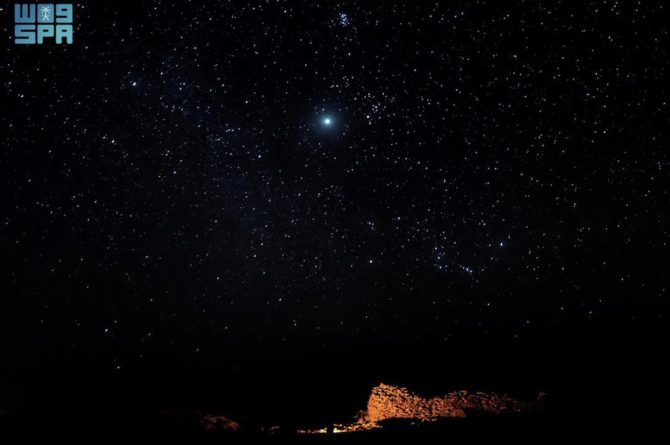
Northern Borders Shine as Saudi Arabia’s Rising Hub for Stargazing and Astro Tourism
Riyadh – Saudi Arabia’s Northern Borders region is emerging as one of the Kingdom’s most promising destinations for astronomical observation, thanks to its exceptionally low levels of light pollution and vast open landscapes that naturally favor clear night skies.
With minimal urban glow and a broad desert horizon, the region offers rare viewing conditions that allow stars, planets, and distant celestial features to appear with striking clarity to the naked eye.
Recent satellite-based observations have confirmed that areas surrounding Turaif, east of Rafha, and west of Arar experience some of the darkest night skies in the country, making them ideal for both amateur and professional astronomy.
The scarcity of tall buildings and limited artificial lighting significantly reduces ambient interference, creating an environment where the Milky Way becomes visible on clear nights without the aid of telescopes.
Astronomy enthusiasts note that such conditions are increasingly rare across the world, positioning the Northern Borders as a valuable natural asset within Saudi Arabia’s expanding scientific and tourism landscape.
According to internationally recognized night-sky measurement standards, the region falls within levels that allow deep-sky objects and faint celestial phenomena to be observed with remarkable precision.
This natural advantage enhances the study of meteor showers, planetary alignments, and lunar phases, offering unique opportunities for scientific research and educational outreach.
Astrophotographers are particularly drawn to the area, as long-exposure photography benefits greatly from darker skies, resulting in sharper images and richer cosmic detail.
The Northern Borders’ climate also plays a supportive role, with dry air and seasonal clarity contributing to stable atmospheric conditions during winter months.
Recently, the region captured widespread attention when a rare optical phenomenon known as light pillars appeared in the night sky, captivating residents and skywatchers alike.
These vertical columns of light, formed by reflections off ice crystals suspended in the atmosphere, are typically associated with polar regions, making their appearance in Saudi Arabia especially noteworthy.
Scientists have described this event as an indicator of unique meteorological conditions that further highlight the region’s distinct environmental profile.
Such phenomena not only enrich scientific understanding but also strengthen the region’s appeal as a destination for astro tourism and nature-based exploration.
Experts believe that the Northern Borders could play a key role in promoting public interest in astronomy, physics, and environmental science across the Kingdom.
Educational institutions and research groups are increasingly viewing the region as an open-air laboratory where students and scholars can engage directly with the night sky.
From guided stargazing experiences to academic observation camps, the potential for structured astronomy-related activities continues to grow.
Local communities have shown enthusiasm for these developments, recognizing the cultural and economic opportunities linked to scientific tourism.
Astro tourism aligns closely with broader national goals focused on sustainable tourism, knowledge-based experiences, and regional development.
Preserving low light pollution levels remains a priority, as maintaining dark skies ensures long-term benefits for science, tourism, and environmental balance.
With careful planning and awareness, the Northern Borders can serve as a global example of how natural darkness becomes a powerful resource.
As interest in space, astronomy, and environmental preservation rises worldwide, the Northern Borders stand ready to welcome observers seeking clarity, wonder, and discovery under truly dark skies.