OPINION: Reko Diq and the New Imperial Loot of Balochistan

Balochistan’s modern history is inseparable from the manner in which it entered Pakistan.
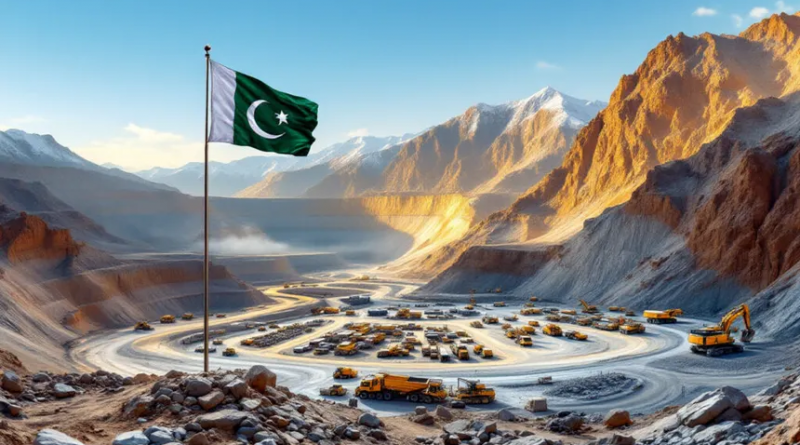
On December 10, the U.S. Chargé d’Affaires in Islamabad, Natalie Baker, announced that the U.S. Exim Bank had approved a package of $1.25 billion in financing to support mining operations at Reko Diq, one of the world’s richest untapped copper and gold deposits. On the surface, Washington framed the decision as a step toward securing global supply chains for critical minerals.
Islamabad portrayed it as a sign of renewed confidence in Pakistan’s investment climate. But for Balochistan, Pakistan’s largest province by land but its poorest by every measure, the announcement landed like yet another reminder that its natural wealth is a prize others are free to carve up.
This Exim Bank financing flows directly after two MoUs were signed on September 8, 2025, between Pakistan and the United States for “critical minerals cooperation.” The military dominated Shehbaz Sharif government heralded the agreements as a milestone. But in Balochistan, they are yet another chapter in an old story: the extraction of Balochistan’s resources by outside powers, facilitated by a central government that treats the province not as a partner but as a colony.
For decades, Pakistan has perfected a model of imperial governance in Balochistan, which combines military control, political manipulation, and economic dispossession. What is new today is not the extraction but the identity of the extractors. The United States now joins China, whose multibillion-dollar projects under the China-Pakistan Economic Corridor (CPEC) have already given Beijing expansive access to Balochistan’s ports, highways, and mineral deposits.
Pakistan’s rulers have turned Balochistan into a marketplace where global powers shop for resources while the people who live above those riches remain among the most deprived in South Asia.
Balochistan’s modern history is inseparable from the manner in which it entered Pakistan. After the forced accession of 1948, the province was governed with suspicion and repression. Islamabad treated Baloch aspirations for autonomy as rebellion, not politics. The result is a province where the most powerful institution is not the provincial assembly but the Quetta cantonment, whose writ supersedes that of any civilian office.
Even today, Balochistan’s political leadership is crafted in military corridors of Rawalpindi and the condonement at Quetta. The current chief minister, Sarfaraz Bugti, is widely viewed as a product of the military establishment, who is another local administrator empowered to manage dissent rather than address the province’s material deprivation. The result is a governance system more interested in securing resource corridors than building schools, hospitals, or representative institutions.
Under this militarized order, resource extraction has been carefully organized to ensure that wealth flows outward to Pakistan’s dominant province, Punjab, and to foreign partners courted by the military-led state. Balochistan’s natural gas from Sui fueled Pakistan’s industrial growth for decades, yet most Baloch households cook on firewood.
Today, its copper and gold fields promise to enrich foreign corporations and deliver revenue to Islamabad, while the communities living in the shadow of these mines remain jobless, landless, and under surveillance.
Even menial jobs at major projects like security guards, cleaners, construction labor, are routinely filled by workers imported from Punjab. The message is unmistakable that the state does not merely extract from Balochistan, it excludes Baloch people from even the crumbs of that extraction.
The rush by both China and the U.S. for access to Balochistan’s minerals reflects how Pakistan’s ruling elite has repositioned the province within global competition. Beijing’s footprint was first to expand, anchored by the Gwadar port and a series of infrastructure and mining agreements.
CPEC promised development but delivered a model where Chinese companies received generous concessions, security cordons were erected to protect foreign workers, and local fishing communities were pushed to the margins.
Now, Washington enters the scene, not as a counterweight to China’s influence but as another partner in Pakistan’s long tradition of opaque, extractive deals. It reflects a bipartisan plunder with Pakistan inviting multiple patrons to mine a region whose own residents are denied the most basic political and economic rights.
The most striking thing about Balochistan is how starkly its material reality contradicts its mineral wealth. Despite being mineral rich in every aspect, the province ranks at the bottom of every development index in Pakistan. For instance, the poverty appears near-universal with 71 percent of the provincial population living in multidimensional poverty. It is nearly double the national average of 38 percent and in districts like Awaran, Kharan, and Panjgur, even exceeds 80 percent.
Likewise, education is in an equally dire state. Literacy hovers around 40–44 percent, the lowest in the country, with female literacy dropping below 25 percent in many rural districts. More than 60 percent of Balochistan’s children are out of school. These are not statistics of a neglected province; they are the metrics of deliberate underdevelopment.
The story is same across healthcare with the province recording the highest maternal mortality ratio of 785 deaths per 100,000 live births. It is abysmal compared to the national average of 186.
Nevertheless, the new U.S. financing for Reko Diq along with the other critical mineral MoU is significant not because it marks a shift in Washington’s policy but because it reveals a continuity in Pakistan’s own governing logic of treating Balochistan as a frontier to exploit.
The province is secured by force, governed through proxies, and opened to whichever foreign power is willing to invest billions with no questions asked about political rights or local consent.
Even when the government speaks of “benefit-sharing,” it does not specify it that the benefit is for Punjabis and Punjabi military and political elite that dominates the levers of power in Pakistan. As such, it is not partnership but a plunder with legal paperwork.
The tragedy is not just that Balochistan’s resources are being plundered. It is that this plunder is now bipartisan, endorsed by Islamabad, welcomed by Washington and Beijing, and justified in the name of development that never arrives.
For the people of Balochistan, the empire has simply added new partners. The loot continues. The province remains impoverished. And the world’s most powerful countries now share in the spoils of a land whose own residents have yet to taste the prosperity lying beneath their feet.
Disclaimer: Views expressed by writers in this section are their own and do not reflect Milli Chronicle’s point-of-view.