Royal Reserve Launches Cutting-Edge Satellite Program to Protect Endangered Red Sea Turtles
Tabuk – The Prince Mohammed bin Salman Royal Reserve has launched a groundbreaking satellite-tracking initiative designed to protect endangered hawksbill and green turtles in the Red Sea.
The program marks a major milestone in regional conservation efforts and reflects the Kingdom’s growing leadership in safeguarding marine ecosystems.
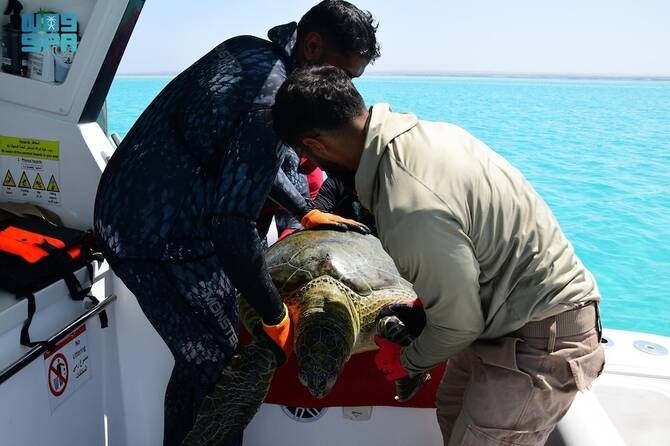
In a historic first, the reserve team successfully tagged a pre-nesting, egg-carrying green turtle, a breakthrough that will provide unprecedented insight into its migratory patterns.
This achievement will help close long-standing knowledge gaps and support unified conservation strategies across the Red Sea region.
Led by senior marine ecologist Ahmed Mohammed and marine megafauna specialist Hector Barrios-Garrido, the team captured and tagged three critically endangered hawksbill turtles and seven green turtles.
Their efforts marked a significant step forward in building a detailed scientific record of turtle behavior and movement.
The satellite tags monitor real-time routes, nesting grounds, feeding areas, and migratory pathways. This information is vital for ensuring the protection of nesting beaches and open-sea habitats that sustain turtle populations.
The data will also guide long-term management plans designed to safeguard these species across international borders.
The program builds on ongoing conservation efforts launched in 2023, expanding the reserve’s turtle monitoring and protection operations.
With 4,000 sq. km of protected waters and a 170 km coastline, the reserve forms one of the largest continuous stretches of managed marine territory in the Kingdom. It lies along an 800 km corridor of protected coastline linking Neom and Red Sea Global.
The reserve’s shores host five of the world’s seven turtle species and serve as a key breeding ground for both green and hawksbill turtles.
Ranger teams consistently patrol land and sea areas, safeguarding nesting sites essential to natal homing, the instinct that draws turtles back to the beaches where they were born.
CEO Andrew Zaloumis emphasized the urgency of protecting hawksbill turtles, which face a high risk of extinction. With fewer than 200 breeding-age females remaining in the Red Sea, every new data point strengthens conservation plans that can help secure the species’ future.
Zaloumis highlighted the immense migratory range of hawksbill turtles, which travel across hundreds of thousands of square kilometers before returning decades later to nest.
He noted that the new tracking technology is a transformative tool for mapping critical habitats and informing national and regional conservation policies.
The program also advances Saudi Arabia’s commitments under global environmental agreements, including the UN Convention on Migratory Species and the Indian Ocean–South-East Asian Marine Turtle Memorandum of Understanding.
This aligns with the Kingdom’s broader environmental vision and long-term sustainability goals.
Marine ecologist Ahmed Mohammed explained that the satellite tags are designed to operate for at least 12 months, providing continuous data on habitat use, seasonal behavior, and developmental zones.
Depth sensors attached to the tags also identify seagrass meadows, which are important feeding areas for green turtles and vital blue-carbon ecosystems.
While green turtles have been reclassified globally, they remain regionally vulnerable and still depend heavily on conservation frameworks to ensure survival. All five Red Sea turtle species continue to be protected under international migration conventions.
The new satellite-tracking initiative represents a major step in deepening scientific understanding, strengthening regional cooperation, and ensuring that endangered turtles can thrive across the Red Sea for generations to come.