India and Russia Strengthen Economic Ties as Putin Begins High-Level Delhi Visit
New Delhi – Russian President Vladimir Putin arrived in New Delhi on Thursday for a two-day state visit aimed at deepening economic cooperation and expanding the scope of bilateral trade.
Prime Minister Narendra Modi personally welcomed him at the airport, reflecting the longstanding warmth between the two nations and signalling the importance of the visit.
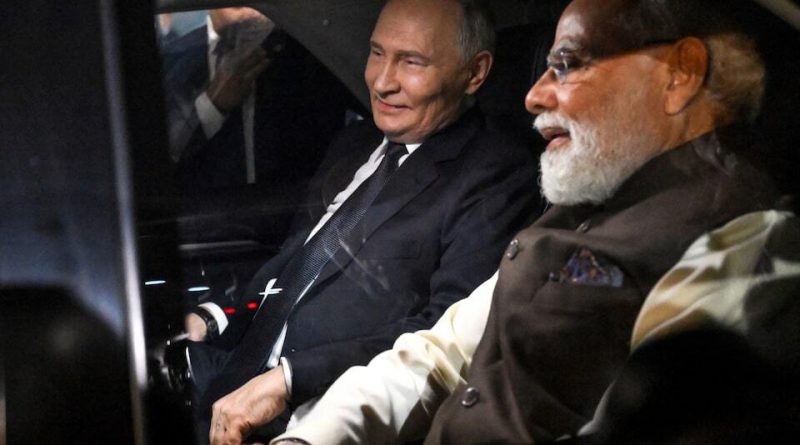
The two leaders shared an extended greeting on the tarmac before departing together in the same vehicle, setting the tone for discussions focused on long-term strategic goals.
Modi is hosting a private dinner ahead of Friday’s summit talks, where senior officials and business representatives from both countries are expected to participate.
India and Russia have set an ambitious goal of reaching $100 billion in annual trade by 2030.
Trade volumes have already grown significantly in recent years, buoyed largely by India’s energy imports, although both sides are now prioritising diversification.
The strong expansion in bilateral commerce from 2021 to 2024–25 demonstrates the resilience of economic cooperation even amid shifting global conditions.
However, recent tariff-related disruptions and sanctions have pushed India to identify new export markets and adjust trade strategies.
As Indian goods face steep duties in the United States, the search for fresh destinations has become increasingly urgent.
Russia has emerged as a key potential partner, expressing interest in boosting imports of Indian products to correct the current imbalance.
Russian officials emphasised that their objective is to expand purchases of Indian goods across a wide spectrum, underscoring a long-term commitment to economic collaboration.
They noted that India’s share in Russian imports remains low, signalling substantial space for growth.
Indian Trade Minister Piyush Goyal highlighted the need to strengthen and diversify exports beyond traditional sectors.
He outlined opportunities in automobiles, electronics, machinery, industrial components, textiles, and processed foods—all areas where India has growing capacity.
Goyal stressed that a more balanced trade basket is essential for sustaining bilateral engagement and unlocking untapped sectors.
He encouraged Indian businesses to explore new avenues in the Russian market, which he described as ripe with potential demand.
Agricultural cooperation also featured prominently in the discussions, with Russia signalling readiness to increase imports of Indian shrimp, rice, and tropical fruits.
Russian companies have likewise expressed interest in sourcing Indian food-processing equipment, aligning with India’s expanding agri-technology sector.
With India already the world’s largest shrimp exporter, the possibility of raising its share in Russia’s import market offers a promising opportunity for coastal economies.
Firms impacted by recent tariff barriers in the U.S. are now increasingly turning toward alternative global markets, strengthening India’s export resilience.
Both countries view the visit as a chance to reinforce long-standing political and cultural ties through a renewed economic framework.
The presence of extensive business delegations highlights the practical, commercially driven nature of the engagements.
As the summit progresses, policymakers expect concrete steps toward reducing trade barriers, widening supply chains, and building new industrial partnerships.
The positive momentum underscores a shared vision of advancing economic stability while creating fresh channels for bilateral growth.
India and Russia appear poised to launch a new phase of collaboration built on mutual benefit and strategic alignment.
With strong political goodwill and expanding commercial priorities, the visit marks an important milestone in shaping the next decade of cooperation.