Europe’s Silence on Pakistan: Digital Repression, Zero Accountability

European states and institutions face a choice. They can treat Pakistan’s clampdown as a bilateral stability problem — useful to manage in quiet channels, rewarded with trade — or they can treat it as a human-rights crisis
When governments throttle the internet, ban critical channels and let critics vanish, the damage is both immediate and structural: lives are imperilled, civic life is narrowed and the civic record is rewritten.
Pakistan’s recent turn toward an intensifying digital chokehold — in which whole swathes of the population are periodically cut off from mobile broadband, social platforms are blocked, independent channels are pushed offline and journalists are intimidated or abducted — should be a clarion call for principled diplomacy from European capitals.
Instead, what we have seen is a studious silence that reveals uncomfortable truths about how human-rights rhetoric is traded against geopolitical convenience.
A digital straitjacket: shutdowns, laws and the shrinking public square
The pattern is now familiar. The Pakistani state has made internet restriction a recurrent instrument of political management: mobile internet are always suspended during protests, platforms including X are blocked, and legislative efforts are repeatedly sought to broaden surveillance and takedown powers.
Human Rights Watch documented the scale and human cost of this policy architecture: “Complete and partial internet shutdowns increased in 2024,” and, according to the same analysis, such shutdowns in 2023 affected almost 83 million Pakistanis, and caused economic loss of $237.6 million to Pakistan’s economy.
These are not abstract inconveniences; they are blanket deprivations of communication, information and the right to organise.
The legal scaffolding is equally troubling. Through amendments to the Prevention of Electronic Crimes Act (PECA), the creation of new regulatory bodies with scant oversight, and press policies enforced by the Pakistan Electronic Media Regulatory Authority (PEMRA), the state has moved to legalise a broader architecture of digital control.
As Farieha Aziz, co-founder of the digital rights group Bolo Bhi, put it at the time those rules were debated: “Their goal appears to be complete control over information by the state, and for the state to have total hegemony over information. They want to turn the internet into another PTV.”
That sentence — blunt and deliberate — captures what is at stake when rules meant to combat harm are drafted without safeguards: the risk that regulation becomes a pretext for muzzling dissent.
The human toll: disappearances, abductions and the Wazir cases
Amnesty International’s reporting — covering enforced disappearances, arrests under cyber and public order laws, and violent repression of protest — is stark: by mid-year the Commission of Inquiry on Enforced Disappearances had received 197 missing-persons cases, while a civil society group recorded 2,332 cases of enforced disappearance across the year.
These figures describe a practice that is systematic rather than sporadic; enforced disappearance is not an afterthought but a method.
There are also emblematic, personal stories that render the policy visible. Independent journalists from Pakistan’s tribal areas have been abducted, reportedly beaten and coerced into silence.
Gohar Wazir, who was kidnapped and later spoke to Radio Mashaal, described his ordeal and its message: “They can kill me at any time,” he said, a sentence that deserves to be quoted in full because it is not theatrical — it is testimony from someone who survived enforced intimidation.
His account of being blindfolded, beaten and forced to record a pledge to stop critical reporting is emblematic of how non-digital and digital repression combine: silencing through physical violence, reinforced by legal and cyber instruments that amplify fear.
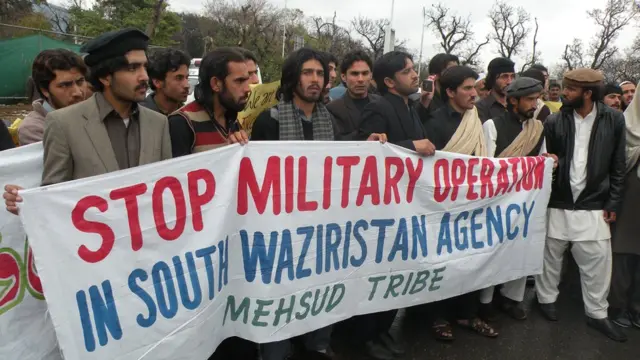
From Gwadar to Islamabad, the cumulative effect is the same: civic courage is punished, civic information is constrained and whole communities — whether PTM activists in Pashtun areas or organisers in Pakistan-occupied Kashmir — face both online and offline mechanisms of erasure.
Amnesty and other monitors document arrests, trials in secret military settings, restrictions on assemblies and punitive legal innovation that together hollow out democratic protections.
Pakistan’s 27th Amendment, media blackouts and the compression of debate
The current political moment crystallises the stakes. Proposals tied to the so-called 27th Constitutional Amendment — which, according to reporting, would touch the military command structure and reconfigure judicial and federal balances — have produced a fierce domestic dispute.
The controversy is not merely about institutional mechanics; it is about whether constitutional change will be debated openly or engineered in darkness.
Opposition parties, civil society groups and journalists have warned that rushed amendments and restricted debate undermine democratic legitimacy. The debate has unfolded alongside an environment in which discussion on sensitive topics is routinely narrowed, sometimes through formal PEMRA prohibitions and at other times by the less formal but equally effective practice of a media blackout enforced by informal pressure.
Reports documenting “invisible” blackouts — where channels simply stop covering certain events without public explanation or legal order — suggest a media landscape bent toward self-censorship by design or intimidation.
This is why the censorship of constitutional debate is particularly corrosive. Democracies must tolerate noise and ugly argument; constitutional change divorced from open deliberation and scrutiny is transformation without consent.
When the state uses both legal instruments and extralegal pressure to compress conversation, it does more than limit dissent: it steals democracy’s most basic asset, the right of citizens to contest the rules that govern them.
Europe’s choice: principled pressure or quiet accommodation?
European states and institutions face a choice. They can treat Pakistan’s clampdown as a bilateral stability problem — useful to manage in quiet channels, rewarded with trade, security cooperation and migration-management concessions — or they can treat it as a human-rights crisis requiring visible diplomatic pressure, support for independent media, protection for exiles and tangible consequences for rights-abusing policies.
The current European posture, characterised in too many quarters by hedged statements and low-volume concerns, amounts to tacit accommodation.
That reluctance is understandable in realpolitik terms: Pakistan is strategically situated, hosts vital migration routes and is a partner on counterterrorism. But principled diplomacy is not symbolic theatre; it is a strategic instrument. Democracies that trade away human rights credibility risk exporting impunity.
If European policy is to be more than transactional, it must stop treating digital repression as an internal administrative problem and begin to regard it as a human rights emergency: support for civil society legal defence funds, relocation pathways for threatened journalists, conditionality on technical assistance that might be repurposed for surveillance, and coordinated public naming of abusive practices.
European engagement must also listen to local experts. As digital rights researcher Seerat Khan warned in recent coverage, “These restrictions will only increase. They aren’t something that will go away with time.” That is not gloom; it is a practical forecast.
The trajectory is visible. If democracies fail to address it now, they will have forfeited the influence they most credibly possess: the ability to insist that the technologies, laws and processes of modern governance respect human rights.
A final word: repression seldom announces its endpoint. Legal restrictions harden, media spaces shrink, the line between digital policy and political policing blurs. The abductions, the shutdowns and the censorship of constitutional debate are not isolated incidents.
They are the parts of a coherent strategy that treats information as a security problem rather than a public good. European foreign policy — if it values democracy beyond slogans and press freedom beyond press releases — must stop treating such practices as acceptable collateral to geopolitical concerns.
If Europe remains silent, it is not only failing Pakistanis under threat; it is teaching other regimes that there is no cost to closing digital spaces and disappearing dissidents. And that lesson will be taught elsewhere, too.
Disclaimer: Views expressed by writers in this section are their own and do not reflect Milli Chronicle’s point-of-view.