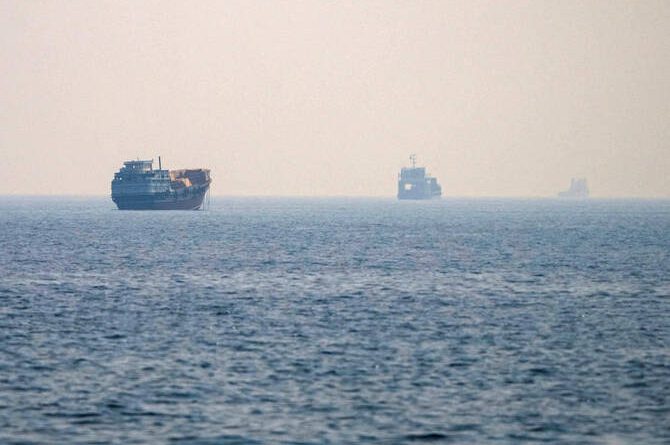
Hormuz Tanker Traffic Slows Sharply as US-Iran Strikes Raise Risks
LONDON- Oil tanker traffic through the Strait of Hormuz slowed to a near standstill on Thursday as renewed U.S. airstrikes on Iran and Tehran’s retaliatory attacks heightened security concerns in the Gulf, prompting shipping companies and insurers to reassess voyages through one of the world’s most important energy corridors.
Shipping data and industry sources indicated that only two tankers had transited the strait during the early hours of Thursday, reflecting growing caution among shipowners as tensions between Washington and Tehran escalated despite a fragile three-week-old truce.
According to analysis by Kpler, the vessels included the crude supertanker Berg 1, which had loaded at Iran’s Kharg Island and is subject to U.S. sanctions, and the Marshall Islands-flagged chemical tanker Well Sail. LSEG ship-tracking data showed Well Sail had previously loaded near Sharjah in the United Arab Emirates.
Industry sources said the actual number of ships moving through the waterway could be higher because an increasing number of vessels were switching off their Automatic Identification System (AIS) transponders, limiting public tracking of their movements.
Jorge Leon, head of geopolitical analysis at Rystad Energy, said the sharp decline in tanker movements reflected mounting concern within the shipping industry over the security situation rather than official statements from either Washington or Tehran.
The latest deterioration followed renewed exchanges between the United States and Iran. Iranian armed forces launched attacks on U.S. military infrastructure in neighboring Gulf states on Thursday in response to American strikes on Iran’s southern coastal and eastern provinces, placing additional strain on the ceasefire reached three weeks earlier.
The latest escalation began earlier this week after attacks on three commercial tankers in the Strait of Hormuz, which the United States blamed on Iran.
Iran’s Revolutionary Guards Navy said U.S. military action and efforts to redirect shipping were disrupting the gradual reopening of the strait and warned that further American intervention would trigger what it described as a “crushing response.”
Before the conflict erupted on Feb. 28, the Strait of Hormuz handled about one-fifth of global oil supplies, making it one of the world’s most strategically important maritime chokepoints.
Although shipping volumes had recovered in recent weeks to an average of about 40 vessel transits a day, they remained well below the pre-conflict level of roughly 125 to 140 daily sailings.
Insurance industry sources told Reuters that some marine war underwriters had advised shipping companies to suspend voyages through the strait, while others were reviewing policy terms in response to the renewed attacks on commercial vessels.
Shipbroker Clarksons said the latest escalation had made the reopening of the Strait of Hormuz appear increasingly uncertain.
One of the vessels attacked earlier this week, the Marshall Islands-flagged Qatari liquefied natural gas tanker Al Rekayyat, remained stranded off the coast of Oman awaiting salvage operations after a projectile struck its engine room and caused a fire on Tuesday.
Industry sources said the immediate risk of an explosion appeared low and that the vessel’s LNG cargo remained secure. The Marshall Islands ship registry said no injuries or environmental damage had been reported in connection with the incident.
A marine war insurance underwriter, speaking on condition of anonymity because of the sensitivity of the situation, said recent attacks underscored the growing potential for significant losses involving high-value commercial vessels operating in the region.