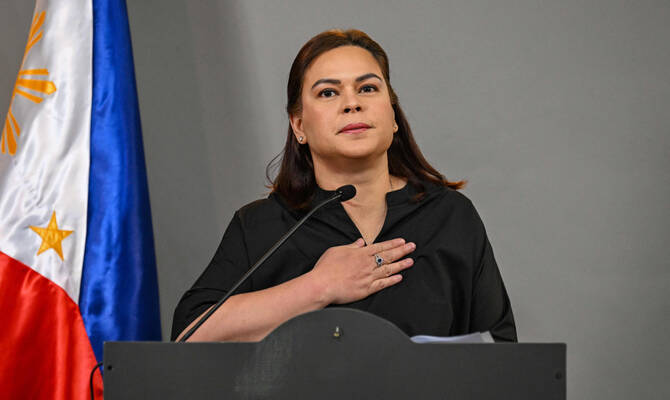
Philippine Senate Opens High-Stakes Duterte Impeachment Trial
MANILA-The Philippine Senate is set to convene on Monday an impeachment court to begin the trial of Vice President Sara Duterte, launching a politically charged proceeding that could determine her future in public office and reshape the country’s political landscape ahead of the 2028 presidential election.
Authorities deployed more than 6,000 police officers, including anti-riot units, around the Senate complex in Manila as supporters and opponents of Duterte prepared to stage demonstrations. Under a pretrial schedule reviewed by The Associated Press, Duterte or her legal team may appear when proceedings formally open, with the trial expected to span 92 days.
The impeachment case stems from charges approved by the House of Representatives last month, where lawmakers overwhelmingly voted to impeach the vice president. The accusations include alleged unexplained wealth, misuse of confidential state funds and a public threat to have President Ferdinand Marcos Jr., the first lady and a former House speaker assassinated if she herself were killed amid escalating political tensions.
Duterte has denied the allegations and has rejected accusations of wrongdoing, although she has largely declined to publicly address the charges in detail before the trial begins.
If found guilty by the Senate, Duterte would face permanent disqualification from holding public office, effectively ending her declared intention to contest the 2028 presidential election, when Marcos is constitutionally due to complete his single six-year term.
A conviction requires the support of two-thirds of the 24-member Senate, or 16 votes.
The impeachment proceedings unfold against the backdrop of a dramatic collapse in the political alliance that propelled Marcos and Duterte to victory in the 2022 national elections. Their partnership united two of the Philippines’ most influential political dynasties but deteriorated into an increasingly bitter public rivalry after they assumed office.
Sara Duterte is the daughter of former President Rodrigo Duterte, whose administration was defined by a controversial anti-drug campaign. He was arrested last year under an order issued by the International Criminal Court and transferred to The Hague, where he remains in custody and is scheduled to stand trial on Nov. 30 over alleged crimes against humanity linked to the anti-drug crackdown.
International human rights organizations and several Western governments have criticized the campaign, which resulted in the deaths of thousands of mostly poor drug suspects. Rodrigo Duterte has denied authorizing extrajudicial killings, although he repeatedly issued public threats against suspected drug offenders while serving as president.
The vice president has accused Marcos of being responsible for her father’s arrest and transfer to the ICC, further deepening the political rift between the two camps.
The dispute has also highlighted contrasting foreign policy orientations. Marcos has strengthened defense cooperation with the United States while adopting a firmer stance toward China’s increasingly assertive activities in the disputed South China Sea. By contrast, Rodrigo Duterte cultivated closer ties with China under President Xi Jinping and with Russia under President Vladimir Putin while frequently criticizing Washington. Sara Duterte has also faced criticism from political opponents for not publicly condemning Chinese actions against Philippine vessels and fishermen in contested waters.
The impeachment trial also comes amid legal troubles involving several senators viewed as allies of the Duterte family. Senator Jinggoy Estrada was arrested last month on a non-bailable plunder charge linked to an alleged flood-control bribery scheme, an accusation he denies. Senator Rodante Marcoleta faces a possible arrest over a separate non-bailable plunder case involving alleged undeclared campaign donations, which he has also denied.
Meanwhile, Senator Ronald dela Rosa, who served as Rodrigo Duterte’s national police chief during the anti-drug campaign, has gone into hiding after the International Criminal Court issued a warrant accusing him of being a co-perpetrator in the killings investigated by the tribunal.
The Senate proceedings are expected to become one of the Philippines’ most consequential political trials in recent years, testing the country’s constitutional accountability mechanisms while carrying significant implications for the balance of power before the next presidential race.