Trump Says Indirect US-Iran Talks in Qatar Showing Progress
Doha-U.S. President Donald Trump said on Wednesday that indirect negotiations between the United States and Iran in Qatar were progressing well, as both sides sought to advance implementation of a preliminary agreement aimed at easing regional tensions and moving toward a broader settlement.
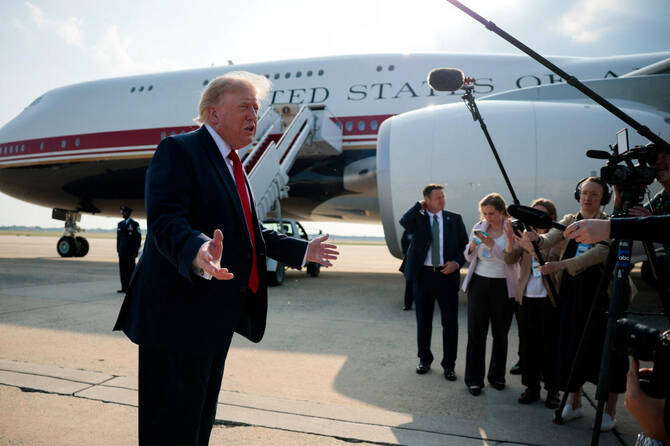
Speaking before boarding Air Force One, Trump described the discussions in Doha as “very good meetings” and said efforts related to Iran’s nuclear programme were moving in a positive direction.
“We hit them very hard… but we’re getting along very well,” Trump told reporters.
The negotiations follow a memorandum of understanding brokered by Qatar and Pakistan and agreed at a summit in Lucerne, Switzerland, last month. The framework includes a 60-day ceasefire, the reopening of the Strait of Hormuz and a timetable for negotiating a permanent agreement addressing Iran’s nuclear programme and the broader regional conflict.
A diplomat familiar with the talks, speaking on condition of anonymity because of the sensitivity of the negotiations, confirmed that technical-level discussions were underway in Doha with Qatari and Pakistani mediators. The diplomat said the meetings were focused on implementing the memorandum and building on agreements reached in Lucerne.
Iran rejected earlier suggestions that direct negotiations with the United States were taking place.
Foreign Ministry spokesperson Esmaeil Baqaei said Iran’s delegation was headed by Deputy Foreign Minister Kazem Gharibabadi and stressed that Iranian officials had no plans to hold direct negotiations with U.S. representatives during the current round of talks.
The diplomat also said U.S. envoys Jared Kushner and Steve Witkoff were not participating in the technical discussions after meeting Qatar’s Prime Minister Sheikh Mohammed bin Abdulrahman Al Thani on Tuesday.
Qatar’s Foreign Ministry said the meeting reviewed ongoing U.S.-Iran negotiations under the memorandum of understanding as well as developments in Lebanon. The office of Qatar’s Emir later confirmed that Sheikh Tamim bin Hamad Al Thani also met the two U.S. envoys.
Analysts said the negotiations remained at an early stage despite positive public messaging.
Anna Jacobs, a non-resident fellow at the Arab Gulf States Institute, said continued engagement after recent military exchanges was a constructive sign, although many disagreements were still being addressed privately.
H.A. Hellyer of the Royal United Services Institute said differing public statements from Washington and Tehran reflected limited transparency surrounding the talks.
Implementation of the agreement has faced challenges since it was signed. Iran and the United States exchanged military strikes after Tehran targeted a commercial vessel in the Strait of Hormuz, prompting U.S. strikes on Iranian military positions. Iran later launched attacks on U.S. bases in Kuwait and Bahrain, which both countries condemned.
Iranian negotiator Mohammad Bagher Ghalibaf said implementation issues were expected following a conflict of such scale and that the Doha talks would focus on provisions relating to the Strait of Hormuz and the conflict in Lebanon.
Recent exchanges of fire have eased in the lead-up to the negotiations, while hostilities between Israel and Hezbollah have also remained relatively subdued.