
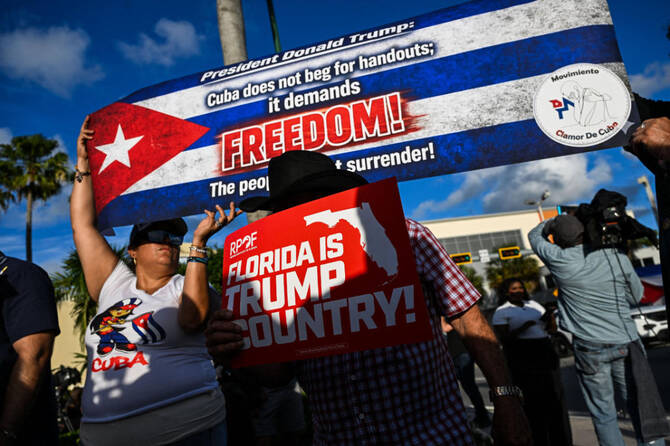
Trump Escalates Cuba Pressure as Rubio Questions Diplomatic Path
Washington-U.S. President Donald Trump and Secretary of State Marco Rubio on Thursday intensified pressure on Cuba, raising the possibility of military action and expressing skepticism that negotiations with Havana can resolve long-standing disputes, a day after U.S. prosecutors unveiled criminal charges against former Cuban leader Raúl Castro.
Speaking at the White House, Trump said previous administrations had considered action against Cuba for decades and suggested he could be the president to pursue it. While he did not outline specific plans, his remarks marked the latest escalation in Washington’s rhetoric toward the communist-run island.
Rubio, speaking separately in Miami before departing for meetings in Europe and India, said the administration’s preferred outcome remained a negotiated settlement but acknowledged doubts that meaningful progress could be achieved with Cuba’s current leadership.
“The president’s preference is always a negotiated agreement that’s peaceful,” Rubio said, adding that prospects for such an outcome were limited given the current political environment in Havana.
The comments came one day after U.S. federal prosecutors announced an indictment accusing Castro of ordering the 1996 shootdown of civilian aircraft operated by Cuban exiles based in Miami. The charges include murder and destruction of an aircraft. Cuban authorities have rejected the case, with Cuban President Miguel Díaz-Canel describing it as a political maneuver intended to justify potential aggression against the island.
The indictment has fueled speculation that the Trump administration may be considering a more confrontational approach toward Cuba. Analysts have drawn comparisons to Washington’s earlier operation against Venezuelan leader Nicolás Maduro, who was captured by U.S. forces earlier this year and faces federal criminal charges in the United States.
Senior U.S. officials, including Rubio and CIA Director John Ratcliffe, have held discussions with Cuban representatives in recent months aimed at improving relations. Rubio said those contacts failed to produce meaningful results and contributed to the administration’s decision to impose additional sanctions on Havana.
Among the latest measures are sanctions targeting Grupo de Administración Empresarial S.A., a business conglomerate controlled by Cuba’s armed forces. Rubio also announced that a relative of the group’s executive president had been detained by U.S. immigration authorities after her legal residency status was revoked.
The administration argues that Cuba presents a national security challenge because of its security and intelligence ties with China and Russia, as well as its relationships with governments viewed as adversarial by Washington.
China rejected the U.S. position on Thursday. Foreign Ministry spokesman Guo Jiakun said Beijing supports Cuba’s sovereignty and opposes external interference and sanctions.
The heightened tensions come as the U.S. military conducts exercises in the Caribbean involving the aircraft carrier USS Nimitz and accompanying vessels. U.S. Southern Command said the deployments are part of previously scheduled maritime operations with regional partners.
Trump has increasingly linked future relations with Cuba to demands that Havana expand economic openness and reduce ties with U.S. geopolitical rivals, while continuing to tighten sanctions pressure on the island’s government.

