Louvre faces leadership change as security failures and costly renovation plan test museum’s future
“The Louvre has reached a worrying level of obsolescence.”
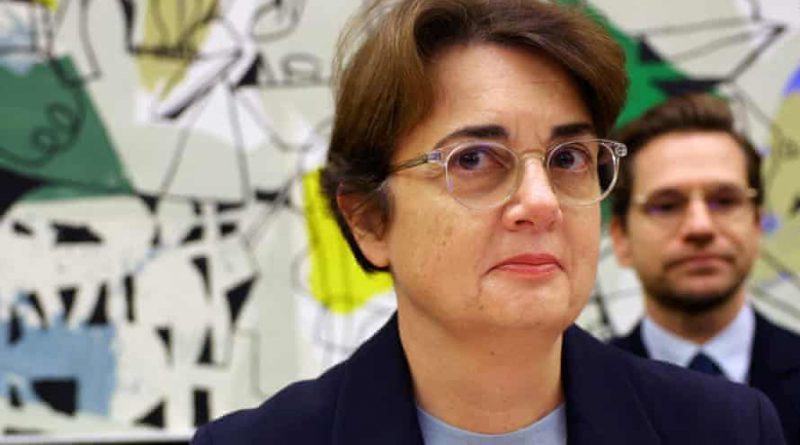
France’s Louvre Museum, the world’s largest and most visited museum, is entering a period of uncertainty after the resignation of its president, Laurence des Cars, following a year marked by infrastructure failures, labor unrest, financial scrutiny and one of the country’s most significant museum thefts in decades.
Des Cars, who had led the institution since 2021 and became the first woman to head the Louvre, stepped down this week after months of mounting pressure over the museum’s management and the future of an ambitious €1 billion renovation project backed by President Emmanuel Macron.Her departure comes little more than a year after she formally warned France’s culture ministry that the Louvre’s condition had become increasingly unsustainable.
In a note to Culture Minister Rachida Dati, des Cars described overcrowded galleries, outdated technology, water leaks, damaging temperature fluctuations and deteriorating visitor facilities, saying the museum had reached a “worrying level of obsolescence.”The warning laid the foundation for “Louvre: New Renaissance,” a large-scale modernization plan unveiled by Macron shortly afterward in front of the museum’s most famous attraction, Leonardo da Vinci’s Mona Lisa.
The proposal includes major repairs, new visitor infrastructure, a separate exhibition room for the Mona Lisa with independent access, and a new grand entrance on the museum’s eastern side near the Colonnade de Perrault.The redesign would also require excavation beneath the Cour Carrée, creating new underground exhibition spaces. Officials estimate the total cost at more than €1.1 billion.The Louvre occupies a 360,000-square-meter complex that began as a 12th-century fortress before becoming a royal palace and later a public museum during the French Revolution in 1793.
It contains more than 400 rooms, roughly nine miles of corridors and over 600,000 objects in its collection, with around 35,000 on permanent display.Originally designed to receive about 4 million visitors annually, the museum welcomed 9 million visitors last year, driven largely by attractions such as the Mona Lisa, the Venus de Milo and the Winged Victory of Samothrace.Supporters of the renovation argue the scale of visitor pressure makes major intervention unavoidable. Critics, however, question both the necessity and timing of the project, particularly as the museum faces immediate operational challenges.
Didier Rykner, editorial director of La Tribune de l’Art, said essential repairs and modernization were needed, but described the broader plan as unnecessary and financially risky.“It’s unnecessary, and it’s harmful,” Rykner said, arguing that Macron viewed the project as a presidential legacy initiative similar to earlier landmark cultural projects commissioned by former French presidents.
France has a long tradition of large museum projects linked to presidential terms, including François Mitterrand’s Grand Louvre project in the 1980s, which created the museum’s glass pyramid entrance designed by Chinese-American architect I.M. Pei. Georges Pompidou oversaw the Pompidou Centre, while Jacques Chirac backed the Musée du Quai Branly.Macron has maintained a close symbolic connection to the Louvre, choosing its courtyard as the setting for his 2017 presidential victory speech.
With his term ending next spring, the renovation plan has become closely associated with his cultural legacy.At the same time, the museum’s immediate problems have deepened.This month alone, two water pipes burst inside the building, including one in the Denon wing, where the Mona Lisa is displayed. In November, flooding damaged more than 300 documents in the Library of Egyptian Antiquities.
Late last year, the Campana gallery, known for its Greek ceramics collection, was closed due to structural weakness in supporting beams. Elsewhere in the Sully wing, offices were relocated because of concerns over floor collapse.Staff morale has also deteriorated sharply. The Louvre employs about 2,300 people, and unions have described working conditions as “untenable,” citing understaffing, poor pay and management decisions they called irresponsible.
Since last summer, repeated strikes have forced the museum to close fully or partially more than a dozen times.In a joint statement, employee unions said staff felt they were “the last bastion before collapse,” reflecting broader frustration over daily operations and resource shortages.This month, police arrested nine people, including two museum employees and two tour guides, over an alleged long-running ticket fraud scheme targeting Chinese tourist groups.
Investigators believe the operation may have cost the museum more than €10 million over the past decade.The most serious reputational blow came in October, when four men carried out a daylight theft from the Apollo Gallery, stealing diamond-studded Napoleonic crown jewels valued at €88 million.Investigators said the gang used a stolen truck fitted with an extendable ladder to reach an unsecured first-floor window, entered the gallery, smashed display cases and escaped on motorbikes within seven minutes.
Four suspects have since been arrested and remain under investigation, but the jewels have not been recovered.The theft intensified criticism of museum security and placed des Cars under further political pressure. Alexandre Portier, the conservative chair of a parliamentary inquiry on museum security, said the list of institutional failures would have triggered leadership change much earlier in many comparable institutions.
Des Cars acknowledged responsibility for part of the security failure but argued she was also facing consequences for earlier warnings about the museum’s structural decline. In comments to Le Figaro, she said she had faced “an unprecedented media and political storm” and believed conditions no longer existed for her to continue implementing reforms.Her successor, Christophe Leribault, takes over after leading the Palace of Versailles and previously directing the Musée d’Orsay and Paris’s Petit Palais.
The culture ministry said his priorities would include strengthening security for the building, collections and staff, while restoring trust inside the institution and advancing necessary modernization.The future of the New Renaissance project remains uncertain. Staff unions have described it as disconnected from the museum’s actual needs, while France’s state auditor, the Cour des Comptes, has warned it presents significant financial risk and argued urgent repairs should take precedence.Funding remains unresolved.
The Louvre expects €200 million to €300 million from licensing fees linked to its Abu Dhabi franchise, with the remainder expected largely from international donors. According to critics, donor support, particularly from the United States, has been slower than anticipated.The architectural competition tied to the project, expected to advance earlier this year, was suspended in February, adding further uncertainty to Macron’s timetable before he leaves office.
Rykner said the museum’s existing revenues from ticket sales, reserves, state subsidies and Abu Dhabi income were sufficient for repairs and a more limited modernization without committing to a large expansion project.He argued that pressure around the Pyramid entrance and the Denon wing could be eased through smaller additional entrances and alternative display arrangements for the Mona Lisa rather than a major underground redevelopment.