Puerto Rican Artist Angel Otero Brings Personal History and Cultural Motifs to Somerset Exhibition
“When I was invited, of course, I accepted,”
In May 2026, Puerto Rican artist Angel Otero is preparing to unveil a new body of work in Somerset, following his recent collaboration with global music figure Bad Bunny.
The exhibition, titled Agua Salada (Salt Water), reflects a shift toward more personal themes in Otero’s practice, drawing directly on memories of his childhood and family life in Puerto Rico.
Otero, 45, described his participation in Bad Bunny’s “La Casita” stage installation during the musician’s 31-show residency on the island as both a professional milestone and a personal moment of recognition. The set recreated a single-storey home typical of Puerto Rican and wider Latin American communities.
According to Otero, the environment closely resembled the domestic spaces that have long informed his work, reinforcing his focus on cultural memory and identity.Born in Santurce, a neighbourhood in San Juan, Otero spent much of his childhood in Bayamón with his grandmother, Maria Luisa.
He described his upbringing as shaped largely by female family members, with his mother working full-time and male relatives largely absent. The domestic interiors of that period, including furniture, decorative objects and photographs, have served as recurring motifs in his paintings for nearly two decades.
Otero’s artistic development began during his studies in Chicago, where he experimented with unconventional techniques to reinterpret traditional oil painting. He developed a process involving “paint skins,” in which layers of dried paint are formed on surfaces such as Perspex and later transferred to canvas.
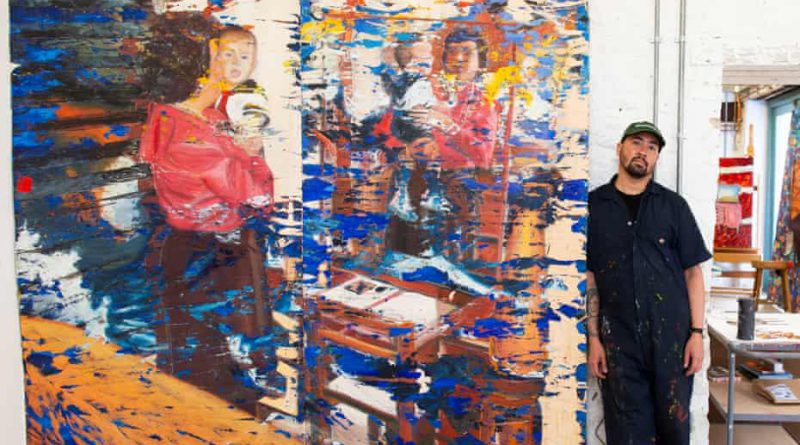
This method produces textured, layered compositions that combine elements of painting, collage and sculpture. The approach, initially driven by resource constraints, became central to his visual language and has been widely associated with his work.The current exhibition marks a departure toward more explicit representation. Among the works is a large-scale diptych based on a photograph of Otero as a child with his grandmother.
The composition presents the figures from two perspectives, partially obscured by layered paint, creating a visual tension between clarity and fragmentation. According to Otero, this approach reflects the instability of memory and the passage of time.Themes of family, loss and personal transition are central to the exhibition.
Otero cited his evolving role as a father and the illness of his own father as influences on the new work. His grandmother, who played a significant role in his upbringing, died several years ago, and her presence continues to shape his artistic narrative. He described these experiences as “layers of life” that inform both subject matter and technique.
The exhibition also introduces recurring architectural elements, including doors and staircases, which Otero uses as symbolic devices. One painting depicts a door opening onto an undefined space, while a sculptural installation at Hauser & Wirth Somerset extends this motif into three dimensions.
These elements, according to the artist, relate to ideas of transition, access and personal boundaries.Water imagery is a dominant feature throughout the exhibition. The title Agua Salada references salt water as both a physical and metaphorical element, associated with the sea surrounding Puerto Rico as well as emotional states such as grief and resilience.
Otero described the motif as representing both erosion and healing, reflecting the dual nature of memory and time.Otero has been working in Somerset for several weeks, using a temporary studio to complete the exhibition. During this period, he engaged with the local community, noting similarities between social spaces in the area and those in San Juan.
He referenced time spent in local establishments as part of his process of situating the work within a broader context of place and belonging.The artist also described a personal ritual associated with completing a body of work. On the night before paintings are transported for exhibition, he spends time alone in the studio, often with music and wine, as a form of closure.
This practice, he said, allows him to reflect on the process and acknowledge the transition from private creation to public display.Otero indicated that the exhibition represents a point of alignment between his personal narrative and professional practice.
While earlier works approached identity indirectly through objects and interiors, the current series incorporates more direct references to his life experiences.He described this shift as part of an ongoing process of engaging with vulnerability within the context of the art world.