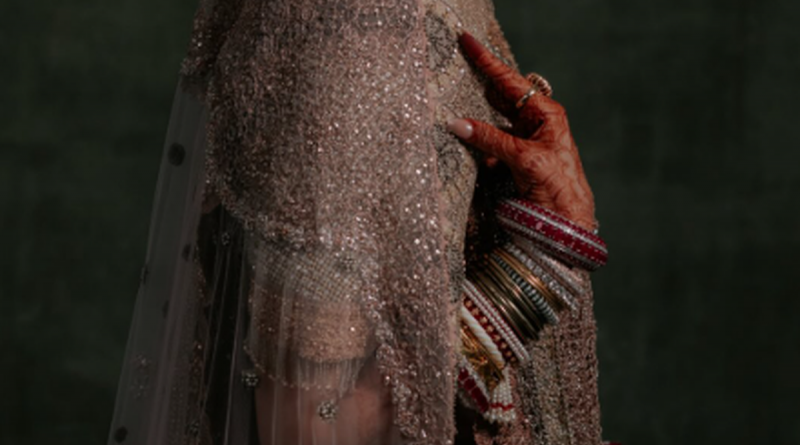
Indian Designer Revives Mughal-Era Kasab Craft with 15,000-Hour Couture Project
“What I discovered was that the jacket had no base fabric!”
In May 2026, Mumbai-based designer Monica Shah of Jade by Monica and Karishma initiated a revival of the historical kasab zari technique, drawing from archival material preserved by Chanakya International. The effort is rooted in the rediscovery of a Mughal-era garment and has resulted in a high-value couture piece requiring approximately 15,000 hours of manual craftsmanship.
Shah’s interest in the technique was sparked during a review of Chanakya International’s textile archive, which includes over 10,000 historical textiles and more than 100,000 craft studies. Among the items was a vintage jacket constructed from pure silver taar. According to Shah, the garment dated back to the Mughal period and was originally made for a child.
Its defining feature was structural: it appeared to exist without a base fabric, with metallic threads forming a self-supporting surface.The rediscovery coincides with the 500-year mark of the First Battle of Panipat, which established Mughal rule in India under Babur.
The kasab technique, which originated in Persia and entered the Indian subcontinent during the Mughal period in the late 16th century, forms part of the broader zardozi embroidery tradition.Kasab, also referred to as kasav or kasab-zari, uses fine threads of gold, silver or copper wrapped around a silk core.
These threads are stitched using an Aari needle and layered over themselves rather than being applied to a textile base. Shah explained that the absence of foundational fabric requires a specialised knotting method known as madkan, which secures each segment of thread.
This technique ensures structural integrity across motifs such as floral patterns and paisleys, effectively creating a self-sustaining textile framework.Following the discovery, Shah spent approximately six months working to understand and replicate the technique.
She collaborated with master artisans associated with Chanakya International, including individuals described as belonging to the 13th and 14th generations of craft practitioners. These artisans played a central role in reconstructing the method and training apprentices to continue the process.Initial experimentation involved producing smaller garments such as jackets and blouses.
According to Shah, these early pieces helped refine the technical process and assess commercial viability. Demand for the revived technique emerged during this phase, prompting further development.The project expanded into the creation of a full kasab lehenga commissioned for jewellery designer Shweana Poy Raiturcar.
The garment was produced entirely by hand, adhering to pre-industrial construction methods. Shah stated that no sewing machines were used, and each panel of the lehenga was assembled manually. The ensemble included 22 panels, some of which required approximately 1,000 hours each to complete.The total labour input for the lehenga, including the blouse and dupatta, reached an estimated 15,000 man-hours.
The construction process maintained the defining feature of the technique, with no base fabric used. Instead, structural cohesion was achieved through interlinked metallic threads and knotting.In developing the blouse component, Shah incorporated elements of macramé, adapting the technique using kasab taar.
Decorative elements such as borders and tassels were also created using the same metallic threadwork, maintaining consistency with the no-fabric approach.Material adjustments were introduced at the production stage. While historical examples used pure silver threads, Shah stated that the modern version utilised a precious alloy due to feasibility constraints.
The modification allowed for durability and cost management while retaining the visual characteristics of the original technique.The revival has occurred alongside broader activity within the label, which continues to work across multiple Indian textile traditions including ikat, Banarasi brocade and Madras checks.
Shah referenced a recent project involving gold-plated silver threads woven in Varanasi, indicating ongoing engagement with traditional craft clusters.The kasab revival highlights the dependence of such techniques on skilled labour and institutional support. Chanakya International’s role in maintaining archives and training artisans enabled the reconstruction process, while the involvement of multi-generational craftsmen facilitated knowledge transfer.
The renewed interest in kasab has generated increased inquiries, according to Shah, though production remains constrained by the time-intensive nature of the craft. Each piece requires extensive manual intervention, limiting scalability but positioning the work within the high-value couture segment.
The initiative reflects a broader pattern within India’s fashion industry, where heritage techniques are being revisited through contemporary design frameworks. In this instance, the process has relied on archival research, artisan collaboration and adaptation of historical methods to modern production conditions.