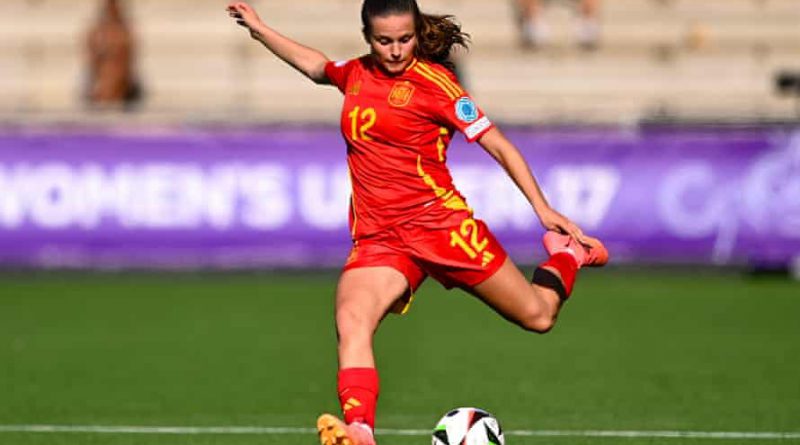
Teenage talents signal shifting dynamics in women’s football pipeline
“Teenagers are no longer prospects but active contributors, delivering measurable output at club and international levels.”
Teenage players are increasingly securing consistent playing time at senior levels of women’s football, reflecting a shift in development pathways and talent integration across clubs.
Performances by players such as Kaylee Hunter, Justine Rouquet and Aiara Agirrezabala illustrate how younger athletes are contributing directly to competitive outcomes rather than remaining in developmental roles.
Clubs across multiple leagues are entrusting teenagers with significant minutes, with performance metrics indicating that these players are not only participating but also producing at levels comparable to more experienced professionals.
The trend is evident across North America and Europe, where emerging players are combining technical output with tactical adaptability.Kaylee Hunter’s rapid progressionHunter, an 18-year-old forward from Canada, has recorded a statistically significant impact at club level since joining AFC Toronto shortly after turning 17.
According to club data, she scored 16 goals in 21 starts during the season, while accumulating more than 2,000 minutes on the field. Her goal-scoring rate of 0.76 per 97 minutes places her in the 91st percentile among attackers with at least 500 minutes played in major leagues.
Her performances contributed to AFC Toronto securing the Supporters’ Shield in the Northern Super League. She was also named Rookie of the Year, reinforcing her transition from prospect to first-team contributor. Hunter has since debuted for the senior Canadian national team and recently made her first start during the SheBelieves Cup, indicating early integration into international competition.
AFC Toronto sporting director Billy Wilson previously described Hunter as “undoubtedly one of the best emerging players in the country,” a characterisation that has evolved as her output has increased. Her consistent selection after initial substitute appearances suggests rapid adaptation to senior-level demands.
Hunter remains under contract until 2027, though her eligibility to sign for clubs outside Canada is expected to attract external interest.Rouquet, 18, has experienced a marked increase in playing time and productivity at Montpellier in France’s top division. After registering 174 minutes across 10 substitute appearances in the previous season, she entered the 2025–26 campaign with increased involvement.
By November, she had scored four goals and secured the club’s player of the month award.Operating primarily as a winger, Rouquet has demonstrated the ability to create and convert attacking opportunities. Her performances include scoring Montpellier’s only goal in a 5–1 defeat to Lyon and providing an assist in a 2–2 draw against Paris Saint-Germain.
These contributions indicate effectiveness against top-tier opposition despite limited prior experience.Rouquet acknowledged the pace of her progression, stating in December that she had not expected to feature so extensively at that stage of the season. Her role with the French under-19 national team further reflects her development trajectory, with a goal and assist recorded in a recent European Championship match against Wales.
While her game continues to evolve, including areas such as ball retention, Rouquet’s output has positioned her as a regular starter within a short timeframe. Her progression underscores the increasing readiness of academy players to transition into senior squads.Aiara Agirrezabala’s positional versatilityAt 17, Agirrezabala has accumulated more senior minutes than several peers in her age group, reflecting early integration into top-flight football with Real Sociedad.
She made her debut at 16 and quickly established herself as a regular starter. In the current season, she opened with a two-goal performance in a draw against Madrid CFF and has since added three goals and two assists.Initially deployed as a full-back, Agirrezabala has transitioned into more advanced roles, including the wing, where her passing and attacking involvement have become central to team play.
She averages 30.54 completed passes per game, with over one-third classified as progressive, advancing the ball significantly towards the opposition goal within attacking areas.Her distribution frequently channels play along the left flank before delivering into the penalty area, contributing to attacking build-up phases.
These attributes place her in the 91st percentile among midfielders in terms of progressive passing, according to available performance data.Agirrezabala’s goal-scoring involvement further highlights her adaptability.
She regularly enters the penalty area during attacking sequences and has demonstrated effectiveness in finishing, including aerial contributions. Her versatility across defensive and attacking roles is considered a defining feature of her development.She has received her first call-up to the senior Spanish national team, though she has yet to make an appearance.
Current regulations restrict her to domestic competition in Liga F, but her level of participation and output indicate continued upward progression.
The performances of Hunter, Rouquet and Agirrezabala reflect broader structural changes in women’s football, where clubs are accelerating the transition of youth players into senior environments. Increased competition, expanded league structures and investment in youth academies have contributed to earlier exposure to high-level matches.
Data from club competitions suggest that younger players are not only filling squad roles but also influencing match outcomes through goals, assists and ball progression metrics. Their integration into national team systems at early stages further indicates alignment between club development and international selection processes.
While adjustment periods remain a consideration when players move between leagues or increase competition levels, current evidence shows that select teenagers are meeting performance benchmarks required at the highest levels.
Their contributions highlight a shift in how clubs evaluate readiness, placing greater emphasis on measurable output rather than age-based progression timelines.